© Ecologic Institute, 2025
Paths to a Near-natural Landscape Water Balance
Ecologic Institute at the DWA Conference
- Presentation
- Date
-
- Location
- Essen, Germany
- Speech
How can we shape landscapes so they store water more effectively, buffer extreme events, and contribute to biodiversity at the same time? This question was at the center of Dr. Benjamin Kupilas's presentation at this year’s DWA conference on "River Basin Management."
A near-natural water balance is far more than a technical issue of water management – it is a cornerstone of climate mitigation and adaptation, as well as nature and resource protection. Recent droughts and floods have made it clear how vulnerable our landscapes and infrastructures are. Natural ecosystems can retain water more effectively, thereby increasing the resilience of entire regions.
Restoration and nature-based solutions as key strategies
Restoring ecosystems and landscape features is one of the most effective ways to reestablish a near-natural landscape water balance. Reconnecting floodplains, rewetting peatlands, or managing forests more naturally creates retention areas, habitats, and carbon sinks – real synergies between climate action, nature conservation, and water management. Managing the landscape water balance is therefore a classic cross-cutting task that requires cooperation, integration, and joint action across administrative and disciplinary boundaries. The goal is to bring different sectors and expert communities closer together – so that restoration becomes not only ecologically sound, but also socially and economically viable.
Linking research, practice, and implementation
Building on a 2024 expert workshop organized by Ecologic Institute for the German Federal Agency for Nature Conservation (BfN), four key areas for future research were identified:
- Developing regional guiding visions for sponge landscapes and river landscapes
- Creating multifunctional land-use concepts
- Expanding our understanding of ecological and hydrological processes, such as the interactions among vegetation, soils, and water availability
- Establishing robust monitoring systems with accessible data
Numerous projects and pilot initiatives are already generating important insights and demonstrating how nature-based solutions can be implemented in different types of landscapes – from hedgerow plantings in agricultural areas to sponge city concepts with green and blue infrastructure.
The central challenge now is to put this knowledge into practice – within a complex landscape of legal, planning, and institutional frameworks. The identified implementation needs span five major areas of action:
- Consistent legal and policy implementation of existing strategies and targets
- Simplified access to funding, flexible contracting, and incentives for private (co-)financing
- Securing adequate land for restoration and water retention
- Strengthening cross-sector collaboration and participatory processes to build societal acceptance
- Carrying out concrete measures, accompanied by monitoring and evaluation of outcomes
Pathways to implementation
- Recognize and leverage synergies: There is significant synergy potential among the goals of nature conservation, water management, floodplain and river protection, climate mitigation, and climate adaptation. These synergies need to be identified early in planning and actively harnessed. Nature-based solutions serve as a unifying element, bringing ecological and technical approaches together.
- Moving from knowledge to practice: We already have extensive knowledge from research, pilot projects, and hands-on experience. The challenge is to translate these insights into real-world action – for example, through model projects that plan and implement sponge landscapes and demonstrate how water can be retained, soils revitalized, and ecosystems stabilized.
- Participation as a key to acceptance: Transforming landscapes toward climate resilience requires participatory approaches. Early and open involvement of local stakeholders, land users, and the broader public strengthens acceptance, builds trust, and enables jointly supported solutions.
- Ensuring long-term financing: Durable impact requires stable, long-term financing structures. In addition to public funding, new financing models – including co-financing by private actors – should be developed to sustain implementation over time.
Contact

- Event
- Organizer
-
German Associaton for Water, Wastewater and Waste (DWA), Germany - Speech
- Date
-
- Location
- Essen, Germany
- Language
-
German
- Project ID
- Keywords
-
natural water management, renaturation, nature-based solutions, sponge landscapes, river basin management, climate adaptation, water retention, biodiversity, resilience, drought, flooding, moorland rewetting, floodplain renaturation, green and blue infrastructure, multifunctional land use, ecosystem services, sponge city, sustainable landscape development, climate resilience, water management, nature and resource conservation, ecological infrastructure, monitoring, data access, regional resilience strategiesregional sponge and river landscapes, floodplains, moorlands, agricultural landscapes, towns, river basinsRenaturation methods, rewetting, floodplain connection, near-natural forest development, multifunctional land use concepts, development of regional models, expanded process understanding (vegetation, soils, water), monitoring methods, data-based monitoring, integrative planning, participatory approaches, cross-sector cooperation, model projects, sponge city concepts, ecohydrological methods, success monitoring, implementation of nature-based solutions
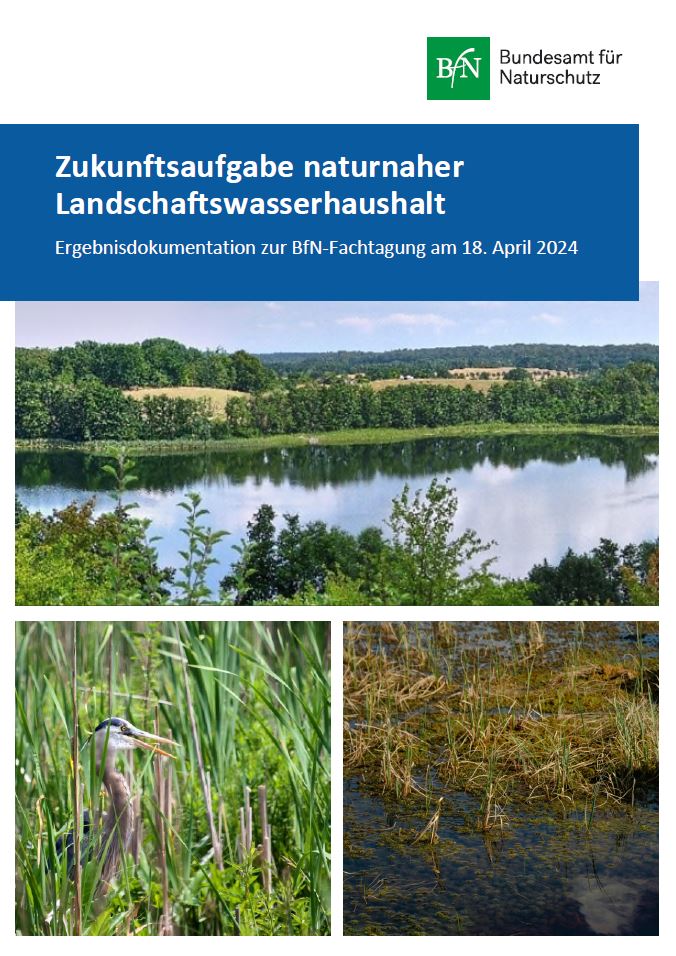
Bundesamt für Naturschutz (Hrsg.) (2024): Zukunftsaufgabe naturnaher Landschaftswasserhaushalt. Ergebnisdokumentation zur BfN-Fachtagung am 18. April 2024. Bonn.

Nature's Integration in Cities' Hydrologies, Ecologies and Societies (NICHES)
- Duration
-
-
- Funding
-
Federal Ministry of Education and Research (BMBF), Germany VDI/VDE Innovation + Technik, Germany
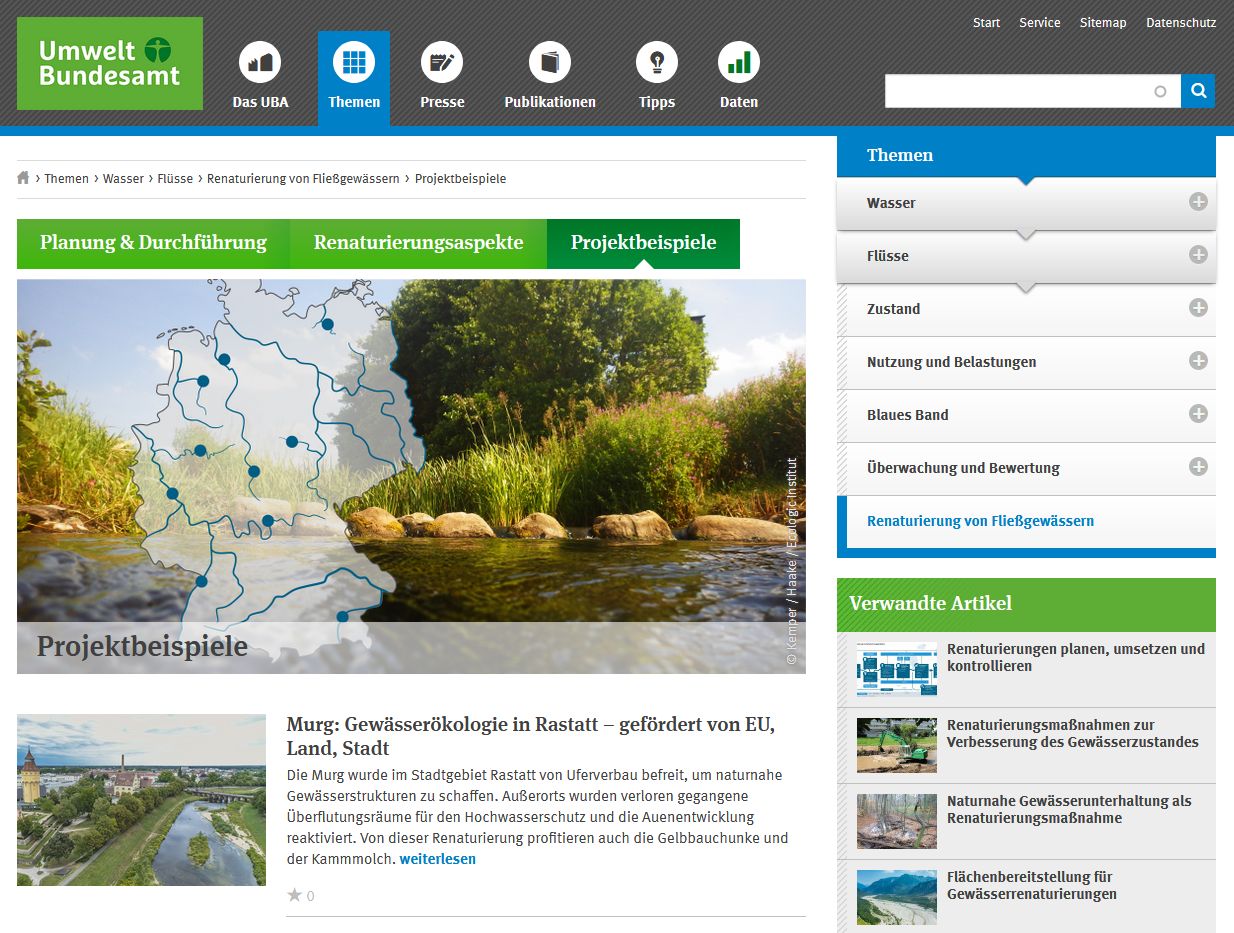
German Environment Agency (ed.) 2019: Renaturierung von Fließgewässern. Internetportal compiled by Kemper M., Lamberty G., Wagner F. and Zumbroich T. on behalf of the German Environment Agency, Dessau-Roßlau. URL: www.uba.de/renaturierung
European Commission 2021: Biodiversity Strategy 2030. Barrier Removal for River Restoration. Luxembourg: Publications Office of the European Union.
Umweltbundesamt 2019: Renaturierung von Fließgewässern in Deutschland. Video. Online: https://youtu.be/PEhVHyFBu-k

Ida Meyenberg, Ulf Stein, Aaron Scheid, Rodrigo Vidaurre, Felix Dengler, Christian Schneider, Johanna Krähling, Richard Beisecker (2024): Handbook of Agricultural Measures for Enhancing Water Retention, Water Quality and Biodiversity in Germany. Ecologic Institute, Berlin. https://doi.org/10.5281/zenodo.15236788
European Environment Agency (ed.) 2024: Europe's state of water 2024. The need for improved water resilience. EEA Report No 07/2024. Luxembourg: Publications Office of the European Union
Rouillard, Josselin et al. 2024: Building water resilience: Towards better implementation of ecological flows and water allocation in Europe. GOVAQUA Policy Brief. Finnish Environment Institute: Helsinki.

Lago, M., McDonald, H. (2024). Overcoming Barriers to Pondscape Nature-Based Solutions. A synthesis and final PONDERFUL Framework. PONDERFUL Project (EU Horizon 2020 GA no. ID869296), Deliverable D1.6
Implementing Nature-based Solutions for Water Retention and Climate Resilience in Europe (SpongeWorks)
- Duration
-
-
- Funding
-
European Commission, Directorate-General Research & Innovation (DG Research & Innovation), International European Climate, Infrastructure and Environment Executive Agency (CINEA), International
Implementation of the National Peatland Protection Strategy (MoorNet)
- Duration
-
-
- Funding
-
Federal Agency for Nature Conservation (BfN), Germany