European Parliament, CC BY 2.0, via Wikimedia Commons
Reputation Analysis of the European Scientific Advisory Board on Climate Change's First Term (2022–2026)
- Project
- Duration
-
-
The European Scientific Advisory Board on Climate Change serves as a central and authoritative source of independent, science-based advice for EU climate policymaking.
Ecologic Institute was commissioned to conduct an internal qualitative reputation analysis of the Advisory Board at the end of its first term. The aim was to investigate how relevant stakeholder groups perceived the Board's overall reputation and stakeholder outreach efforts across five benchmarks: relevance, credibility, consensus, balance, and timeliness. The analysis derived actionable insights and key narratives from over 30 expert interviews with key stakeholders from EU and national institutions, civil society organizations, academic partners, and business associations. Findings were synthesized into an internal report for the Secretariat and the Board for use in supporting strategic decisions.
Contact

- Funding
-
European Scientific Advisory Board on Climate Change (ESABCC), International - Partner
-
Ecologic Institute, Germany - Team
- Duration
-
-
- Project ID
- Keywords
-
EU climate policymaking, science-based policy advice, independent scientific advice, climate governance, stakeholder perception, institutional credibility, trust in science, policy relevance, climate policy discourse, European Climate Law, advisory board reputation, stakeholder outreach, public-facing engagement, European Union, EU level, European climate policy, Europe-wide governance, EU institutions, EU policy framework, EU climate governanceEuropequalitative reputation analysis, internal evaluation, expert stakeholder interviews, qualitative interviews, stakeholder analysis, reputation assessment, benchmark-based evaluation, narrative analysis, synthesis of qualitative findings, evidence-based assessment, internal reporting, stakeholder engagement analysis
Strengthening Europe's Climate Resilience: Supporting the European Scientific Advisory Board on Climate Change – Adaptation
- Duration
-
-
- Funding
-
European Environment Agency (EEA), International European Commission, Directorate-General for Climate Action (DG Climate), International
Climate Change and Carbon Removals
- Duration
-
-
- Funding
-
European Environment Agency (EEA), International
Evans, Nick, Paula Schöberlein, Matthias Duwe (2024). Raising the bar on national climate governance in the EU: How EU policy can help Member States deliver certainty, accountability, consensus, and consistency on the road to net zero. Ecologic Institute: Berlin.
Evans, Nick; Matthias Duwe (2021): 'Climate governance systems in Europe: the role of national advisory bodies'. Ecologic Institute, Berlin; IDDRI, Paris.
Assessments Supporting EU Progress towards Climate Neutrality
- Duration
-
-
- Funding
-
European Climate Foundation (ECF), International

Meyer-Ohlendorf, Nils; Spasova, Deyana; Graichen, Jakob; Gores, Sabine (2023): Designing the EU 2040 climate target. Ecologic Institute, Berlin
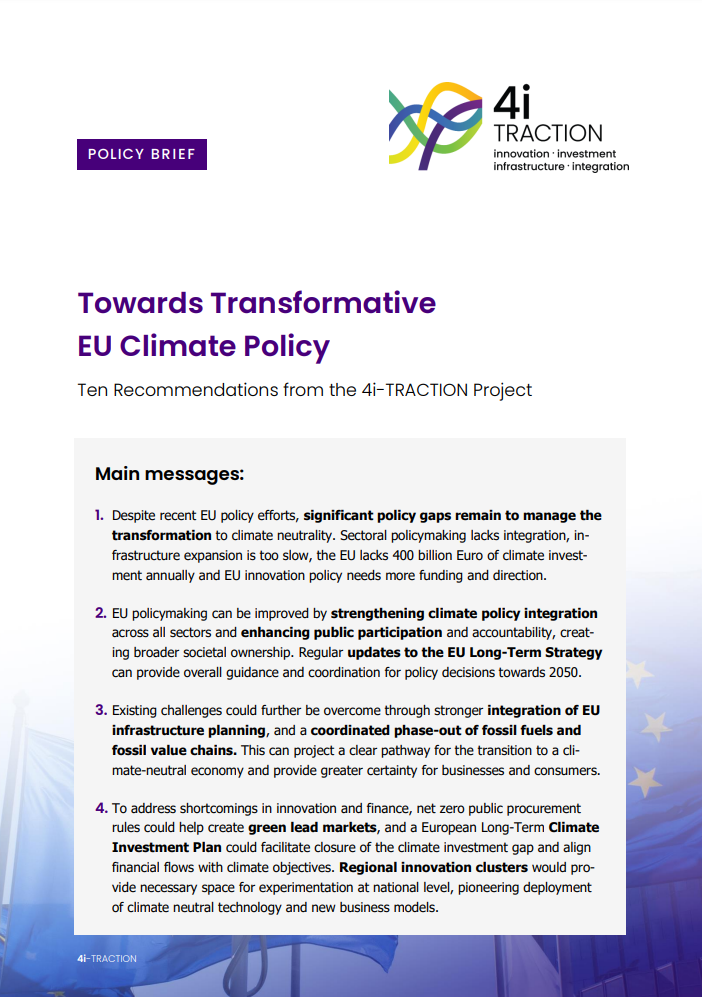
4i-TRACTION (2024): Towards Transformative EU Climate Policy. Ecologic Institute, Berlin.

Meyer-Ohlendorf, Nils et al. (2025): Climate Targets for EU Member States after 2030: Functions and Options. Ecologic Institute, Berlin.