
Nachhaltige Bewirtschaftung des Landschaftswasserhaushaltes zur Erhöhung der Klimaresilienz (KliMaWerk)
Management und Werkzeuge
- Publication
- Citation
Sommerhäuser, M. et al. (2025). Sachbericht zum Verwendungsnachweis: Verbundprojekt KliMaWerk – Nachhaltige Bewirtschaftung des Landschaftswasserhaushaltes zur Erhöhung der Klimaresilienz: Management und Werkzeuge (Fördermaßnahme WaX – Wasser-Extremereignisse). Projektbericht.
Climate change is exacerbating drought, low water levels, and heavy rainfall in German river basins, posing new challenges for agriculture, forestry, water management, ecosystems, and municipal planning. Against this backdrop, the project KliMaWerk – Sustainable management of the landscape water balance to increase climate resilience in the Lippe catchment area in North Rhine-Westphalia – investigated how the landscape water balance can be made climate-resilient through integrated, practical strategies and measures. The KliMaWerk final report summarises the key findings and strategic conclusions.
A special feature of KliMaWerk was the combination of different methods: physical-chemical and biological measurements provided reliable data on the condition of water bodies, while coupled surface and groundwater models mapped hydrological processes in their current state and under future climate scenarios. In addition, measures were developed in multi-sectoral workshops together with local stakeholders, and their synergies and interactions under different socio-economic and climatic conditions were evaluated using cross-impact balance analysis.
A key result of the project is a modular toolbox, a practical planning instrument that supports the targeted selection and prioritisation of measures to increase the climate resilience of the landscape water balance. In addition, 18 concrete recommendations for action were developed, ranging from water and rainwater management to land use adjustments and governance approaches, which can serve as guidance for planning and implementation.
Key scientific findings and recommendations for action derived from the KliMaWerk final report includes:
- Measures aiming at individual goals have only a limited effect. Modelling shows that only a combination of measures that link water retention in wet periods with delayed runoff in dry periods can stabilise the landscape water balance at the catchment level.
- Large-scale, nature-based measures are significantly superior to technical solutions. While technical approaches mitigate peak runoff in the short term, measures such as floodplain development, unsealing, or land use changes have stable effects on groundwater recharge, high and low water regimes. Localised implementation is not sufficient to achieve climate resilience, but large-scale implementation of measures is necessary to achieve significant effects.
- Ecological resilience depends largely on local river structure. Riparian vegetation, depth variability, and hydromorphological diversity reduce temperature peaks and create refuges for aquatic species during extreme events.
- The Cross-Impact-Balance analysis shows that climate resilience is not primarily a technical issue but a governance issue: sustainable development paths with integrated land use and inter-sectoral coordination generate greater synergies. Urban conflicts of interest, such as between water storage and infiltration, require strategic prioritisation and spatial differentiation.
KliMaWerk thus not only provides tools for landscape water management but also a clear strategic message: without a paradigm shift in land use, water management, and governance, the consequences of climate change in the water sector cannot be sustainably managed.
The project is funded by the German Federal Ministry of Education and Research (BMBF) as part of the Research for Sustainability (FONA) strategy.
Contact

- Language
-
German
- Authorship
- Funding
-
Federal Ministry of Education and Research (BMBF), Germany - Published by
-
Lippeverband, Germany University of Duisburg-Essen (UDE), Germany Christian-Albrechts-Universität zu Kiel (CAU), Germany Planungsbüro Koenzen, Germany delta h Ingenieurgesellschaft (delta h), Germany Hydrotec Ingenieurgesellschaft für Wasser und Umwelt (Hydrotec), Germany Ecologic Institute, Germany - Year
- Dimension
- 173 pp.
- Project
- Project ID
- Table of contents
-
Click to show full table of contents
- Keywords
-
Climate adaptation Water management, catchment area management, water management Climate adaptation, climate-adapted landscape planning, sustainable water management, adaptation strategies Climate change Water, resilience of water systems, integrated water management, climate impact adaptation Water bodies, nature-based solutions Water, strategic water planning, adaptation to extreme weather eventsLippe catchment area, North Rhine-Westphalia, Lippe, Westphalia, Rhine tributary, river catchment area Germany, water management model region North Rhine-Westphalia, watercourseHydrological model coupling, groundwater-surface water interaction, climate scenario analysis, participatory methods, transdisciplinary research, impact analysis of measures, scenario assessment, systemic analysis approaches, decision support systems, model-based measure assessment, field investigation, stakeholder process, catalogue of measures, hydraulic modelling, toolbox, recommendations
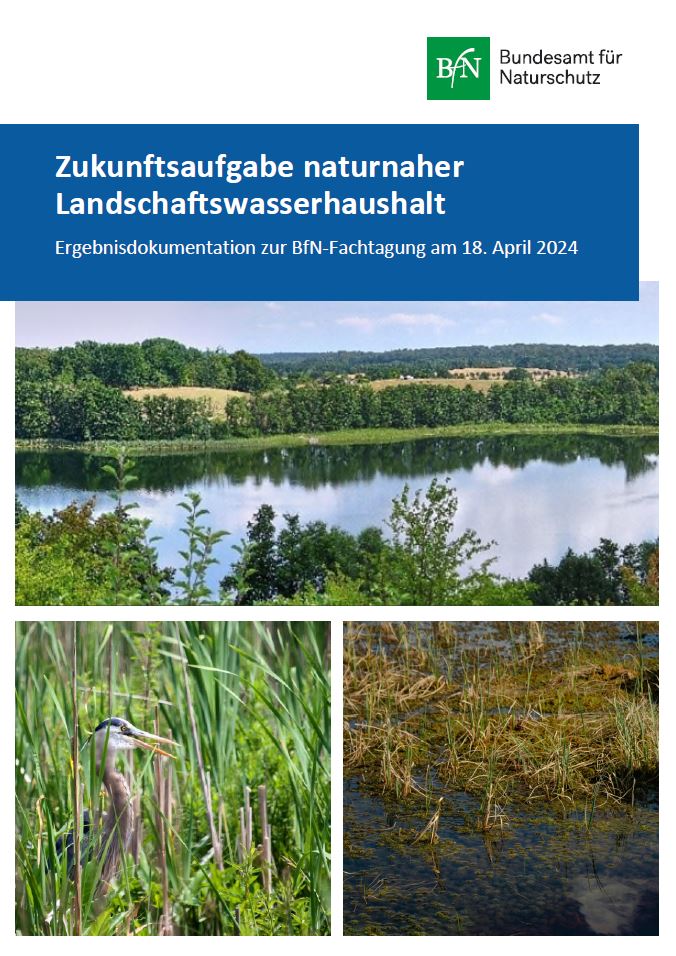
Bundesamt für Naturschutz (Hrsg.) (2024): Zukunftsaufgabe naturnaher Landschaftswasserhaushalt. Ergebnisdokumentation zur BfN-Fachtagung am 18. April 2024. Bonn.
Workshop:Measures to Increase the Climate Resilience of Water Bodies and the Landscape Water Balance
- Date
-
- Location
- Wesel, Germany
Conference:The Future Task of Near-natural Landscape Water Balance
- Date
-
- Location
- Bonn, Germany

Nature's Integration in Cities' Hydrologies, Ecologies and Societies (NICHES)
- Duration
-
-
- Funding
-
Federal Ministry of Education and Research (BMBF), Germany VDI/VDE Innovation + Technik, Germany

Ida Meyenberg, Ulf Stein, Aaron Scheid, Rodrigo Vidaurre, Felix Dengler, Christian Schneider, Johanna Krähling, Richard Beisecker (2024): Handbook of Agricultural Measures for Enhancing Water Retention, Water Quality and Biodiversity in Germany. Ecologic Institute, Berlin. https://doi.org/10.5281/zenodo.15236788