Evaluation of the Green Architecture of the CAP Strategic Plans
Guidelines
- Publication
- Citation
EUROPEAN COMMISSION – Directorate-General for Agriculture and Rural Development – Unit A.3, Evaluation of the green architecture of the CAP Strategic Plans – Guidelines (2026).
The CAP Strategic Plans (CSPs) bring together a wide range of instruments designed to address environmental and climate objectives. This combination of instruments is referred to as 'green architecture' (GA). These guidelines support managing authorities and evaluators in assessing how these instruments function collectively. The focus is not on individual measures in isolation but on analysing the GA as an integrated system.
Purpose and approach of the guidelines
The guidelines aim to enable consistent and transparent evaluations of the GA during the 2023–2027 programming period. They emphasise the importance of understanding interactions between instruments, including synergies and trade-offs, as well as their combined contribution to environmental and climate objectives. A robust evaluation requires a clear understanding of the GA’s design and intervention logic, as well as its positioning within the broader EU environmental and climate policy framework. This allows for the identification of the contributions of individual instruments, as well as potential overlaps and gaps.
A structured evaluation framework: effectiveness, coherence and efficiency
The guidelines propose an evaluation framework based on three core criteria:
- Effectiveness – the extent to which instruments contribute to environmental and climate objectives
- Coherence – the degree of alignment and interaction between CSP instruments and EU and national environment and climate policy frameworks
- Efficiency – the relationship between resources used and results achieved towards environmental and climate objectives
From design to implementation
For each of these criteria, the guidelines outline a three-step approach:
- Defining the evaluation framework
- Selecting indicators, data sources and methods
- Conducting the analysis and formulating recommendations
This structured process supports robust and comparable evaluations while allowing flexibility across Member States.
Identifying synergies and trade-offs
Given the strong interlinkages between GA instruments, assessing them in isolation is insufficient. A combined assessment enables the identification of synergies, the recognition of trade-offs, and an overall judgement of performance. Previous programming periods already included evaluations of multiple “green” instruments. However, the current CAP introduces new elements, such as the integration of GAECs into CSPs and the introduction of eco-schemes. At the same time, dedicated guidance on assessing the GA as a whole has been limited.
These guidelines address this gap by providing a practical and structured framework for evaluating the GA as an integrated system.
Role of Ecologic Institute
Ecologic Institute was in charge of developing the annex on the analysis of coherence, which focuses on evaluating synergies and trade-offs between:
- The instruments forming part of the GA (e.g. typically conditionality, ecoschemes, environment and climate interventions, non productive investments)
- The GA instruments with the rest of the CSP (e.g. direct income support, coupled support, productive investments)
- The GA instruments with instruments external to the CSP, such as relevant environment and climate planning tools derived from EU legislation (e.g. under the Water Framework Directive, Nature Directive, energy policies) and other national regulations and planning tools.
Contact

- Language
-
English
- Authorship
- Credits
The guidelines ‘Evaluation of green architecture of the CAP Strategic Plans – Guidelines’ were developed by the Thematic Working Group 10 in the framework of the EU CAP Network supported by the European Evaluation Helpdesk for the CAP. Carina Folkeson Lillo, with the support of Anna Gregis, coordinated the work, which was co-authored by Dimitris Skuras, Gerald Schwarz, Josselin Rouillard and Kaley Hart.
The Thematic Working Group 10 and the stakeholder board provided valuable input and comprised more than 20 members, including evaluators, researchers, and representatives of the European Commission’s Directorate-General for Agriculture and Rural Development (DG AGRI) and the Joint Research Centre (JRC).
Representatives from DG AGRI contributed to the coherence of the guidelines with the EU’s policy framework. Filip Stefanic supported the editorial quality and visual appearance of the final publication
- Funding
-
European Commission, Directorate-General for Agriculture and Rural Development (DG Agriculture), International - Published by
-
European Commission, Directorate-General for Agriculture and Rural Development (DG Agriculture), International - Year
- Dimension
- 84 pp.
- Project
- Project ID
- Table of contents
-
Click to show full table of contents
- Keywords
-
Environmental impacts, climate impacts, effectiveness, coherence, efficiency, intervention logic, policy evaluation, agri-environmental measures, eco-schemes, GAEC, biodiversity, climate protection in agriculture, sustainable land use, EU agricultural policy, Common Agricultural Policy, CAP 2023–2027, EU environmental policy, EU climate policy, policy-making, governance structures, policy implementation, funding instruments, public administration, evidence-based policy, policy evaluation, regulatory framework, sustainable agriculture in Europe, EU agricultural reform, environmental indicators in agriculture, climate adaptation in agriculture, sustainable agricultural systemsEuropeEvaluation framework, impact analysis, intervention logic analysis, indicator-based evaluation, qualitative analysis, quantitative analysis, mixed-methods approach, literature review, stakeholder survey, case study analysis, comparative analysis, time-series analysis, policy analysis, monitoring and evaluation (M&E), evaluation design, evaluation methodology, impact indicators, data analysis, evidence-based analysis, environmental monitoring, policy impact analysis
Assessment of Draft CAP Strategic Plans with Respect to Environmental Requirements
- Duration
-
-
- Funding
-
European Commission, Directorate-General Environment (DG Environment), International
CAP Strategic Plans Shadow Assessment of Environmental Needs in Germany
- Duration
-
- Funding
-
European Environment Agency (EEA), International
Scheid, A. and S. Ittner (2023) 'Assessment of the German CAP Strategic Plan: environmental and climate contributions', Policy report, Institute for European Environmental Policy and Ecologic Institute
Midler, E., Hobeika, M., Riedel, A. and J. Pagnon (2022), Environment and climate assessment of Poland's CAP Strategic Plan, Policy report, Institute for European Environmental Policy and Ecologic Institute
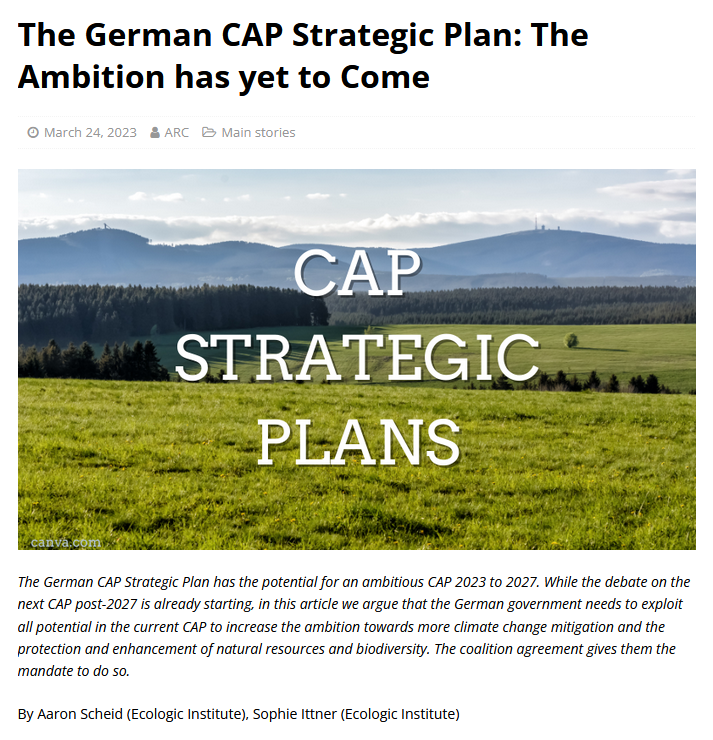
Scheid, Aaron and Sophie Ittner 2023: The German CAP Strategic Plan: The Ambition has yet to Come. In: Agricultural and Rural Convention – ARC2020. Brussels.
European Commission, Directorate-General for Agriculture and Rural Development, Folkeson Lillo, C., Chartier, O., Valli, C. et al., Mapping and analysis of CAP strategic plans – Assessment of joint efforts for 2023-2027, Folkeson Lillo, C.(editor), Chartier, O.(editor), Publications Office of the European Union, 2023, https://data.europa.eu/doi/10.2762/71556
Frelih-Larsen, A., S. Ittner and E. Kollenda (2021) ‘CAP Strategic Plans shadow assessment of environmental needs: Germany’, Ecologic Institute and Institute for European Environmental Policy