Assessment of Coherence of the Green Architecture
Insights from the EU CAP Network Good Practice Workshop
- Presentation
- Date
-
- Location
- Larnaca, Cyprus
- Speech
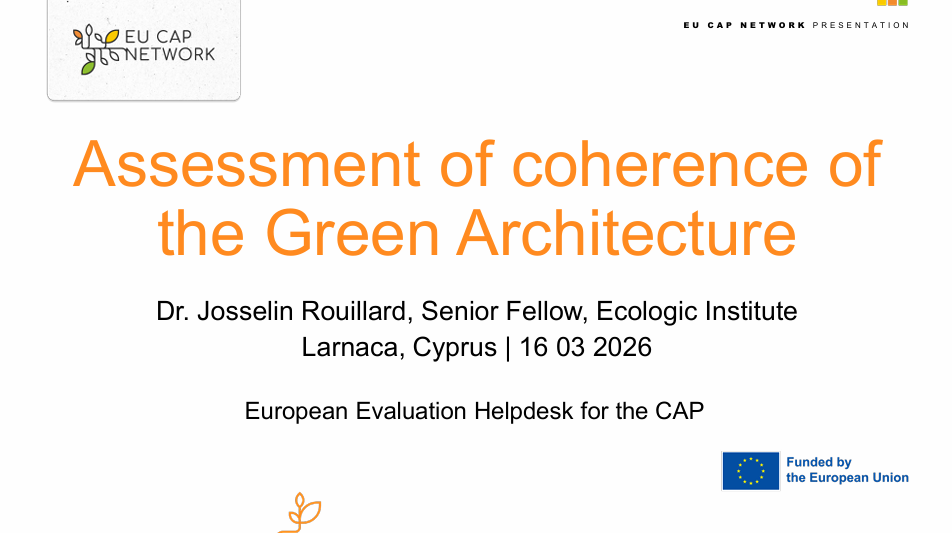
At the Good Practice Workshop on the assessment of the Green Architecture (GA) of CAP Strategic Plans, held in March 2026 in Larnaca (Cyprus) Dr. Josselin Rouillard presented key considerations for evaluating the coherence of CAP instruments. The workshop, organised under the EU CAP Network with support from the European Evaluation Helpdesk for the CAP, brought together evaluators, policymakers and experts to exchange approaches and practical experiences on assessing the GA.
Why coherence matters: Moving beyond isolated policy assessment
A central message of the presentation was that assessing individual instruments in isolation is no longer sufficient. Instead, coherence focuses on how well different policies and measures complement each other.
Evaluating coherence helps to:
- avoid conflicting policy signals and incentives for farmers
- maximise the overall impact of CAP interventions
- reduce administrative complexity
- strengthen contributions to EU and national environmental and climate goals
Understanding coherence across policy layers: Linking CAP instruments with broader policy frameworks
Coherence needs to be assessed across multiple dimensions:
- interactions between GA instruments (e.g. eco-schemes, GAECs, agri-environment-climate measures, non productive investments)
- relationships between GA and non-GA CAP instruments (e.g. direct income support, coupled support, productive investments)
- alignment with broader EU environmental and climate legislation and national regulation and policy action
This broader perspective reflects the increasing integration of agricultural, environmental and climate policies within the CAP.
From concept to practice: A structured approach to coherence assessment
The presentation illustrated a stepwise approach to assessing coherence, as reflected in the evaluation guidelines:
- Defining the evaluation framework and key questions
- Selecting appropriate data sources and methods
- Analysing interactions and identifying synergies, gaps and trade-offs
This approach supports a more systematic understanding of how instruments interact in practice.
Towards a system-level perspective: Capturing interactions between instruments
A key challenge is moving towards system-level assessments. Rather than focusing on individual measures, evaluations need to consider how combinations of instruments influence outcomes. Interactions between CAP instruments and other policy frameworks – for example in the area of water management or climate mitigation – can significantly affect overall performance and should therefore be explicitly assessed.
Implications for policy and evaluation practice: Strengthening the green architecture
The workshop discussions highlighted that coherence assessment is an important tool for improving policy design and implementation. By identifying inconsistencies, overlaps and missed opportunities, evaluations can help strengthen the effectiveness of the CAP’s green architecture.
The presentation contributes to ongoing work under the EU CAP Network to develop practical guidance and build capacity for evaluating the environmental and climate performance of CAP Strategic Plans.
Contact