Moving to a Clean Industrial Future in Europe
Clean Industrial Transition Monitor
- Publication
- Citation
Fürst, Corinna et al. 2026: Clean Industrial Transition Monitor. Moving to a clean industrial future in Europe. Progress, Gaps and Policy Implications
of the Clean Industrial Deal. European Climate Neutrality Observatory (ECNO).
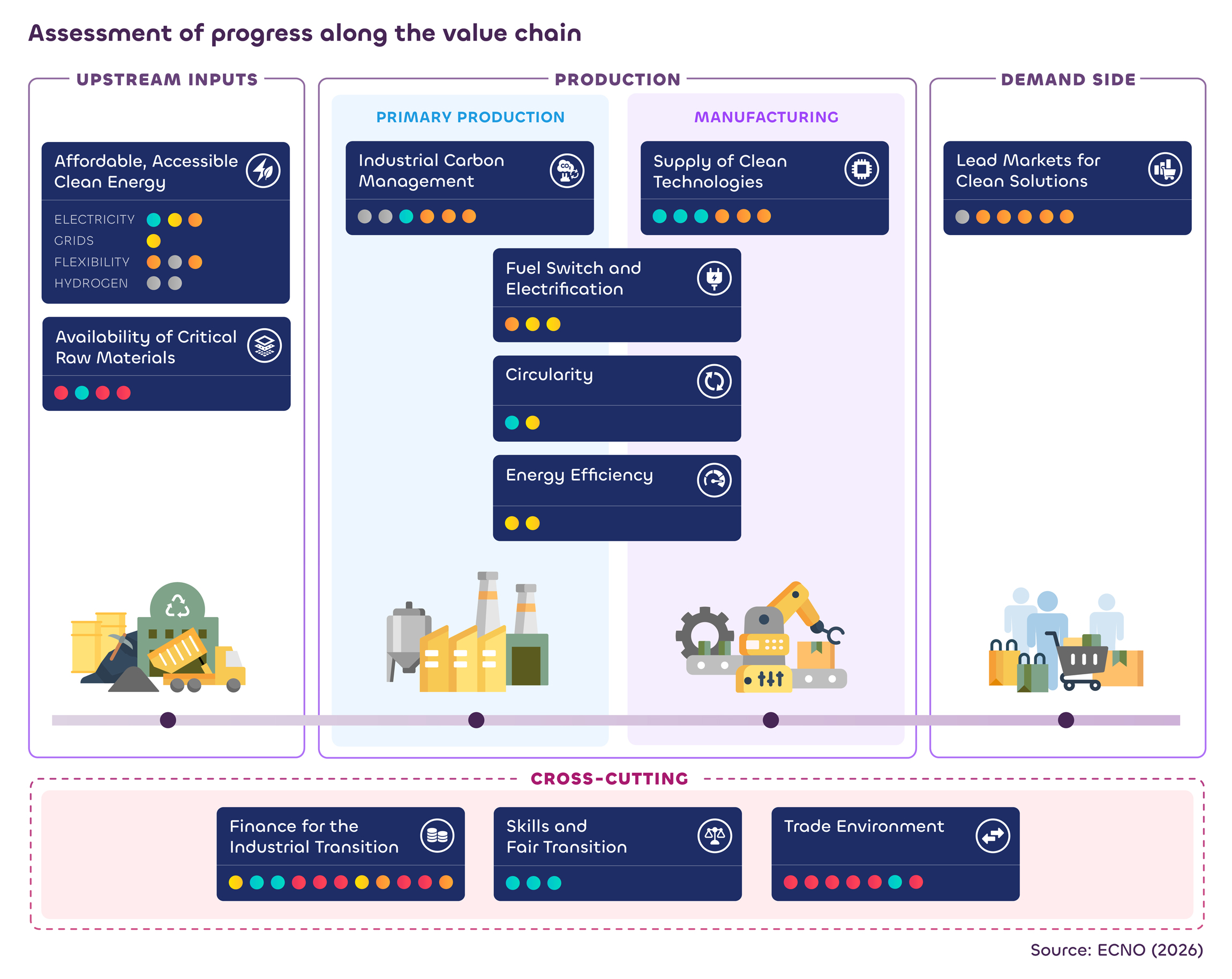
The transition to a clean and competitive industrial base is crucial to strengthening Europe’s resilience and strategic economic independence. The Clean Industrial Transition Monitor by ECNO assesses real-world progress using more than 50 indicators and provides a comprehensive and nuanced picture of both progress and remaining gaps.
Uneven progress and persistent bottlenecks
While progress is visible across several key enabling conditions, the transition remains uneven. Key challenges include weak demand for clean products and materials, infrastructure bottlenecks, limited financing, and difficulties in diversifying the supply of critical raw materials. Addressing these barriers will require targeted and sustained policy action.
At the same time, the Clean Industrial Deal already provides a broad and comprehensive policy framework. The report assesses more than 80 initiatives, which together cover most of the key drivers of industrial transformation. However, their impact will depend on how quickly, coherently and effectively they are implemented.
Demand, carbon pricing and key policy levers
A notable shift in the policy landscape is the growing focus on demand-side measures. Initiatives such as the Industrial Accelerator Act and the Public Procurement Act aim to create lead markets for clean technologies and materials. Establishing reliable and predictable demand will be essential to unlock investment and scale low-carbon production across Europe.
At the core of the transition remains the EU Emissions Trading System (ETS). As the central economic signal, it helps internalise and reduce the cost gap between fossil-based and low-carbon production while also generating revenues for industrial decarbonisation. Maintaining a stable and robust carbon price is therefore essential for investment certainty and long-term planning.
Additional decisive initiatives under the Clean Industrial Deal are the Grids Package, the Clean Industrial State Aid Framework, and the forthcoming Circular Economy Act. Together, they act as key cross-cutting levers across multiple areas—from infrastructure and financing to resource use.
Financing, resilience and the global dimension
Ensuring sufficient and sustained financing will be key to maintaining momentum. While current EU instruments have already contributed to positive trends in investment and employment, additional and better-targeted funding will be needed to support deep structural transformation across regions.
At the same time, accelerating electrification and renewable energy deployment will strengthen Europe’s economic resilience by permanently reducing dependence on imported fossil fuels. Finally, the success of the transition will also depend on its global dimension. By maintaining a clear and consistent policy direction and building strategic partnerships, the EU can strengthen its competitiveness and actively shape emerging global markets for clean industrial products.

Contact

- Language
-
English
- Authorship
- Credits
Design: Jennifer Rahn (Ecologic Institute)
- Funding
-
European Climate Foundation (ECF), International - Published by
-
Ecologic Institute, Germany - Year
- Dimension
- 55 pp.
- Project
- Project ID
- Table of contents
-
Click to show full table of contents
- Keywords
-
industrial decarbonisation, low-carbon industry Europe, clean manufacturing transition, green industrial transformation, net-zero industry, industrial competitiveness Europe, decarbonisation pathways industry, green supply chains, sustainable industrial production, energy transition industry, industrial innovation Europe, climate-neutral manufacturing, industrial policy EU Green Deal, clean technology marketsEuropeindicator-based assessment, policy monitoring framework, comparative analysis, data-driven evaluation, performance benchmarking, transition monitoring, multi-indicator analysis, policy gap analysis, evidence-based policy assessment, systems approach evaluation, longitudinal analysis, policy tracking, quantitative indicators analysis
Velten, Eike Karola et al. 2025: 2025 Flagship Report: State of EU progress to climate neutrality. An indicator-based assessment across 13 building blocks for a climate neutral future. European Climate Neutrality Observatory (ECNO).
Velten, Eike Karola et al. 2024: Flagship Report: State of EU progress to climate neutrality. An indicator-based assessment across 13 building blocks for a climate neutral future. European Climate Neutrality Observatory (ECNO).
Velten, Eike Karola et al. 2023: Flagship Report: State of EU progress to climate neutrality. An indicator-based assessment across 13 building blocks for a climate neutral future. European Climate Neutrality Observatory (ECNO).