Foto von Volodymyr Hryshchenko auf Unsplash, Cover: Umweltbundesamt, 2026
Zu Risiken und Nebenwirkungen fragen Sie ... das Umweltbundesamt!
Informations- und Lehrmaterialien für einen umweltbewussten Umgang mit Humanarzneimitteln
- Publication
- Citation
Kemper, Melanie et. al. (2026): Zu Risiken und Nebenwirkungen fragen Sie ... das Umweltbundesamt! Informations- und Lehrmaterialien für einen
umweltbewussten Umgang mit Humanarzneimitteln. Abschlussbericht. Dessau-Roßlau: Umweltbundesamt.
This final report summarises the results of a four-year project on the environmental aspects of human pharmaceuticals. The publication documents informational and educational materials for the fields of medicine, pharmacy, and health communication. The project aimed to reduce the release of pharmaceutical substances into the environment and to strengthen the integration of environmental knowledge into education, teaching, and professional practice. The project produced openly accessible materials for universities and continuing education programmes, pharmacies, and the general public. In addition, an online platform was established to consolidate scientific background information, infographics, and teaching resources.
Pharmaceutical Residues in Water Bodies and Soils
The authors point out that active pharmaceutical ingredients and their metabolites enter the environment via wastewater following human use. Another contributing factor is the improper disposal of left-over medicines, for example via toilets or sinks. Pharmaceutical residues are detectable in surface waters, soils, and other environmental compartments. The report also outlines potential effects on aquatic organisms and other non-target species.
For medical and pharmaceutical professionals, the project developed infographics illustrating topics such as the influence of different dosage forms on environmental emissions and differences in the ecotoxicity of individual active substances. Additional materials address patients directly and provide guidance on the appropriate use and disposal of medicines.
Materials for Pharmacies and Healthcare Professionals
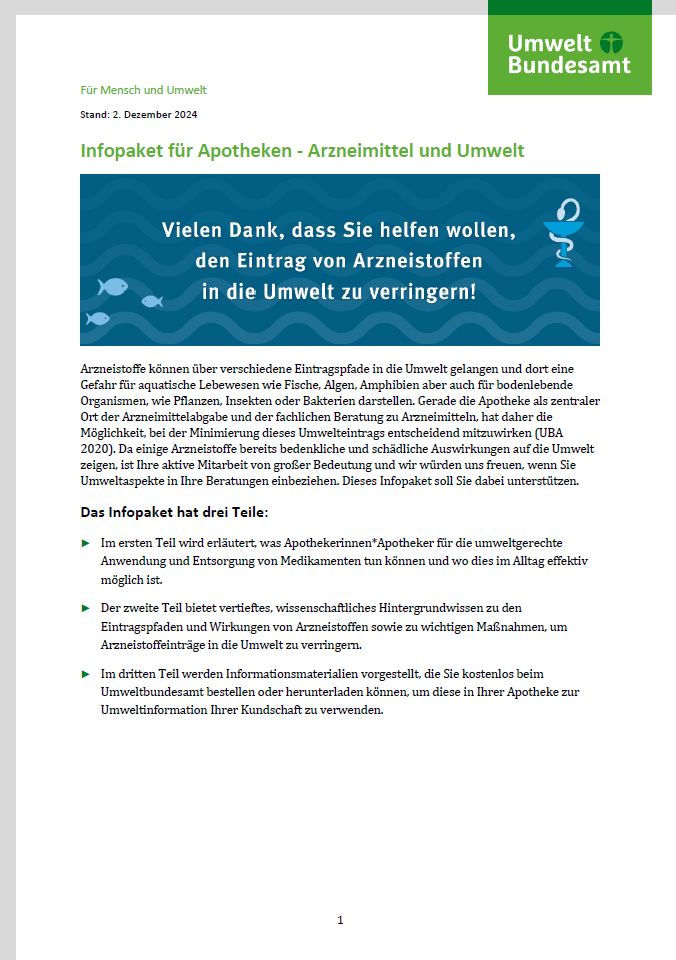
A central focus of the publication is the provision of informational resources for pharmacies. The developed “materials toolkit” contains posters, brochures, postcards, and digital content on the proper disposal of medicines. Several materials are available in multiple languages, including English, French, Turkish, Polish, Russian, and Arabic.
One postcard recommends to reduce the amount of pharmaceuticals released into waste water by first wiping hands with a paper towel after application of creams and gels containing pharmaceuticals. The paper towel is to be disposed of in the household waste, and only then hands should be washed. Other materials explain regional disposal options for unused medicines in Germany and provide guidance on handling liquid pharmaceutical waste.
Teaching Materials for Higher Education and Professional Training
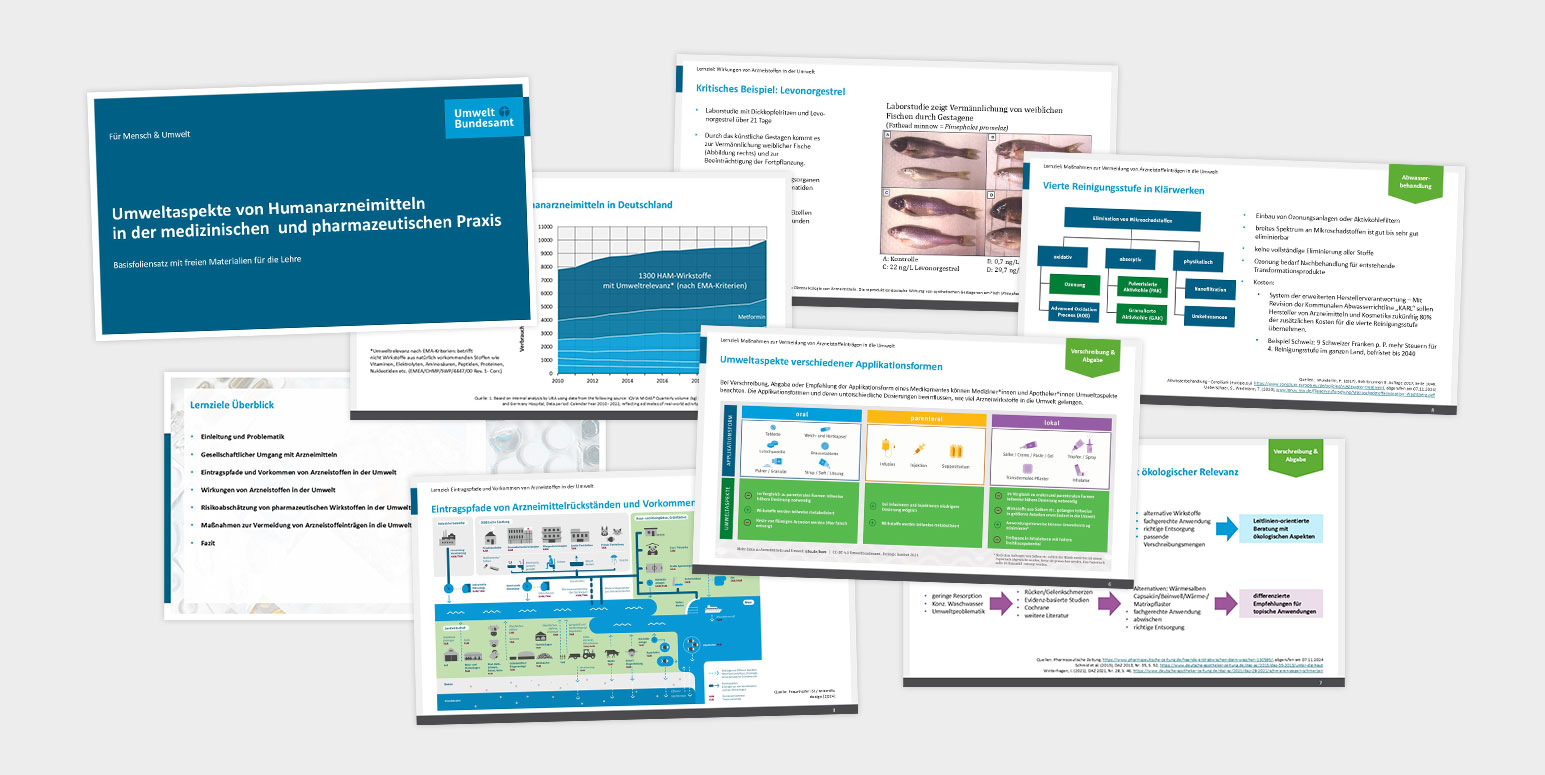
The report also describes the development of comprehensive teaching materials for universities and medical and pharmaceutical continuing education programmes. The core slide deck comprises more than 70 slides covering emission pathways, environmental impacts, environmental risk assessment, and mitigation strategies related to human pharmaceuticals. In addition, the project produced a strategic framework aimed at strengthening the integration of the topic “Pharmaceuticals and the Environment” into academic education, vocational training, and continuing professional development. Professional associations, educators, and other stakeholders contributed to its development through workshops and advisory bodies.
Project Partners Developed Materials and Communication Formats
The project was carried out from October 2021 to March 2025 by a consortium consisting of Ecologic Institute, the Institute of Pharmacy at Kiel University, and the Institute of Toxicology and Pharmacology for Natural Scientists at the University Medical Center Schleswig-Holstein.
Ecologic Institute coordinated the development of the information platform, communication materials, and dissemination strategy. The institute also organised workshops and exchange formats involving professional associations, universities, pharmacists, and other stakeholders from the healthcare sector. The scientific content on the environmental impacts of pharmaceutical substances, as well as the teaching materials, were developed in collaboration with the participating pharmaceutical and toxicological institutions.
Contact

- Language
-
German
- Authorship
- Funding
-
German Environment Agency (UBA), Germany - Published by
-
German Environment Agency (UBA), Germany - Year
- Dimension
- 21 pp.
- ISSN
-
1862-4804
- DOI
- Project
- Project ID
- Table of contents
-
Click to show full table of contents
- Keywords
-
Pharmaceutical residues, disposal of medicines, human medicines, environmental impact of medicines, pharmacy, medicine, pharmaceutical substances in water, healthcare, environmental effects of medicinesGermanyInformation platform, teaching materials, science communication, environmental education, stakeholder workshop, risk assessment, infographics, communication materials
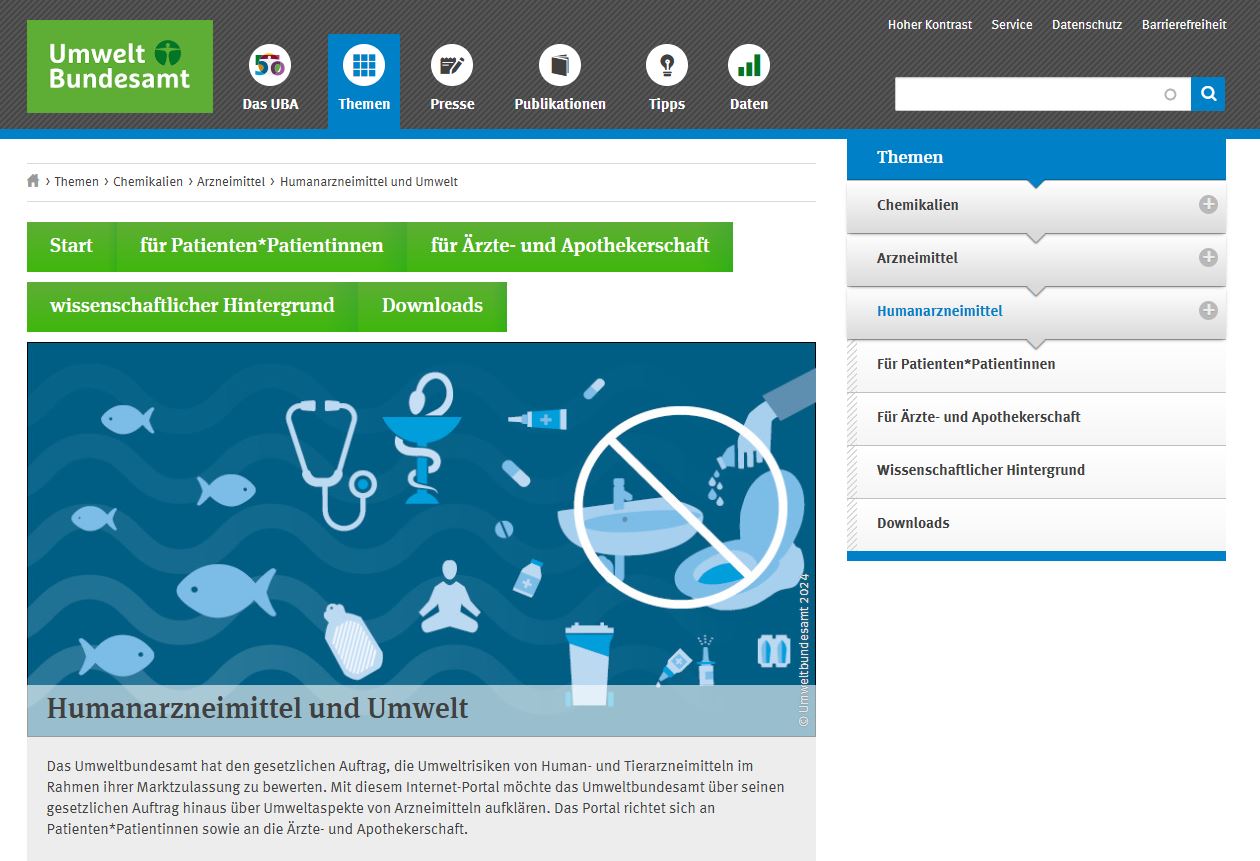
German Environment Agency (Ed.) 2025: Pharmaceuticals and the Environment. Internet portal. Dessau-Roßlau. URL: www.uba.de/en/hmp
Environmental Risks in the Authorisation Process of Veterinary Pharmaceuticals
- Duration
-
-
- Funding
-
German Environment Agency (UBA), Germany
Communication Strategies for Reducing Agriculture-related Entry of Veterinary Pharmaceuticals into the Environment
- Duration
-
-
- Funding
-
German Environment Agency (UBA), Germany
Prioritisation and Risk Evaluation of Medicines in the EnviRonment (PREMIER)
- Duration
-
-
- Funding
-
European Commission, Directorate-General Research & Innovation (DG Research & Innovation), International
Vidaurre, Rodrigo et al. (2024): Design of greener drugs: aligning parameters in pharmaceutical R&D and drivers for environmental impact. Drug Discovery Today, Volume 29, Issue 7, doi: 10.1016/j.drudis.2024.104022.