
Photo: Uberprutser, CC BY-SA 4.0, via Wikimedia Commons, Report: Ecologic Institute, 2027
EU Methane Regulation Article 27: the Case Against a Grace Period
Why the ordinary enforcement regime does not endanger EU energy security
- Publication
- Citation
Piria, Raffaele (2026): EU Methane Regulation Article 27: the Case Against a Grace Period. Why the ordinary enforcement regime does not endanger EU energy security. Berlin: Ecologic Institute.
This paper argues that there is no plausible basis for the introduction of a “grace period” in respect of infringements of Article 27 of the EU Methane Emissions Regulation (EUMR), as proposed in a recently leaked draft European Commission Recommendation.
The paper disputes that the ordinary application of the penalty regime under Article 33 EUMR to infringements of Article 27 could endanger the security of the EU’s energy supply. Even in the context of the current energy crisis, importers can comply with their obligations under Article 27 without exposing themselves or their suppliers to significant penalty risks and without jeopardising energy security.
For a part of imported crude oil, natural gas and coal, compliance with Article 27 can be achieved without significant difficulty. Even where the objectives underlying Article 27 cannot yet be fully realised because the necessary tracing systems and other adaptations are not fully in place, Article 27 contains safeguards that avoid the risk of disproportionate penalties for importers making genuine efforts to comply. Serious penalties are likely to arise only where importers are unwilling to make such efforts.
The introduction of a grace period for Article 27 infringements would have significant drawbacks. It would unfairly disadvantage market participants that have already invested in compliance over the past two years. It would weaken incentives for compliance and increase the risk of non-compliance, thus failing to achieve the climate objectives of the Regulation. It would discourage competent authorities from investigating potential breaches of importers’ obligations. It would also jeopardise the implementation of other importer obligations, including after the expiry of the grace period, and risk undermining the credibility of future, unrelated EU legislation.
This paper focuses exclusively on Article 27. The absence of any discussion on the importer obligations pursuant to Articles 28 and 29 should not be interpreted as expressing a view on the appropriateness of a grace period or any other form of penalty relief in relation to those provisions.
Contact

- Language
-
English
- Authorship
- Credits
The author would like to thank Dr. Stephan Sina (Ecologic Institute) for his valuable contribution and support.
- Published by
-
Ecologic Institute, Germany - Year
- Dimension
- 12 pp.
- Table of contents
-
Click to show full table of contents
- Keywords
-
EU methane regulation, methane emissions reduction, methane mitigation policy, energy sector emissions, fossil fuel supply chains, climate policy compliance, environmental regulatory compliance, methane transparency requirements, greenhouse gas emissions regulation, energy imports and sustainability, climate law enforcement, emissions accountability, decarbonisation of energy imports, environmental due diligence, energy transition governance, climate policy implementation, emissions reporting obligations, regulatory certainty, climate legislation effectiveness, methane emissions monitoring, international energy suppliers, global fossil fuel supply chains, imported natural gas, imported crude oil, imported coal, European energy security, cross-border energy trade, international climate governanceEuropelegal analysis, regulatory assessment, policy analysis, legislative interpretation, compliance assessment, penalty regime analysis, risk assessment, implementation analysis, legal reasoning, evidence-based policy evaluation, comparative assessment of regulatory impacts, analysis of enforcement mechanisms, evaluation of compliance incentives, assessment of unintended policy consequences, climate policy effectiveness analysis, governance analysis, regulatory impact evaluation, legal argumentation, implementation risk analysis, policy recommendation review
Raffaele Piria, Hannah Lentschig, Ana-Maria Boromisa, Anca C. Sinea, Borbála Takácsné Tóth, Loyle Campbell and Sabrina Schulz: European energy security or acquiescence? A critical review of the 24 February 2026 United States-Central and Eastern Europe Joint Statement. Ecologic Institute, Berlin, 2026.
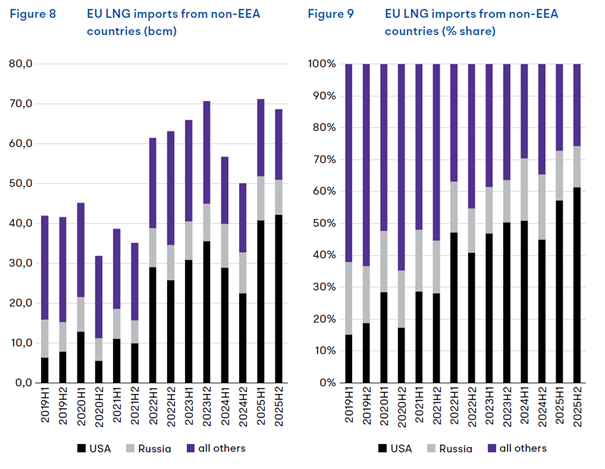
Raffaele Piria, Kacper Szulecki, Hannah Lentschig and Louise van Schaik: Europe’s Selective Blindness on Gas: US LNG and the Limits of Supply Diversification. Clingendael, Ecologic Institute, Norwegian Institute of International Affairs, The Hague/Berlin/Oslo, 2026.
Piria, Raffaele: Penalty regimes for violations of the EU Methane Regulation across EU Member States. Ecologic Institute, 2025, Berlin.

Piria ,Raffaele, Benjamin Görlach (2024): Pricing methane emissions from the energy sector: consideration of options, for the EU. Ecologic Institute, Berlin.