Geschichte der Umweltpolitikforschung – ein Zeitstrahl von den 1960er Jahren bis zur Energiewende
Interaktiver Zeitstrahl
- Publication
- Citation
Ecologic Institut (2014): Geschichte der Umweltpolitikforschung – ein Zeitstrahl von den 1960er Jahren bis zur Energiewende. Interaktiver Zeitstrahl. Berlin: Ecologic Institut.
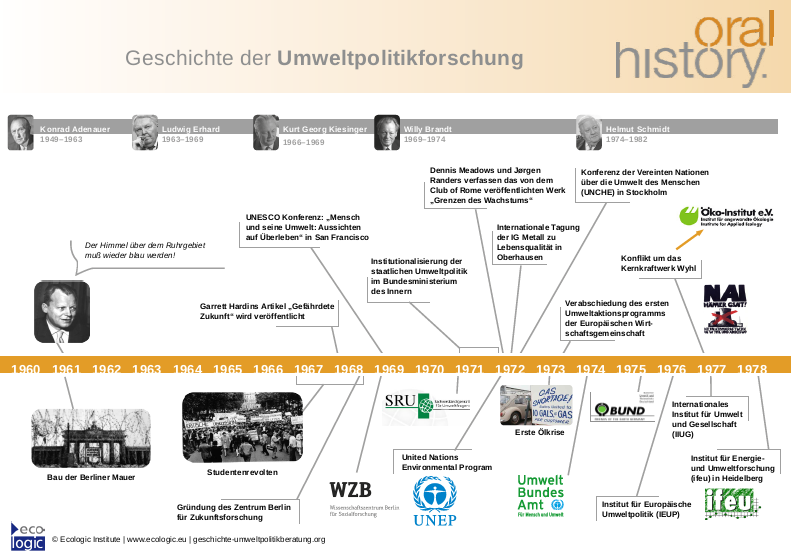
How have environmental policy, environmental research and science-based policymaking evolved in Germany – and which political, societal and institutional developments have shaped this trajectory? Developed as part of the project “From ‘Blue Skies over the Ruhr’ to the Energy Transition”, this interactive timeline brings more than five decades of German environmental policy history into view.
Spanning the early debates of the 1960s through to Germany’s energy transition, the visualisation brings together political developments, societal conflicts, international milestones and the emergence of key environmental research institutions. In doing so, it shows that science-based environmental policy research did not develop in isolation from its wider political and societal context. Rather, it emerged through the interplay of government policy, critical research, the environmental movement, international influences and new societal challenges.
Environmental policy history in context
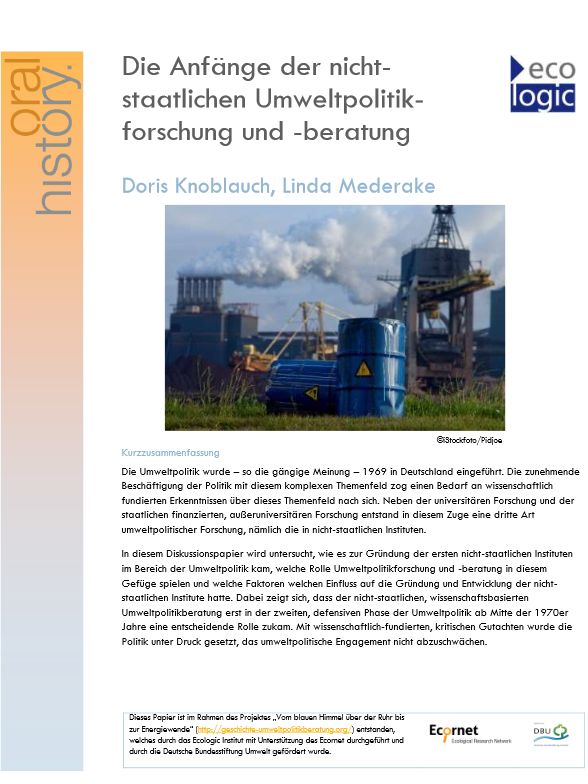
The timeline begins in the 1960s, when environmental concerns were gradually emerging as a distinct field of public policy. Willy Brandt’s call for the “sky over the Ruhr” to become blue again came to symbolise the beginnings of this political shift. The timeline places this transformation alongside international developments such as the 1972 United Nations Conference on the Human Environment in Stockholm, the Club of Rome’s Limits to Growth and the establishment of the United Nations Environment Programme (UNEP). At the same time, it traces the institutionalisation of environmental policy in Germany and the emergence of new research and policy institutions. Among the developments documented are the establishment and evolution of the German Environment Agency, the German Advisory Council on the Environment, the Öko-Institut, the Institute for Energy and Environmental Research Heidelberg (ifeu), the International Institute for Environment and Society, the Institute for European Environmental Policy and numerous other organisations.
From the environmental movement to an established research landscape
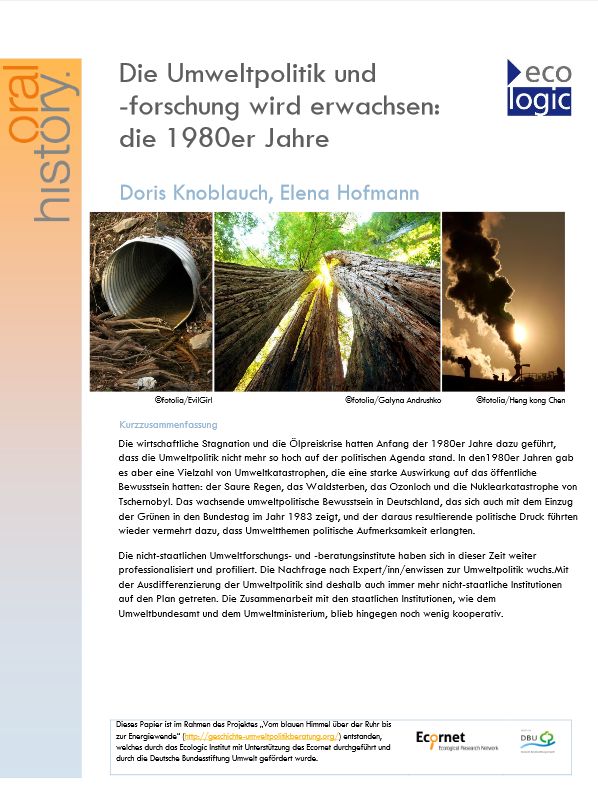
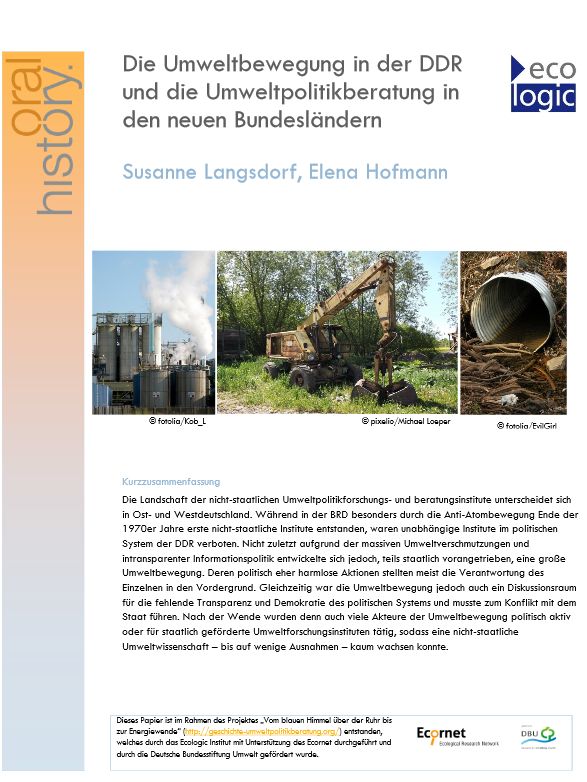
For the 1970s and 1980s, the timeline illustrates particularly clearly how societal conflicts and environmental crises influenced the development of both environmental policy and research. The controversy surrounding the proposed Wyhl nuclear power plant, the oil crises, the anti-nuclear movement and the Chernobyl nuclear disaster appear alongside the establishment of new research institutes, the creation of the Federal Environment Ministry and the growing scientific engagement with environmental and energy issues. Developments in East Germany are also represented. The establishment of the Society for Nature and the Environment in the GDR, the East Berlin Environmental Library, the documentary Bitteres aus Bitterfeld and, ultimately, the founding of the Independent Institute for Environmental Issues (UfU) illustrate the distinctive role played by the environmental movement and critical environmental research in the GDR. At the same time, the timeline shows how initially small and, in some cases, deliberately “alternative” research organisations gradually developed into an increasingly professional and institutionalised environmental research landscape.
Global environmental challenges transform research and policy
From the 1990s onwards, global environmental challenges and international sustainability policy became increasingly prominent. The United Nations Conference on Environment and Development in Rio de Janeiro, the work of the Intergovernmental Panel on Climate Change (IPCC), the establishment of the German Advisory Council on Global Change (WBGU) and the growing prominence of social-ecological research all mark this transition. The timeline follows these developments into the 2000s and early 2010s. It connects the introduction of Germany’s Renewable Energy Sources Act, the German Sustainable Development Strategy and the establishment of new research institutions with wider political and societal debates on climate action, transformation and the energy transition. The Fukushima nuclear disaster and the subsequent mobilisation both for and against the energy transition mark another important turning point. In this way, the timeline demonstrates how the scope of environmental policy expanded over the decades: from addressing immediately visible forms of environmental pollution to confronting the complex challenges of global environmental change, sustainable development and societal transformation.
An early interactive approach to environmental policy history
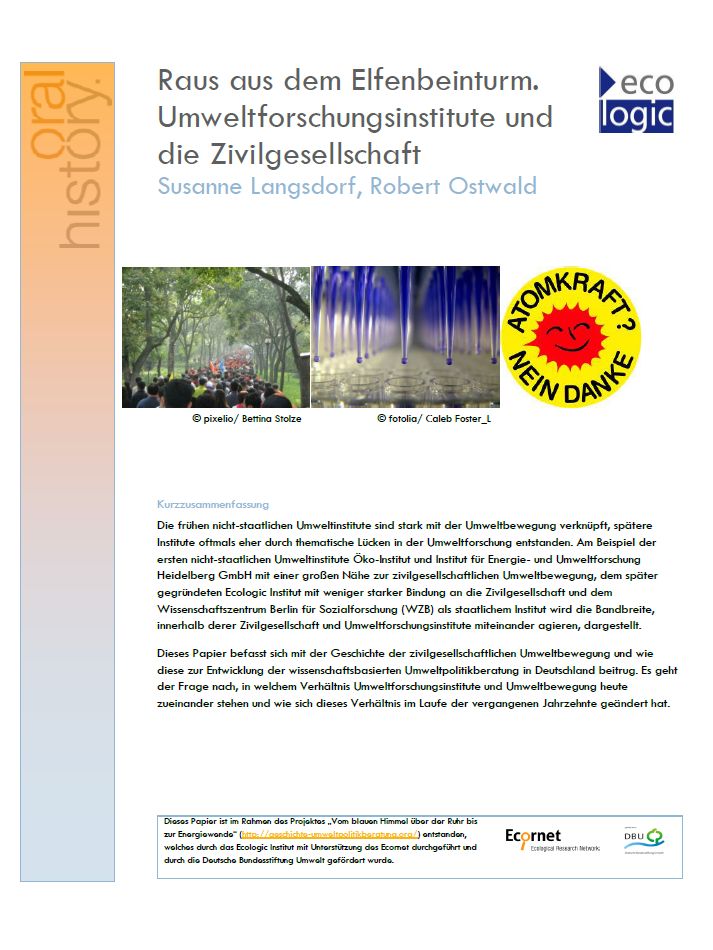
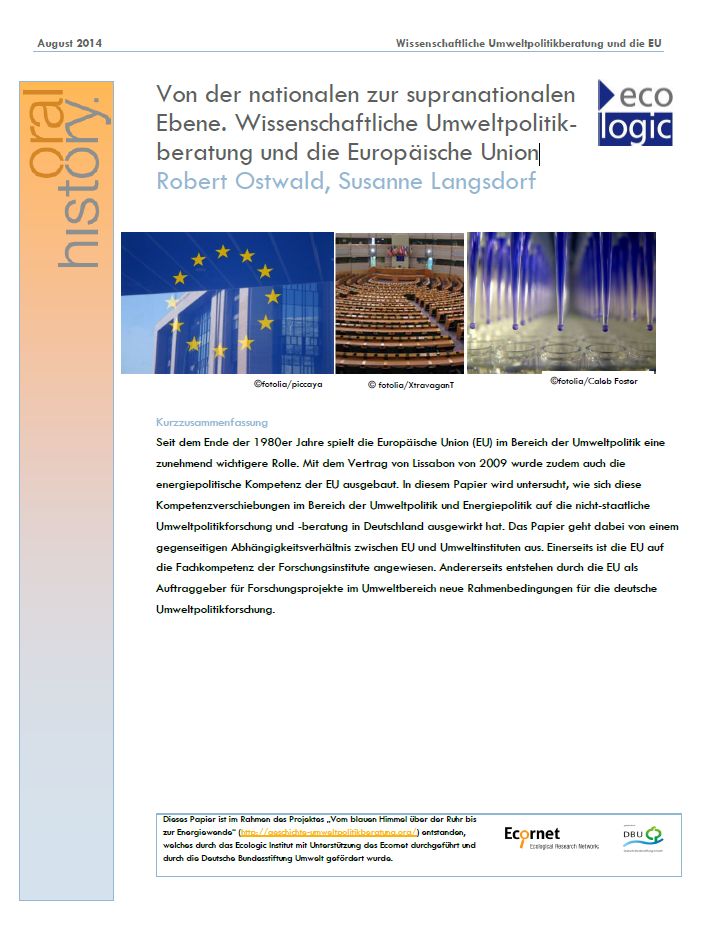
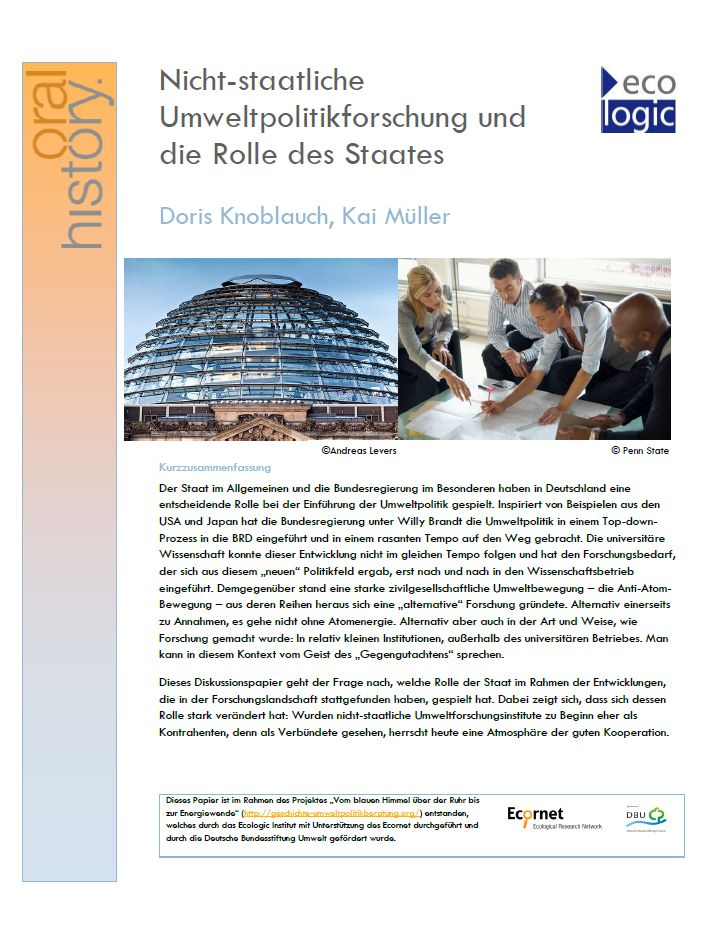
The timeline was developed in 2013 and 2014 as part of the digital outputs of “From ‘Blue Skies over the Ruhr’ to the Energy Transition”, a project implemented by Ecologic Institute in cooperation with Ecornet and funded by the German Federal Environmental Foundation (DBU). The project investigated the origins and development of science-based environmental policy research in Germany. For its time, the timeline represented a comparatively innovative approach to presenting this history. Rather than documenting the evolution of environmental policy research solely through written analysis, it brought political events, societal developments, key individuals, research institutions and international milestones together in an interactive, navigable chronology. On the original project website, users could move through the timeline interactively, while a PDF version was also made available. The timeline thus complemented the project's discussion papers and eyewitness interviews with a visual perspective. It makes chronological relationships immediately apparent, allowing users to trace, for example, how environmental crises, political decisions, civil-society mobilisation and the establishment of new research institutions unfolded alongside one another and influenced subsequent developments.
Today, the timeline continues to provide a concise historical perspective on a question at the heart of the original project: How did a distinct landscape of science-based environmental policy research emerge in Germany, and how did it become an established part of modern environmental policymaking?