Eyewitness Perspectives: The History of Science-Based Environmental Policy Research in Germany
Videoserie
- Publication
- Citation
Ecologic Institut (2013–2014): Die Geschichte der wissenschaftlichen Umweltpolitikberatung in Deutschland. Zeitzeugeninterviews im Rahmen des Projekts „Vom ‚blauen Himmel über der Ruhr‘ zur Energiewende“. Videoserie. Berlin: Ecologic Institut. YouTube. Verfügbar unter: https://www.youtube.com/playlist?list=PLRCS6sCRjnO0aiZYxmLA8h4_AJAySY5d_.
How did science-based environmental policy research in Germany emerge, and what roles did independent research institutes, policymakers, academia and civil society play in its development? Produced as part of the project “From ‘Blue Skies over the Ruhr’ to the Energy Transition”, this video series brings together 19 eyewitnesses and pioneers who helped shape environmental policy research in Germany.
The interviews feature leading figures from politics, academia, public administration, environmental organisations and research institutes, who offer first-hand accounts of the emergence and professionalisation of environmental policy research and policy consultancy in Germany. The conversations explore the origins and evolution of key institutions and research traditions, while tracing how relationships between academia, policymaking and civil society have changed over several decades.
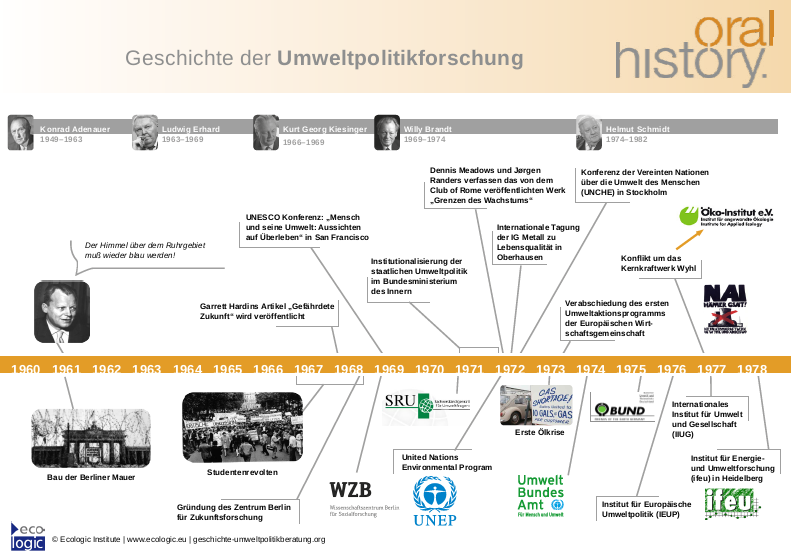
The series reveals how closely the development of environmental policy research was intertwined with wider political and societal change. The interviews show how the environmental movement and critical scholarship gave rise to new forms of independent research, how non-governmental environmental research institutes became established, and how scientific expertise increasingly found its way into political decision-making.
Together, the conversations provide a range of perspectives on formative stages in this history: from the beginnings of German environmental legislation and the anti-nuclear movement to the establishment of independent research institutes and the emergence of new approaches to environmental policy analysis, as well as the Europeanisation of environmental policy and growing cooperation between public institutions and independent research organisations.
19 Perspectives on the History of Environmental Policy Research
- Prof. Dr. Edda Müller – The Primacy of Politics and the Role of Science
The former Minister for Nature and the Environment of Schleswig-Holstein talks to Doris Knoblauch about the primacy of politics and the supporting role played by science in environmental protection. - Dr. Hans-Joachim Ziesing – Environmental Policy at the Interface of Research and Policymaking
The energy expert talks to Matthias Duwe about the interplay between policymaking and research and the role of the German Institute for Economic Research (DIW) in science-based environmental policy consultancy. - Prof. Dr. Meinhard Schulz-Baldes – The Establishment and Development of the WBGU
The former Secretary-General of the German Advisory Council on Global Change (WBGU) talks to Susanne Langsdorf about the Council's establishment and subsequent development. - Prof. Dr. Angelika Zahrnt – The Environmental Movement and Alternative Environmental Research
The Honorary Chair of Friends of the Earth Germany (BUND) talks to Doris Knoblauch about gaps in the early landscape of environmental policy research and how the establishment of formerly “alternative” environmental institutes transformed environmental research. - Dr. Christian Hey – The SRU and Germany's Environmental Research Landscape
The then Secretary-General of the German Advisory Council on the Environment (SRU) talks to Susanne Langsdorf about the history of the Council and the particular conditions that contributed to the success of Germany's environmental research institutes. - Prof. em. Dr. Eckard Rehbinder – Environmental Legislation and the German Advisory Council on the Environment
The former long-standing member and Chair of the SRU talks to Doris Knoblauch about the development of German environmental legislation, the context in which the Council was established and the evolution of European environmental legislation. - Dr. Hans-Jürgen Nantke – The German Environment Agency and Environmental Research Institutes
The then Head of the German Emissions Trading Authority talks to Benjamin Görlach about the early years and original responsibilities of the German Environment Agency, its contribution to the emergence and development of environmental institutes, and its subsequent role. - Dr. Thomas Jahn – The Development of Social-Ecological Research
The co-founder of the Institute for Social-Ecological Research (ISOE) talks to Benjamin Görlach about the institute's history and the broader development of social-ecological research. - PD Dr. Helmut Weidner – The Berlin School of Environmental Policy Analysis
The former researcher at the WZB Berlin Social Science Center talks to Susanne Langsdorf about the development of the International Institute for Environment and Society, formerly based at the WZB, and the emergence of the “Berlin School of Environmental Policy Analysis”. - Prof. Dr. Rolf Kreibich – The Establishment of Environmentally Oriented Research Institutes
The founder of the Institute for Futures Studies and Technology Assessment and former President of Freie Universität Berlin talks to Camilla Bausch about the circumstances that led to the establishment of environmentally oriented research institutes in Germany. - Dr. Hendrik Vygen – Government and Independent Environmental Research
The former senior ministerial official talks to Camilla Bausch about the interplay between the Federal Environment Ministry, the German Environment Agency and independent environmental research institutes. - R. Andreas Kraemer – Independent Environmental Research and Policy Institutes
The Director of Ecologic Institute talks to Susanne Langsdorf about the significance of independent research and policy institutes in the field of environmental policy and traces the histories of the Institute for European Environmental Policy and Ecologic Institute. - Michael Sailer – From Alternative Institute to Established Actor: The Öko-Institut
The long-standing staff member and spokesperson of the Öko-Institut traces its development from an alternative source of scientific information to an established part of Germany's environmental research landscape. - Dr. Volker Hauff – The Role of Government in the Emergence of Independent Environmental Research
The former Federal Minister for Research and Technology and Federal Minister for Transport talks to R. Andreas Kraemer about the role of government. During his tenure as Research Minister, Hauff initiated some of the first research commissions awarded to independent environmental research institutes. - Dr. Ulrich Höpfner – The Establishment and Development of ifeu
The interview traces the origins of the Institute for Energy and Environmental Research Heidelberg (ifeu) in the University of Heidelberg's “Environmental Protection Tutorial” and explores the considerable resistance its young researchers initially encountered from the established scientific community and public institutions. - Prof. Dr. Martin Jänicke – Critical Environmental Research and the Berlin School
The interview explores the disadvantages faced by critical environmental researchers during the early years of independent environmental research, the distinctive role of the Berlin School of Environmental Policy, the value of proximity to policymaking in Berlin, and the development of the Environmental Policy Research Centre at Freie Universität Berlin. - Dr. Michael Zschiesche – Environmental Research and the Environmental Movement in East Germany
The representative of the Independent Institute for Environmental Issues (UfU) discusses the history of science-based environmental policy research in Germany, the particular role of UfU, the environmental movement in the German Democratic Republic (GDR), the limited scope for critical environmental research there, and the repositioning of the East German environmental movement following German reunification. - Prof. Ernst Ulrich von Weizsäcker – The Institute for European Environmental Policy and the Wuppertal Institute
The interview explores the history of science-based environmental policy research in Germany, with particular attention to the development of the Institute for European Environmental Policy (IEEP) and the Wuppertal Institute. - Prof. Dr. Dr. h. c. Udo E. Simonis – The WZB and Policy Consultancy in Germany
The environmental scientist discusses the history of science-based environmental policy research in Germany and the distinctive role played by the WZB Berlin Social Science Center in the country's policy research and consultancy landscape.
From Personal Recollections to a History of Environmental Policy Research
The eyewitness interviews constitute an important body of empirical material for the project “From ‘Blue Skies over the Ruhr’ to the Energy Transition”. Taken together, they provide a multifaceted account of how science-based environmental policy research and consultancy emerged, diversified and became professionalised in Germany. The interviewees' personal recollections and experiences complement the discussion papers produced by the project, adding different perspectives on institutional developments and on the political, societal and scientific debates that shaped their time.
As a video series, the interviews document more than the histories of individual institutions and personalities. Viewed as a whole, they reveal how relationships between the environmental movement, independent research, public institutions and policymakers evolved over several decades – from critical distance and a tradition of producing independent “counter-expertise” to the establishment of science-based environmental policy research as a recognised field and increasingly close cooperation between research and policymaking.
Contact


- Language
-
German
- Funding
-
Deutsche Bundesstiftung Umwelt (DBU), Germany - Published in
- Ecologic Institut's playlist Vom "blauen Himmel über der Ruhr" zur Energiewende [German]
- Published by
-
Ecologic Institute, Germany - Year
- -
- Dimension
- 19 Interviews
- Project
- Project ID
- Keywords
-
Geschichte der Umweltpolitik, wissenschaftliche Umweltpolitikberatung, Umweltpolitikforschung, unabhängige Umweltforschung, Umweltforschungsinstitute, Umweltbewegung, wissenschaftsbasierte Politikberatung, Wissenschaft und Politik, Wissenschaft-Politik-Schnittstelle, Umweltgovernance, deutsche Umweltpolitikgeschichte, Umweltforschungslandschaft, Anti-Atomkraft-Bewegung, sozial-ökologische Forschung, Umweltgesetzgebung, Berliner Schule für Umweltpolitikanalyse, Geschichte der Energiewende, ForschungslandschaftDeutschland, Bundesrepublik Deutschland, DDRZeitzeugeninterviews, Experteninterviews, Oral History, qualitative Interviews, historische Analyse, institutionelle Analyse, Akteursanalyse, Umweltpolitikanalyse, Wissenschaft-Politik-Analyse, qualitative Sozialforschung, historische Politikforschung, Rekonstruktion institutioneller Entwicklungen, Analyse der Forschungslandschaft
Langsdorf, Susanne; Hofmann, Elena 2014: Die Umweltbewegung in der DDR und die Umweltpolitikberatung in den neuen Bundesländern.
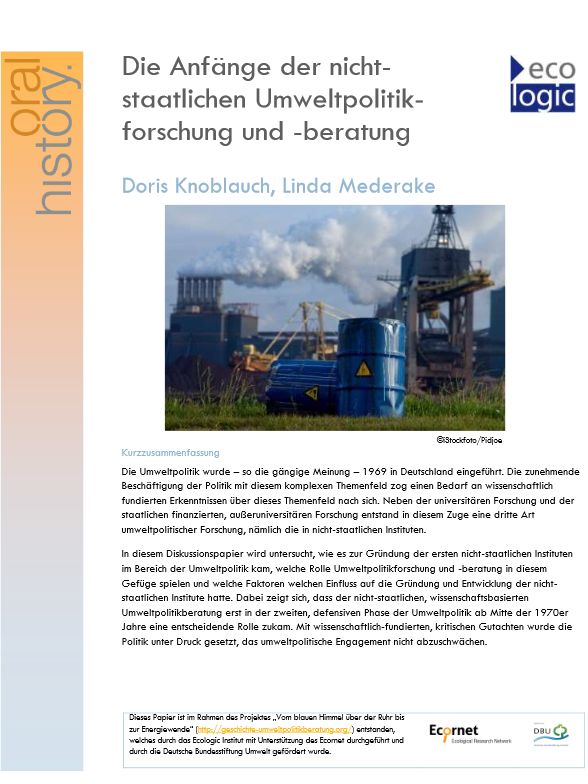
Knoblauch, Doris; Mederake, Linda 2014: Die Anfänge der nicht-staatlichen Umweltpolitikforschung und -beratung.
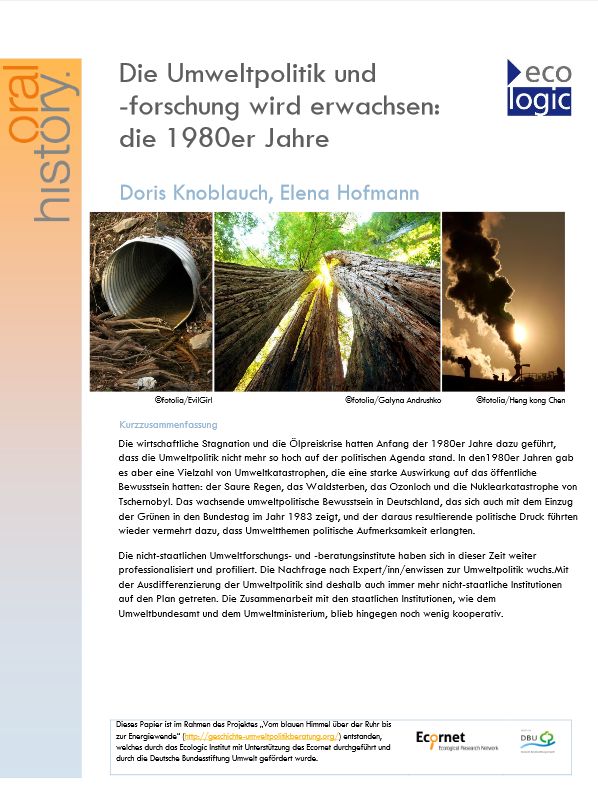
Knoblauch, Doris; Hofmann,Elena 2014: Die Umweltpolitik und -forschung wird erwachsen: die 1980er Jahre.
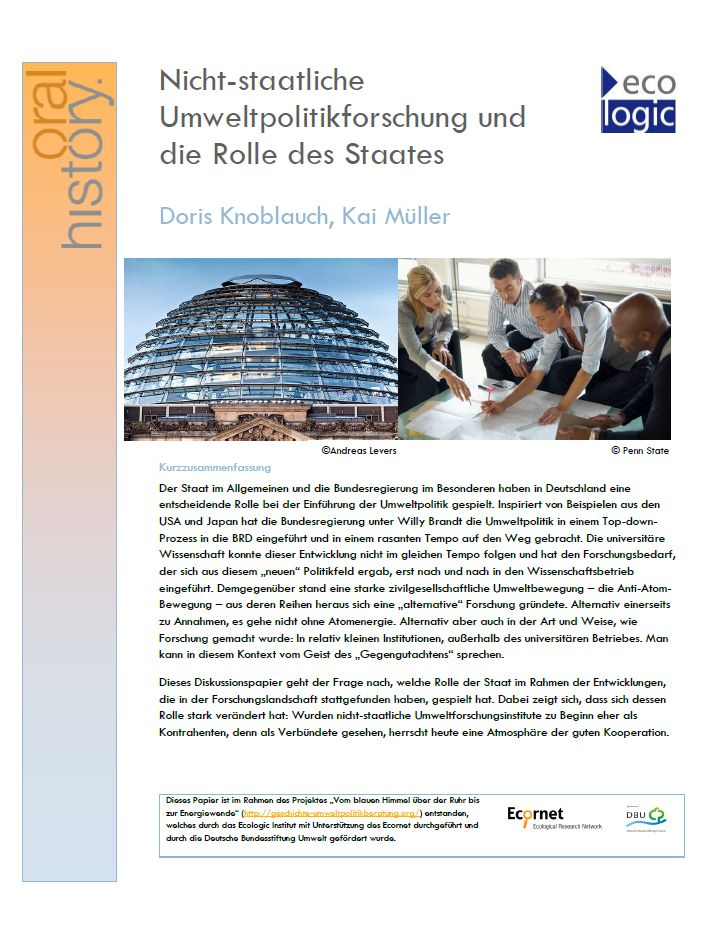
Knoblauch, Doris; Müller, Kai 2014: Nicht-staatliche Umweltpolitikforschung und die Rolle des Staates.
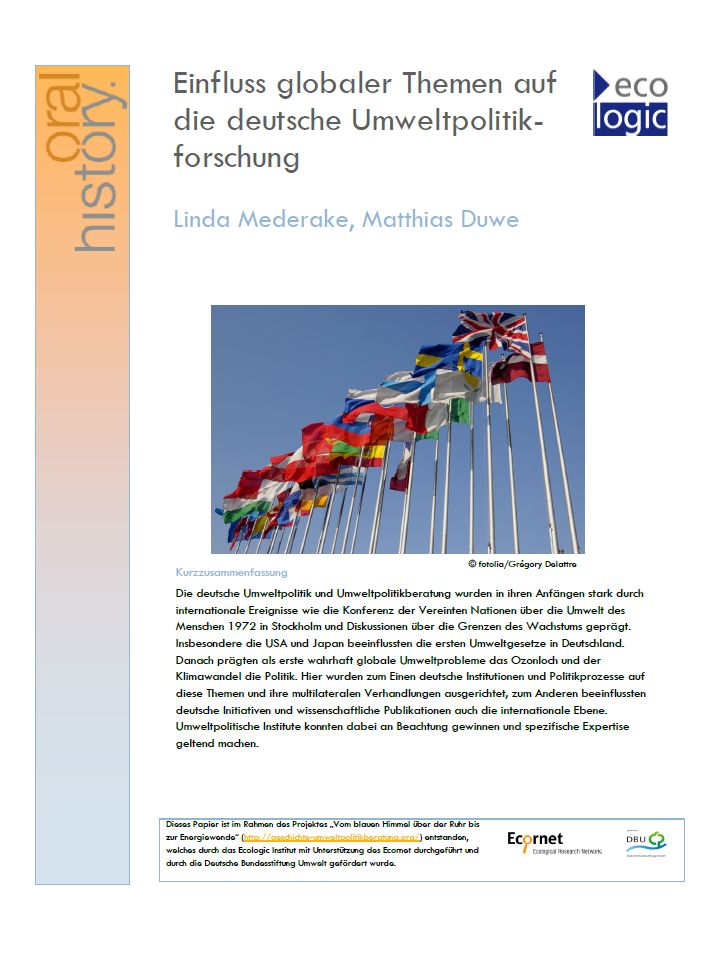
Mederake, Linda; Duwe, Matthias 2014: Einfluss globaler Themen auf die deutsche Umweltpolitikforschung.
Ostwald, Robert; Langsdorf, Susanne 2014: Von der nationalen zur supranationalen Ebene. Wissenschaftliche Umweltpolitikberatung und die Europäische Union.
Langsdorf, Susanne; Ostwald, Robert 2014: Raus aus dem Elfenbeinturm. Umweltforschungsinstitute und die Zivilgesellschaft.