
© R. Andreas Kraemer, 2026
The Ocean is no Longer Free and Boundless
R. Andreas Kraemer on governing the sea within ecological limits
- Presentation
- Date
-
- Location
- University of Aveiro, Portugal
- Panel discussion
Speaking at the University of Aveiro, R. Andreas Kraemer, founder and director emeritus of Ecologic Institute and a special advisor in the Board of Directors of Fundação Oceano Azul, used a panel hosted by the BESIDE ERA Chair project to argue that the ocean can no longer be governed as if it had no limits. Asked which single change would best improve implementation of marine and coastal commitments, he answered that he needed “a whole constellation here, not just one star”.
An ocean at its limits
Kraemer pointed out that the long-standing idea of the freedom of the seas presupposes that human activity causes no harm and excludes no one. “That is no longer true,” he said. He called for marine spatial planning for the ocean as a whole, not only for protected areas or individual fisheries, coordinated across countries, levels of government and sectors. Shipping, trade and subsea cables, and other uses of the ocean are each governed, he noted, but the rules “don’t talk to one another”, and enforcement is weak to sometimes non-existent. Because the ocean is fluid and interconnected, legal principles developed for land fit it poorly, and economics and law alike must recognise its ecological limits.
What economics cannot tell us
In a lively exchange with fellow panellist Stephen Hynes (University of Galway) on measuring natural capital, Kraemer cautioned against treating whatever cannot be monetised as zero. Such values, he said, end up in footnotes, like the leaflet in a medicine pack that nobody reads. Governance should state what economics can tell us, what it cannot, and what else we know, which includes irreplaceability and long-term and cumulative effects. He warned against “blind trust” in a single figure such as GDP, which perversely rises when damage is done and then must be repaired but records nothing when an ecosystem stays intact.
He also cautioned that discount rates give “completely erroneous results” where irreplaceable losses are concerned, and that models built on continuous linear equations struggle with extreme events and tipping points. Risks that are not sudden, unforeseen and unintended, such as those associated with climate change, become uninsurable and therefore unbankable. The same is true for risks emanating from very rare events or where potential consequences are catastrophic. In those cases he called for scenario building, multi-criteria decision-making and governance structures in which communities make the final value judgments, with expert input.
A shared agenda
Fellow panellists Mohamed Azzim (ISCTE), Filipa Saldanha (Crédito Agrícola), Stephen Hynes and Zeeshan Arshad (University of Aveiro / BESIDE) addressed blended finance, the sequencing of public and private capital, and the role of evidence in policy. Moderator Helena Vieira (BESIDE ERA Chair Holder, University of Aveiro / CESAM) steered the discussion across all three themes.
Contact

- Organizer
-
University of Aveiro (UA), Portugal - Panel discussion
- Date
-
- Location
- University of Aveiro, Portugal
- Language
-
English
- Keywords
-
Ocean Governance, International Ocean Policy, Marine Environmental Protection, Sustainable Ocean Management, United Nations Convention on the Law of the Sea (UNCLOS), High Seas Treaty, Blue Economy, Blue Carbon Ecosystems, Marine Biodiversity Conservation, Ocean Climate Change Impacts, Sustainable Fisheries Management, Marine Pollution Prevention, Seabed Mining, International Ocean Cooperation, Arctic CouncilAveiro, PortugalDiscussion, Dialogue
RISE UP for the Ocean
- Duration
-
-
- Funding
Kraemer, R. Andreas (2022). “El reto de la gobernanza oceánica: una oportunidad para la tierra.” In: Fàbregues, Francesc and Farrés, Oriol (coords.), Anuario Internacional CIDOB 2022. Barcelona: CIDOB, pp. 29–38
Kraemer, R. Andreas et. al. 2017: Sustainable Ocean Economy, Innovation and Growth: A G20 Initiative for the 7th Largest Economy in the World. Online: www.g20-insights.org/policy_briefs/ocean-dimension-2030-agenda-conserva….
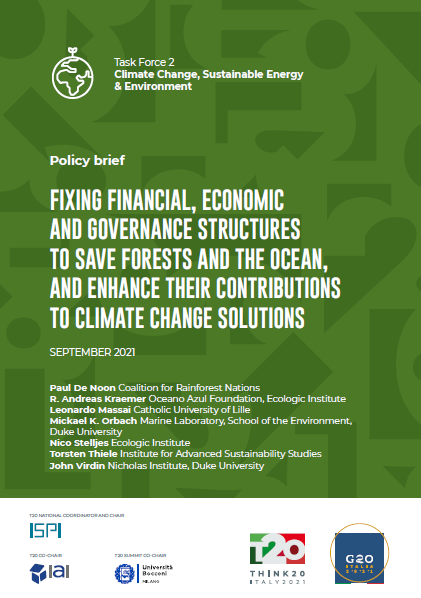
Noon, Paul De; Andreas Kraemer; Leonardo Massai et. al 2021: Fixing Financial, Economic and Governance Structures to Save Forests and the Ocean, and Enhance Their Contributions to Climate Change Solutions. T20 Policy Brief TF2 – Climate Change, Sustainable Energy & Environment.
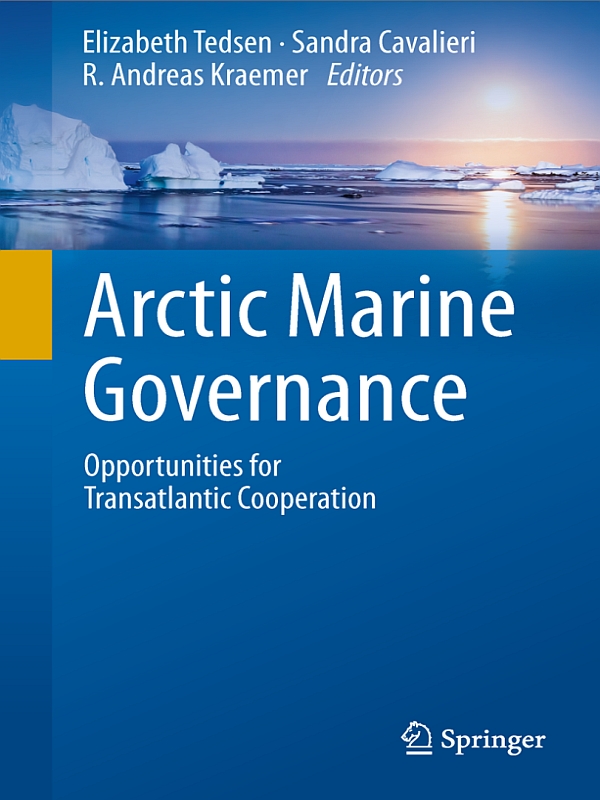
Tedsen, Elizabeth, Sandra Cavalieri, and R. Andreas Kraemer (eds.) 2014: Arctic Marine Governance. Opportunities for Transatlantic Cooperation. Heidelberg: Springer.