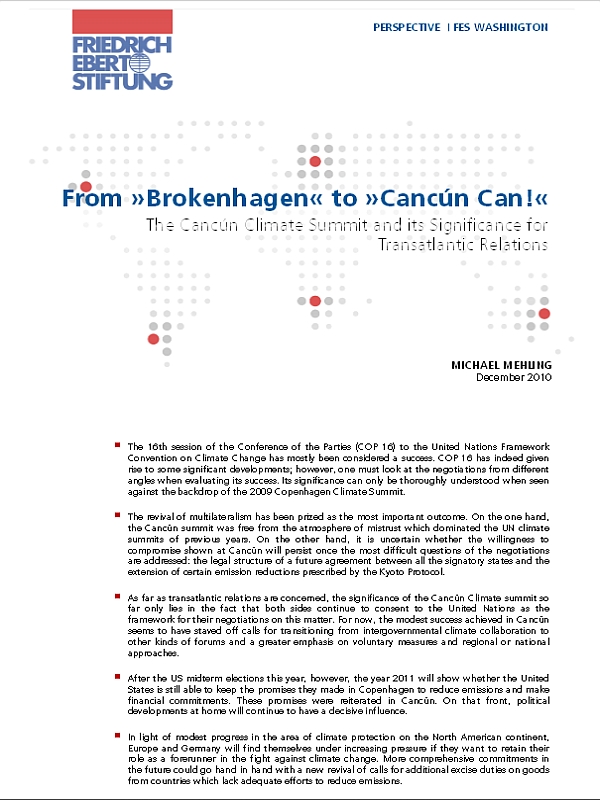
The climate summit 2010 in Cancún has mostly been considered a success. The revival of multilateralism has been prized as the most important outcome. However, it remains that the most difficult decisions, were postponed in Cancún. Michael Mehling of Ecologic Institute outlines the importance of the results for transatlantic relations. The article is available for download.
Today, the loss of biological diversity has already reached alarming proportions, proportions which climate change is not expected to reach for several decades. Despite this, climate change continues to dominate political debates, whereas biodiversity is still seen as an issue of secondary importance. In this publication, Sascha Müller-Kraenner, Senior Policy Advisor of Ecologic Institute, summarizes why a political and institutional reassessment of biodiversity is so necessary.
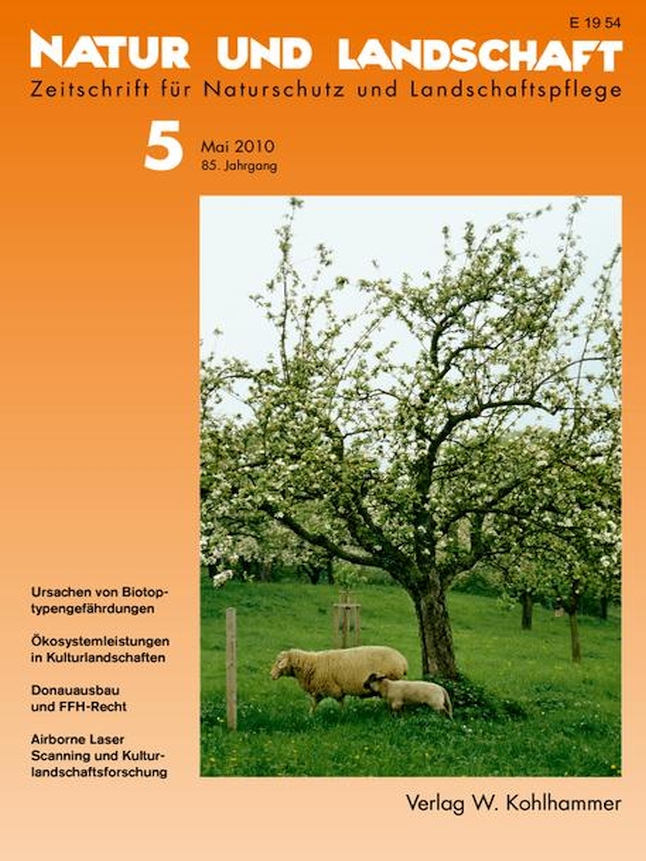
European cultural landscapes are significantly shaped by human activities and provide a multitude of ecological services which benefit human society. In an article published in the May 2010 issue of "Natur und Landschaft", the concept of ecosystem services is evaluated in regard to its limits and potentials to analyse conflicts between land use and nature conservation.
In the first issue of the Renewable Energy Law and Policy Review for 2010, Dominik Müller, fellow at Ecologic Institute and member of Ecologic Legal, reviews "The Renewable Energy Yearbook", edited by Christopher Jones. This yearbook deals with the current state and developments of European politics in the field of renewable energies.
Evolutionary branching has been suggested as a mechanism to explain ecological speciation processes. In this article, the authors use a mechanistic ecological model to examine the influence of demographic stochasticity and environmental fluctuations on the branching process.
Survey of the policy background and the existing regulatory framework for the use of renewable energies in the electricity, heat and transport sectors in Germany.
The Clean Development Mechanism (CDM) should remain in place beyond 2012 and be improved to facilitate more meaningful participation by developing countries in climate mitigation efforts. This is the conclusion reached in an article written by, inter alia, Michael Mehling, President of Ecologic Institute Washington.
The financial and economic crisis that Germany has been going through since 2008 has shed a new light on the pros and cons of economic growth and the methods of measuring welfare. Whereas some indicators indicate that the worst effects of the crisis are behind us, others reveal that we may not have seen the end of the crisis just yet. In the 2/2010 edition of “Berliner Republik”, Benjamin Görlach, Senior Fellow at the Ecologic Institute, discussed how the crisis has played out in different economic indicators, why politics still resort to GDP as the main indicator for economic welfare and what the perspectives are for establishing alternative indicators.
At the end of this year in Cancún, Mexico, a Roadmap for a binding climate agreement should be in place. After finding themselves at the sidelines of what was a disappointing Copenhagen summit, it is even more important that Europeans now inject new life into the negotiations.
The implementation of Germany's highly effective Feed-in-Tariff model (FITM) for the promotion of renewable energy (RE) is a remarkable achievement given the rigid structure of the German political system. The many veto points in the political system cause certain policy inertia -Reformstau- in Germany, making comprehensive policy changes a rare occurrence. In this article, Prof. Dr. Christoph Stefes, Senior Fellow at Ecologic Institute, addresses how Germany's FITM was nonetheless passed in the 1990s, leading to a boom for renewable energy in Germany.
In this article, Ecologic Institute's Max Grünig provides an overview of different definitions of "green jobs" and describes advantages and problems connected with this concept. He emphasizes that it is not enough to create new green jobs, but that every job has to become more environmentally-friendly.
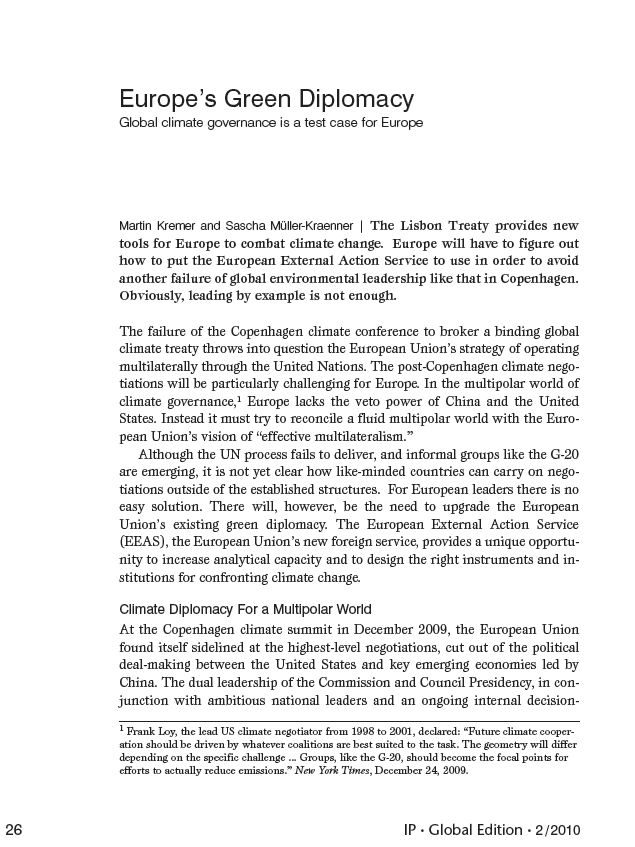
In this article in Internationale Politik, Germany's leading foreign policy magazine, Martin Kremer of the Stiftung Wissenschaft und Politik (SWP) and Sascha Müller-Kraenner, Senior Policy Advisor of Ecologic Institute, discuss the new tools for EU climate foreign policy under the Lisbon Treaty and the possible role of the European External Action Service.
Researchers and the international community today are essentially in agreement: global warming cannot surpass an increase of two degrees Celsius if dangerous, irreversible and uncontrollable consequences for the environment and society are to be avoided. Protection measures taken by the international community are also pursuing this goal, and yet they leave out adequate mandates for the minimisation of green house gas emission.
This article by Christiane Gerstetter, Dominic Marcellino, and Elena von Sperber explores the state of the climate technology transfer negotiations following the COP 15 meeting in Copenhagen in December 2009. The article appears in the Spring 2010 edition of the journal Carbon and Climate Law Review.
The debate about geo-engineering is unstoppable. Strong interests push for research and experimental application. Geo-engineering is a play for time, at best, but always also a dangerous deviation from emission reduction and climate change adaptation. Properly conducted, the debate can help clarify the design of international institutions, argue R. Andreas Kraemer and Ralph Czarnecki of the Ecologic Institute in an article in Internationale Politik, Germany's leading foreign policy magazine.