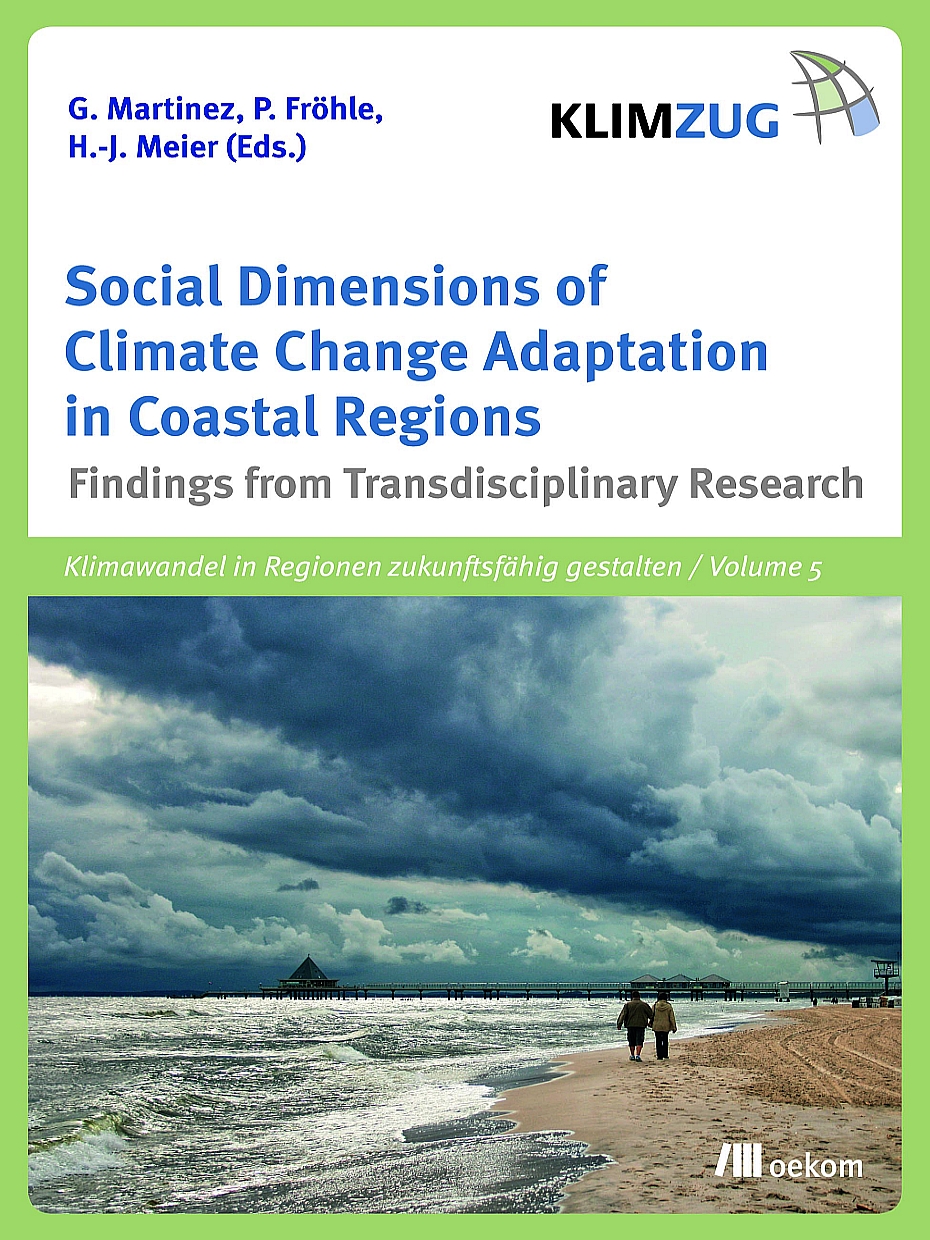
The German Bundesländer Schleswig-Holstein and Mecklenburg-Vorpommern both lie on the Baltic Sea coast. Their attitudes towards a) climate change adaptation and b) the way in which local communities and industries shape their climate change adaptation measures are different. Doris Knoblauch and Dr. Nico Stelljes, both Fellows at Ecologic Institute suggest in their article that there are cultural settings, which influence the perception of climate change and, consequently, the proposed adaptation measures in the two states.
Wunder, Stephanie 2014: "Ökologische Tierhaltung und Naturschutz – Synergien und Konflikte", in: Lieske Voget-Kleschin; Leonie Bossert and Konrad Ott (eds.): Nachhaltige Lebensstile. Welchen Beitrag kann ein bewussterer Fleischkonsum zu mehr Naturschutz, Klimaschutz und Gesundheit leisten? Weimar bei Marburg: Metropolis Verlag für Ökonomie, Gesellschaft und Politik, 202-215.
After the flooding of 2002, many measures for flood protection have been planned and implemented in Germany. However, the next big flooding event in 2013 showed that technical solutions are not sufficient for the protection of houses, land, and people in endangered areas. Alternatively, flood prevention with ecological protection measures should be focused.
Martinez, Grit and Mike K. Orbach 2014: "Küstenschutz – Europa und USA im Vergleich", in: Heike Leitschuh et al. (eds.): Jahrbuch Ökologie 2015. Re-Naturierung. Stuttgart: S. Hirzel Verlag, 214-222.
Blobel, Daniel et al. 2014: "RADOST – Regionale Anpassungsstrategien für die deutsche Ostseeküste", in: Hendrik Bieberler et al. (eds.): Wege zur Anpassung an de Klimawandel. Regionale Netzwerke, Strategien und Maßnahmen. Köln: Institut der deutschen Wirtschaft Köln Medien GmbH, 21.
Evaluation and monitoring is a crucial part of the German energy transition (Energiewende), especially for the National Climate Initiative, which supports climate-friendly behavior among businesses, consumers, and local authorities. In this book chapter, the authors provide an insight into the the National Climate Initiative, its evaluation approach and lessons learnt for following programmes.
In this book chapter, R. Andreas Kraemer offers insights to the functional aspects and challenges in the Ecologic Institute organization, in both a German and European context. After presenting strategies like network cooperation, and internal structures, e.g. the "Fluid Matrix Organization" of the staff, R. Andreas Kraemer highlights policy successes regarding water or nuclear power policy.
Energy subsidies come in many shapes and forms. Reducing them is a rare win-win. Both public budgets and the climate would profit. In this book chapter, Frans Oosterhuis and Katharina Umpfenbach are digging into the conundrum why energy subsidy reform remains slow across the world despite its obvious benefits.
Van Dongeren, A., Ciavola, P., Viavattene, C., De Kleermaeker, S., Martinez, G., Ferreira, O., Costa C., R. McCall, 2014. RISC-KIT: Resilience-Increasing Strategies for Coasts–toolkit. In: Green, A.N. and Cooper, J.A.G. (eds.), Proceedings 13th International Coastal Symposium (Durban, South Africa), Journal of Coastal Research, Special Issue No. 70, pp. 366–371, ISSN 0749-0208.
Dr. Stephan Sina, lawyer and Senior Fellow at Ecologic Institute, commented on the provisions regarding closed cycle management of bio-waste and sewage sludge (section 11 KrWG) and quality assurance in the field of bio-waste and sewage sludge (section 12 KrWG) in a new legal commentary on the Closed Cycle Management Act (Kreislaufwirtschaftsgesetz, KrWG). The legal commentary, edited by Jahn/Deifuß-Kruse/Brandt, was published by Kohlhammer in February 2014. It provides guidance to lawyers, administrative agencies, and waste management companies with respect to the application of the new Closed Cycle Management Act.
Climate change is perceived as a problem by most stakeholders (policy makers, administrations and civil society) on the Baltic Sea Coast. However, they do not agree on how to deal with it. Nico Stelljes, Doris Knoblauch, Robin Körth and Grit Martinez sum up the findings of different surveys and interviews and compare them in their article. Within the RADOST project, several stakeholders on the Baltic Sea Cost were interviewed using different methodologies. The topic of interest for all the surveys and interviews was stakeholders' views on adaptation to climate change on the Baltic Sea Coast.
Beese, Karin; Haller, Inga; Müncheberg, Rieke: Alle auf einmal und jede(r) für sich. Klimaanpassungskommunikation im Rahmen einer Veranstaltungsreihe. In: Beese, Karin et al. (eds.) 2014: Anpassung an regionale Klimafolgen kommunizieren. Konzepte, Herausforderungen und Perspektiven. [KLIMZUG-Reihe: Klimawandel in Regionen zukunftsfähig gestalten 2]: oekom Verlag.