This document presents main takeaways and insights from a workshop organised by the Ariadne Project in Brussels on 30 November 2022. The workshop convened experts from seven organisations that operate carbon market models – academic institutions as well as carbon market analysts.
The report maps out four policy avenues for how the EU could attain climate neutrality. The policy avenues consist of a mix of policy instruments sequenced over time, and the institutional arrangements to deliver them. Each policy avenue embodies a different paradigm, i.e., a different approach to (climate) policymaking. They thus sketch different paths that the EU could follow to align its climate policy with the goal of climate neutrality by 2050.
With the Fit-for-55 package about to be put into law, and the RePowerEU plan adopted in response to the energy crisis, EU climate and energy is undergoing the most profound change in years, getting the EU on track to a post-fossil energy system. In a three-day series of events, partners from the Ariadne research project presented key insights from their work that is relevant for the further development of EU climate and energy policy, and discussed these with representatives from political institutions, academia, civil society and business. The events served to share research insights, to discuss and validate findings and their relevance for EU policy process, and to gather inputs for further research.
While policymakers are currently mulling over the EU-ETS reform, it is a good time for analysts and scientists to take a step back and discuss the analytical tools used to project the outcome – specifically, the expected, predicted or necessary carbon price(s) towards 2030. To that end, the Potsdam-Institute for Climate Impact Research (PIK) and Ecologic Institute organised a workshop in Brussels on 30 November 2022.
This event discussed how stable long-term policy direction can be maintained despite uncertainties, and in this context will zoom into the role of long-term strategies and scientific climate advisory councils. To exchange views on these tools with each other and the audience, Climate Recon 2050 and ARIADNE have brought together several experienced practitioners.
This report discusses the potential role of green hydrogen in achieving a climate-neutral economy, focusing on sectors where electrification is challenging. It highlights the necessity for green hydrogen to be produced using renewable energy to align with climate neutrality goals. The report outlines necessary components for establishing a global market, including tracking systems, standards, and governance mechanisms to ensure compliance and foster international trade.
This document outlines detailed information on stakeholder engagement activities within the ALL-Ready project. The objective of the stakeholder engagement plan is to guarantee a coordination and alignment of stakeholder engagement during all project activities.
A democratic dialogue with a broad spectrum of stakeholders and the society is considered necessary for the transformation to a sustainable bio-based economy. As such, several dedicated bioeconomy strategies across Europe and beyond outline objectives towards broader stakeholder and public engagement. In this book chapter Zoritza Kiresiewa, Laurens Duin and Holger Gerdes address the degree of participation and the role of the individual actor groups and society in strategy development processes and recommend concrete actions for more inclusive and effective stakeholder and public engagement.
The report looks at how the system generates income for Member States and how they spent this money over the 2013-2021 period. WWF's analysis finds the current system is full of flaws and that significant changes are needed – including much stricter rules on how EU countries spend their ETS cash. Ecologic Institute's Isabel Haase contributed to the report.
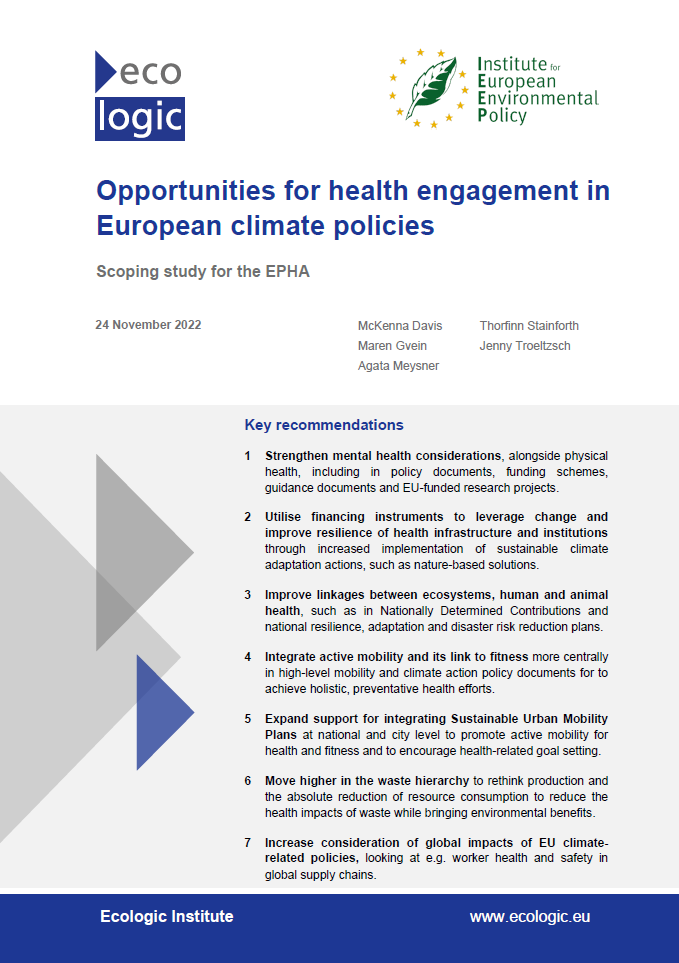
This paper, produced jointly by Ecologic Institute and IEEP for the European Public Health Alliance (EPHA), scopes 20 EU policy documents focused on adaptation, biodiversity, water, waste, mobility, and cross-cutting topics to analyse their treatment of health in the broader context of climate mitigation and adaptation policy. The purpose was to assess their integration of health-related concepts in order to identify gaps and opportunities, as well as provide recommendations for further advocacy for the health community.
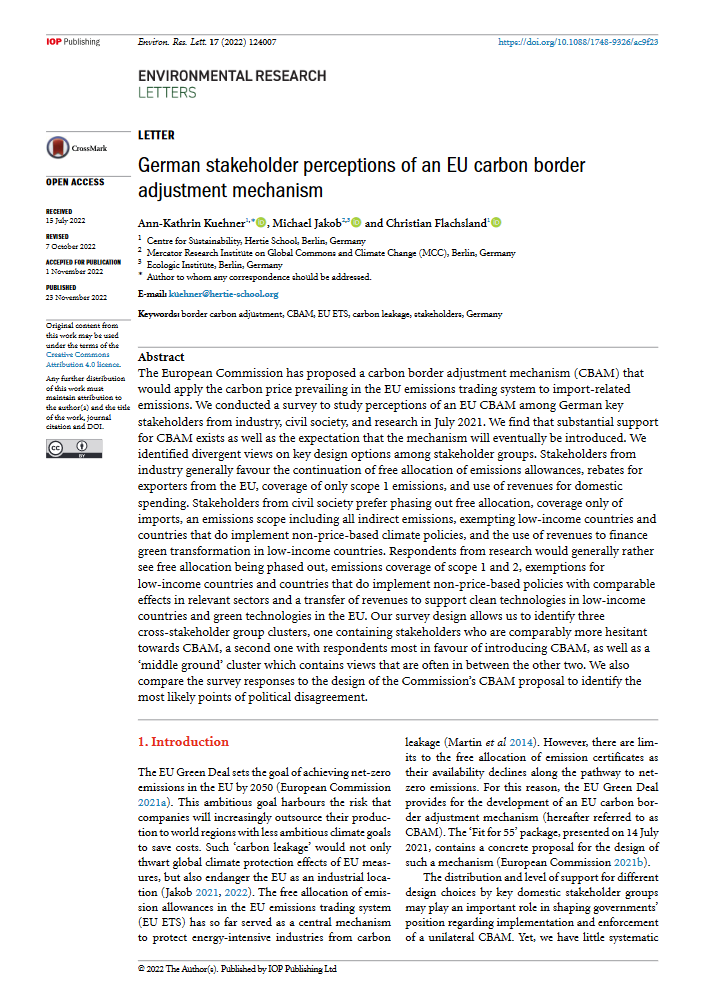
The European Commission has proposed a carbon border adjustment mechanism (CBAM) that would apply the carbon price prevailing in the EU emissions trading system to import-related emissions. In July 2021, the authors, including Dr. Michael Jakob of Ecologic Institute, conducted a survey to study perceptions of an EU CBAM among German key stakeholders from industry, civil society, and research. They find that substantial support for CBAM exists, as well as the expectation that the mechanism will eventually be introduced. Divergent views on key design options were found among stakeholder groups.
On 21 November 2022, Ecologic Institute kick-started a new webinar series for young people in Europe. Participants entered the dialogue with the webinar hosts Ewa Iwaszuk and Aaron Best from Ecologic Institute and their expert guests Adam Wallin from We Don’t Have Time and Stefan De Keersmaecker, Coordinating Spokesperson for the European Green Deal from the European Commission to discuss what the European Green Deal means for young people in Europe.
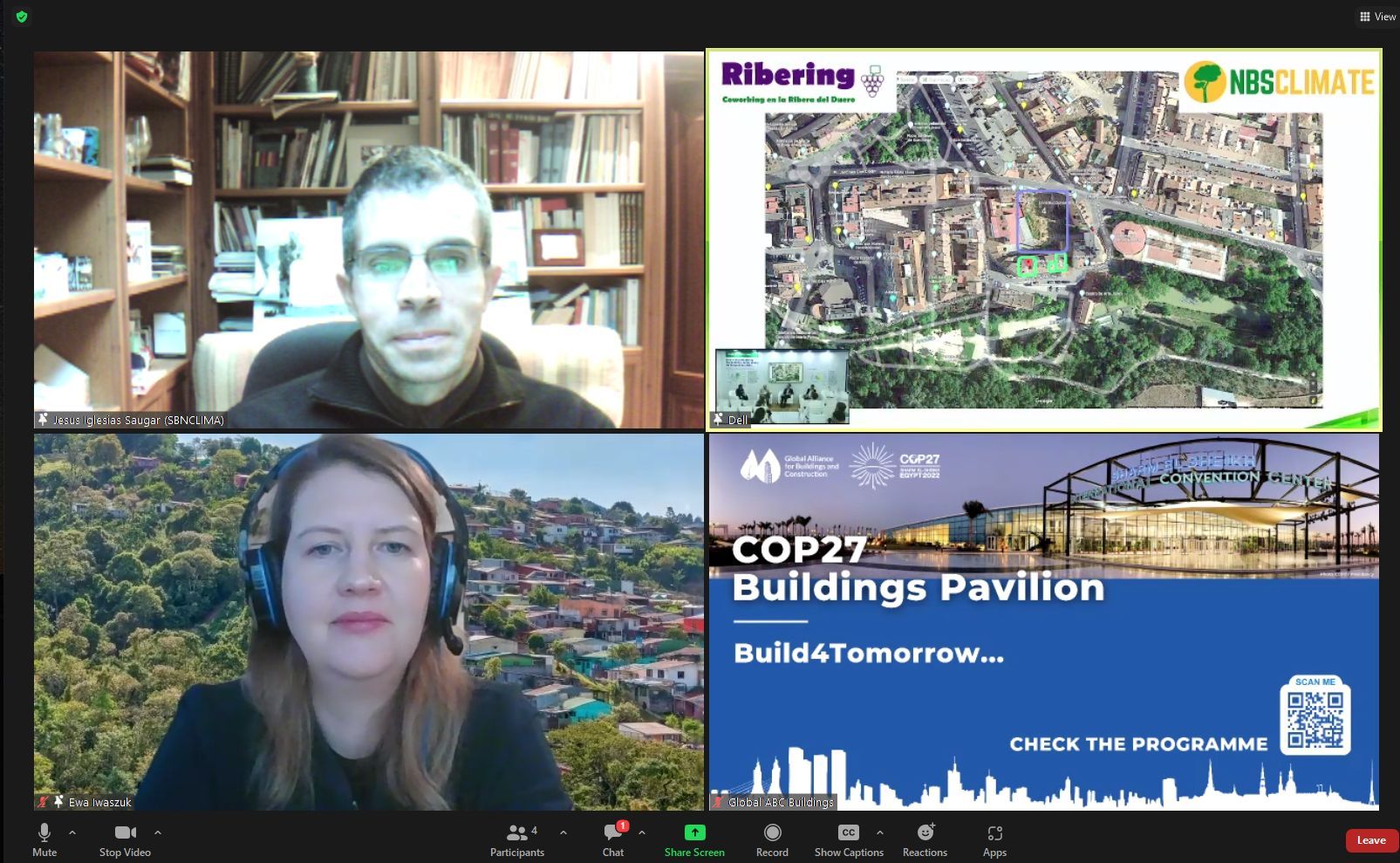
Ewa Iwaszuk, a Fellow at Ecologic Institute, held a presentation "Policy instruments to promote implementation of nature-based solutions" at a side-event "Nature-based solutions for building performance" during the global climate conference COP27 in Sharm-el-Sheikh (Egypt). Ewa's presentation made the case that policy instruments and their governance act as critical enablers or barriers to adoption of nature-based solutions. She presented the Urban Governance Atlas that Ecologic Institute is currently developing in the frames of the INTERLACE project and discussed good practice examples of policy instruments from around the world that support the implementation of nature-based solutions at a building level.
This paper provides an overview of the process of developing an LTS and its challenges, examines the support available for countries undergoing this process, and presents some ideas on how the G20 could raise the political profile of the strategies. It has been included as input into the T20 process preceding the 2020 summit.
A research team including Arne Riedel from Ecologic Institute examines the political agency of transnational city alliances – particularly the Arctic Mayors' Forum (AMF) – and their contribution to sustainable urban development in the European Arctic.