Lough Erne sustains multiple competing activities, each with different demands from the system in terms of ecosystem services and physical resources. It is a heavily modified water body, containing a range of non-native Invasive Alien Species (IAS) are considered a threat to Lough Erne biodiversity and also negatively affect the society that surrounds it. In this report, we apply the AQUACROSS Assessment Framework to understand this challenge and identify and assess ecosystem-based management solutions to the challenge of the IAS Nutall’s pond weed. The case study is available for download.
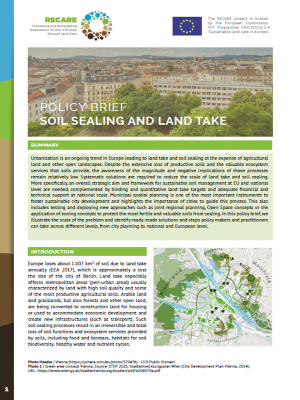
Despite the extensive loss of productive soils and the valuable ecosystem services that soils provide, the awareness of the magnitude and negative implications of these processes remain relatively low. In this RECARE policy brief, Ecologic Institute's Sandra Naumann and Ana Frelih-Larsen together with Gundula Prokop from the Austrian Environment Agency illustrate the scale of the problem and identify ready-made solutions and steps policy makers and practitioners can take across different levels, from city planning to national and European level. The RECARE policy brief is available for download.
Wind and water carry our carelessly thrown things even into the Arctic. If we handle waste in Germany more consciously, we relieve the unique Arctic environment. This postcard is part of a series of three postcards that provide information on how the daily consumption of energy and raw materials in Germany can affect the Arctic. The postcards were developed by Ecologic Institute for the Federal Environment Agency within the project "Environmental Guidelines for a German Arctic Policy".
Freshwater ecosystems in the Swiss plateau are threatened by multiple stressors that deteriorate water quality and hydromorphology. To restore these ecosystems and stop the biodiversity decline, multiple management measures will be implemented over the next decades. We propose methods for a spatial and temporal prioritisation to coordinate measures from different sectors and maximise their effectiveness while considering other societal needs. The case study is available for download.
Over the past three years, the AQUACROSS Assessment Framework was developed, tested, and applied in eight case studies across Europe to solve local biodiversity challenges. Finally, results from each Case Study were published in a 30-page case study report and 3-page executive summary report. The case study is available for download.
The term illiberal democracy is used often. This is a problem. The term "illiberal democracy" makes it invisible that democracy is dismantled in so-called "illiberal democracies". Nils Meyer-Ohlendorf, Head of International and European Governance at Ecologic Institute, and Michael Meyer-Resende, both co-founders of Democracy Reporting International, argue in the Süddeutsche Zeitung that the appropriate terms are undemocratic or authoritarian.
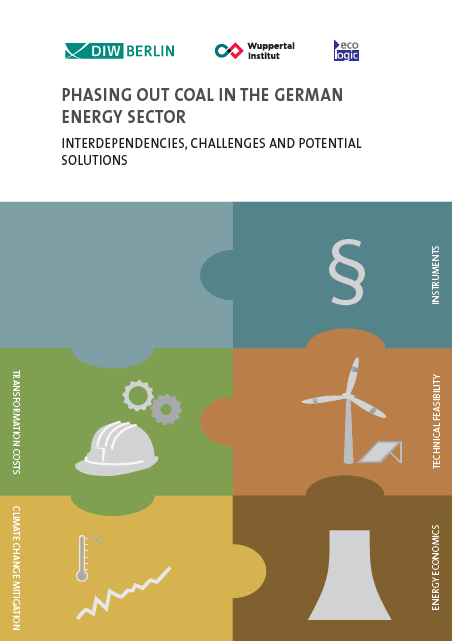
In this press briefing, the "Coal Reader" is presented. It has been developed by the German Institute for Economic Research (DIW), Wuppertal Institute, and Ecologic Institute. The "Coal Reader" presents options and implications of a phase-out of coal-fired power generation in Germany. It provides facts, explains the pros and cons, and shows the respective scientific background.
In January 2019, Germany made a big step towards a coal phase-out: A stakeholder commission established by the federal government agreed on a schedule for plant retirement and on measures to support coal regions. For experts and journalists seeking to understand the context of the phase-out decision, scientists from the German Institute for Economic Research, Ecologic Institute, and the Wuppertal Institute have developed a comprehensive reader detailing what is at stake. The publication explains why the phase-out is needed and how it can become a success.
The short analysis by Mandy Hinzmann gives an overview of the different positions on laboratory-produced artificial meat and shows the lines of argumentation of different stakeholder groups in Germany. The study is available for download.
Which trends and developments characterise the energy system? How are digital technologies and data-based business models changing the energy system? What challenges do different actors face? These questions are the subject of a short study written by the Ecologic Institute on behalf of the Heinrich Böll Foundation.
Ecologic Institute contributed to the Agenda Conference for Social-Ecological Research (SÖF) by leading on and supporting research theme clusters. The event took place in Kassel on 19 and 20 September. It ended with an outlook by Florian Frank from the German Federal Ministry of Education and Research (BMBF), who called for "dangerous" research to solve pressing socio-ecological problems.
The topic of sustainable nutrition is increasingly relevant in political, scientific and media debates. In this context, there are different perspectives and motivations surrounding the topic. Within the project "Wissenschaftliche Koordination der Fördermaßnahme Nachhaltiges Wirtschaften" (NaWiKo), Ecologic Institute will organize a workshop on "Sustainable nutrition systems and sustainable nutrition culture – Action approaches for transformative processes and practices" on 26 September 2018 in Berlin.
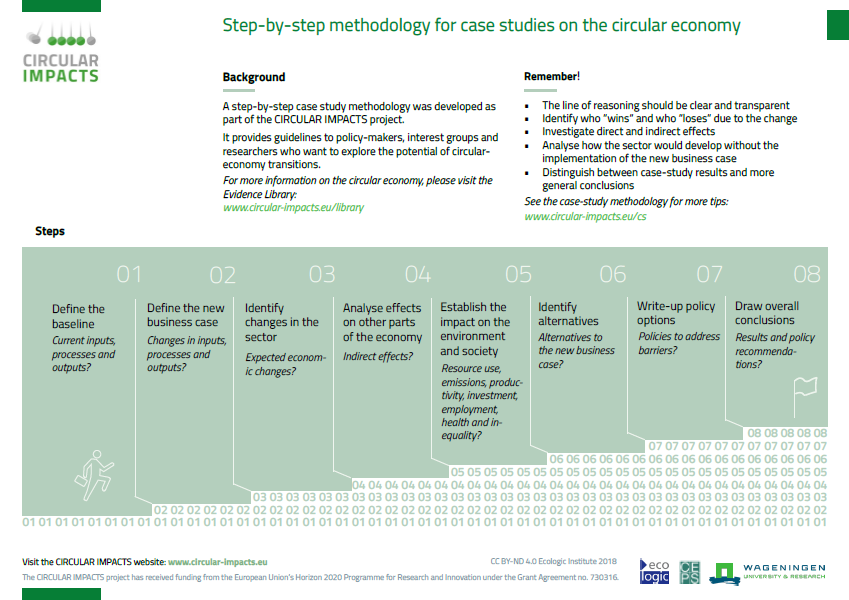
This infographic provides guidelines to policy-makers, interest groups and researchers who want to explore the potential of circular-economy transitions by conducting case studies. It visualizes the step-by-by step methodology developed within the CIRCULAR IMPACTS project in an intuitive way. It also highlights the most important aspects to consider when preparing such case studies.
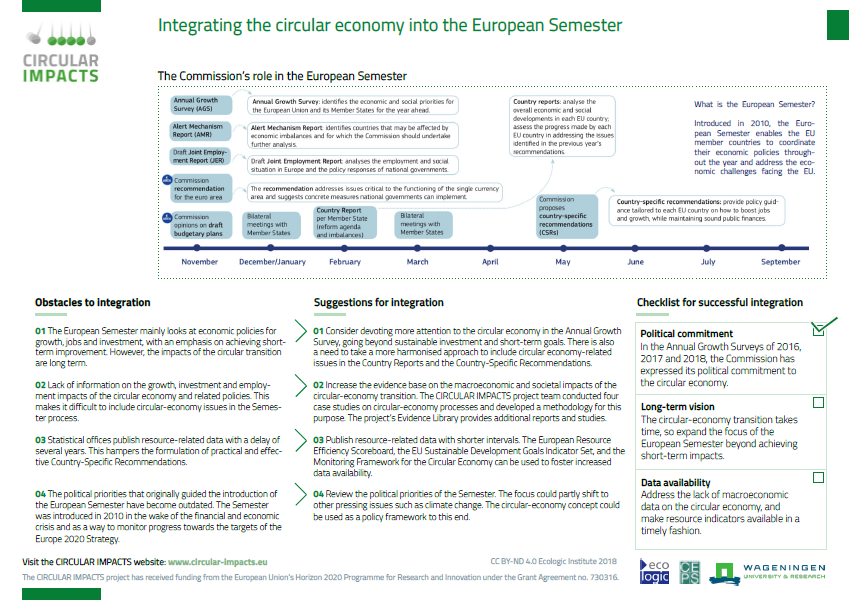
This infographic focuses on how the circular economy can be integrated into the European Semester. It illustrates the European Commission's role within the process and identifies obstacles to integration, along with possible suggestions to address these obstacles. Additionally, it provides a checklist for successful integration.