NetBiome-CSA is a European funded project that aims to extend and strengthen research partnerships and cooperation for the smart and sustainable management of tropical and subtropical biodiversity in Outermost Regions (ORs) and Overseas Countries and Territories (OCTs). The NetBiome Network, with the participation of Ecologic Institute, has developed a Strategic Document that compiles a series of policy and research priorities for improving knowledge about biodiversity and the practice of biodiversity governance in the EU ORs and OCTs. The priorities emerged from participatory processes within NetBiome-CSA. The document is available for download.
The TRAFIS project investigates the development of climate resilient and resource-conserving infrastructures through the lens of transition and action research. The project focuses primarily on interlinked infrastructures.
Ahrensfelde was a "city of the future" as part of the project "City of the future - living together sustainably" and creates a vision about what the community should look like in 2030 and beyond. In order to develop the vision, a survey was conducted among the citizens of Ahrensfelde in November 2015. Doris Knoblauch presented the results of the survey at a town hall meeting on the 30 November 2015 and she also moderated the evening.
Climate adaptation innovations could significantly reduce Europe's exposure to climate hazards such as droughts, floods, and extreme weather. However, many innovations fail to reach the market because innovators lack the funds and ability to turn their prototypes into market-ready products. BRIGAID is a four year Horizon 2020 research project that aims to bridge the gap between prototype and market. It supports innovators to test and implement their innovation and develop their business. By developing practical tools and methods, BRIGAID aims to further climate adaptation innovation and ultimately reduce the impact of climate change in Europe.
This study, carried out by Ecologic Institute, provides a set of tools, policy frameworks, and contextual information that can help Local and Regional Authorities (LRAs) to develop and initiate their own programs towards successful reaching the Europe 2020 strategy's goals. The study is available for download.
<p>The overall aim of this project is to support the Committee of the Regions (CoR) in the analysis of legislative reviews in the area of energy market with a focus on the most relevant provisions for cities and local and regional authorities (LRAs). This analysis is carried out by CE Delft, ICLEI and Ecologic Institute.</p>
On Saturday, 23 April 2016, 15 children and young adults between the ages of 10 and 17 from different parts of the Ahrensfelde municipality met to participate in a creative workshop. The goal was to create a vision of how their community should develop sustainably until 2030. The day-long workshop was organized by Ecologic Institute in cooperation with the Hochschule Eberswalde, the youth coordinator of the community and the municipality.
Increasing material use efficiency is important to mitigate future supply risks and minimize environmental impacts associated with the production of materials. The policy mix presented in this paper aims to contribute to reducing the use of virgin metals in the EU by 80% by 2050 without significantly shifting burdens to other material resources, the environmental or other parts of the world. The article, which was written with the collaboration of Dr. Martin Hirschnitz-Garbers (Senior Fellow at Ecologic Institute), is available for download.
The project, "Policy Mix for an Updated Adaptation Action Plan," aimed at developing science-based recommendations for the update to the Adaptation Action Plan of the German Strategy for Adaptation to Climate Change. The focus was on the compilation and evaluation of potential adaptation measures and political instruments to further their implementation. The final report of this project is available for download.
A new report by the Ecologic Institute makes concrete proposals for reforming the EU Effort Sharing Decision (ESD). A reduction target for 2050 as well as a robust review and target adjustment mechanism are highlighted as the main reform proposals. The report also touches on proposals for enhancing the flexibility of the ESD. The report is available for download.
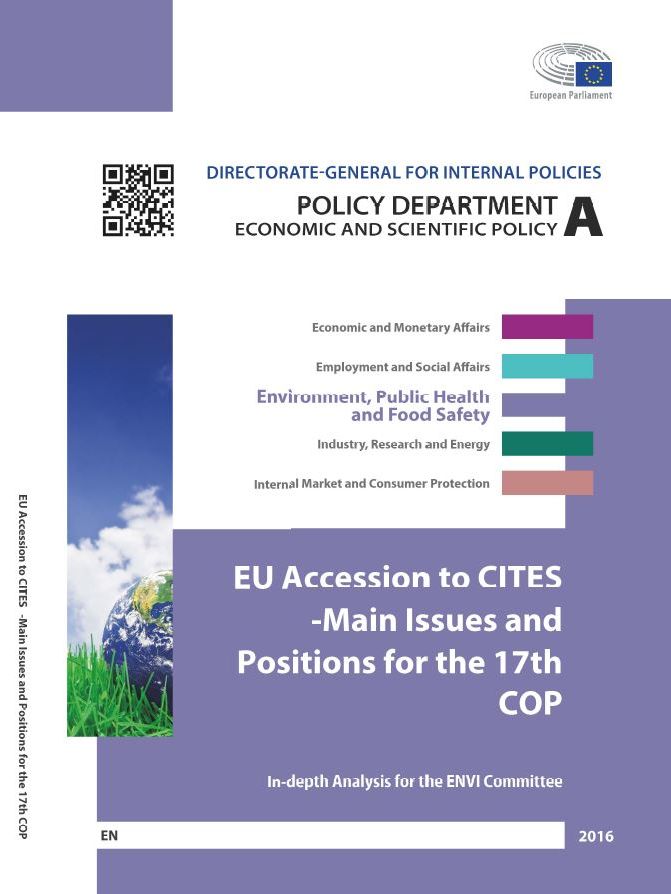
On 19 April 2016, Stephan Sina and Christiane Gerstetter, Senior Fellows at Ecologic Institute, presented a study on wildlife crime to the Committee on the Environment, Public Health and Food Safety (ENVI) of the European Parliament in Brussels. The study was compiled by a consortium lead by Ecologic Institute and published recently on the European Parliament's website. The presentation is available for download.
According to Chinese authorities, the coronavirus spread to humans from wildlife at a wildlife market in Wuhan. Most likely, Ebola and AIDS also originated from wildlife. Besides the serious threats to biodiversity and sustainable development, the risk for human health is thus an additional reason to strengthen the efforts to combat wildlife trafficking and other forms of wildlife crime. Over the last years, Ecologic Institute has published several studies on environmental compliance and crime related to wildlife crime. The most comprehensive study on wildlife crime was presented to the Committee on the Environment, Public Health and Food Safety (ENVI) of the European Parliament in Brussels in April 2016.
The Ecologic Institute, together with a consortium, conducted a study on wildlife crime, which gives an overview over the state of wildlife crime in Europe. As as a basis for this study, in-depth analyses were carried out for five EU member states. Ecologic Institute conducted the in-depth analysis of wildlife crime in Germany. The analysis concludes that Germany is not a main destination for illegal wildlife products from iconic species, but still an important destination for live animals like reptiles for the pet market. It is also an important transit country for ivory and other illegally traded animal parts from Western and Central Africa with East and South-East Asia as the main region of destination. The studies were compiled on behalf of the European Parliament and are available for download.
On 21 April 2016, the final conference of the EU-FP7 funded project “POLIMP” took place in Brussels. How can climate policies be designed, what impacts do they have and what other options are there? These are important questions to stakeholders and policy-makers. The project POLIMP aims at making answers to these issues more easily accessible and understandable. To this end, POLIMP examines knowledge gaps for different policy and decision making levels and covers these with the help of existing research results.
This chapter examines the complex interactions between society and the environment in the Atlantic Space. Ecologic Institute authors highlight examples of cooperation, leadership and the increasing polycentrism of Atlantic environmental governance. It is part of a publication that gathers insights from over four years of EU funded research within the scope of the Atlantic Future research project. The full publication is available for download.