Meyer-Ohlendorf, Nils, Aaron Best; Michael Mehling et. al. 2009: The Green New Deal. Finanz- und Wirtschaftskrise als Chance für eine ökologische Wirtschaftspolitik. Berlin.
Sustainability of biofuel policies is a largely debated issue, particularly with regards to environmental impacts. To address these issues, European and national legislative initiatives have been designed that aim to ensure the sustainability of biofuels. Germany has been among the top runners in trying to implement sustainability criteria for biofuels. In August 2009 the German government set up the Biomass-electricity-sustainability ordinance ("Biomassestrom-Nachhaltigkeitsverordnung", abbreviated "BioSt-NachV"). The background paper written by the Ecologic Institute in October 2009 provides an overview for plant operators who will need to proof their compliance with the new ordinance.
German water policy-making, analysed in this article by Wolfgang Rüdig and R. Andreas Kraemer of Ecologic Institute, defies easy categorisation. Policy processes are highly complex, fragmented, and diverse. In the areas of drinking water supply and water pollution, the most important feature is the enormous importance of regional and local government in both policy formulation and implementation.
The German Packaging Ordinance of 1991 marked one of the first attempts to introduce the concept of producer responsibility into environmental policy. In this article, Tilman Eichstädt, Alexander Carius, and R. Andreas Kraemer of Ecologic Institute use policy network analysis to assess policy outcomes as well as the environmental and economic efficiency of the German packaging policy.
Since 2007, on initiative by the European Parliament, the European Commission (DG Relex) has sponsored transatlantic dialogues with a view to developing new approaches for handling global challenges. A conference in Brussels on 16 November 2009 reviewed the results of the first 5 pilot projects. R. Andreas Kraemer presented the outcomes of the Arctic Transform dialogue initiated by Ecologic Institute.
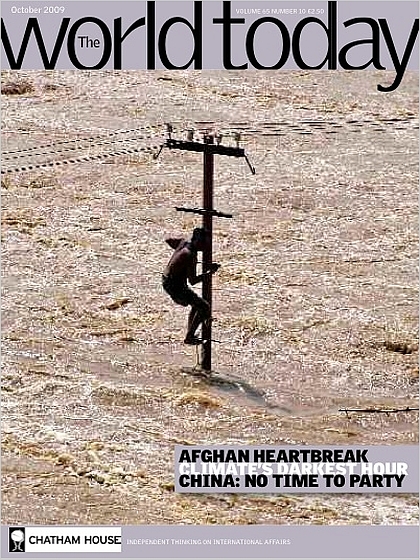
Deforestation is responsible for roughly one fifth of global carbon emissions, most of it in the tropical forests of the developing world. At the Copenhagen climate talks, negotiators discussed a potential new mechanism to compensate nations for keeping their forests intact. The article by Duncan Brack and Katharina Umpfenbach looks at these REDD proposals (Reducing Emissions from Deforestation and Degradation), arguing that carbon finance alone might not be enough to stop deforestation – unless part of it is spent upfront on improving forest governance.
In a consortium of five research institutes, Ecologic Institute evaluated the effects of the national climate initiative (NKI). With an annual volume of 280 million Euros, this initiative represents a cornerstone of Germany's efforts at climate protection. In the course of the evaluation, the consortium assessed in what way the supported projects have contributed to Germany's climate policy targets. Ecologic Institute covered a range of projects, including the fields of low-carbon transport, industrial transformation and biomass use.
Water resource licensing is increasingly becoming a cornerstone of integrated water resources management (IWRM). Licensing and other allocation mechanisms are important because they determine who gets access to water and provide a means of managing water fairly, efficiently and sustainably. As water grows scarce in an increasing number of countries, there is a significantly greater risk of corruption in the water licensing process. These risks, and their underlying factors, are not well understood. The authors of the report explore the nature of the risk of corruption using a 2007 field study, with Chile and Kazakhstan as case studies.
Under the title "Setting the Course for the Future, not Nursing a Hangover – After the Copenhagen Debacle, Europe Needs an Effective Strategy for Climate Negotiations", Sascha Müller-Kraenner, Senior Policy Advisor at the Ecologic Institute, suggests options for the future external climate policy of the European Union. The article (in German) is available exclusively online from Internationale Politik, Germany's leading foreign policy magazine.
This working paper affirms that emissions trading systems currently under development in the US raise certain challenges for an operational market link, but are not generally incompatible. Specifically, certain design elements of trading systems may give rise to concern, such as cost containment provisions and borrowing and offset provisions.