To achieve the EU's goals, we need to rethink mobility from the ground up. This involves many aspects, including electric mobility, walking, cycling and public transport. The second episode of the "Green Deal – Big Deal?" podcast examines the challenges and issues that the mobility transformation needs to address, including environmental problems like climate change and air pollution.
Climateurope2 is a 4.5-year Horizon Europe project that addresses the need for timely delivery and effective use of climate information. The project aims to support the climate services community and propose standardisation procedures for future equitable and quality-assured climate services, useful for decision making in all sectors of society.
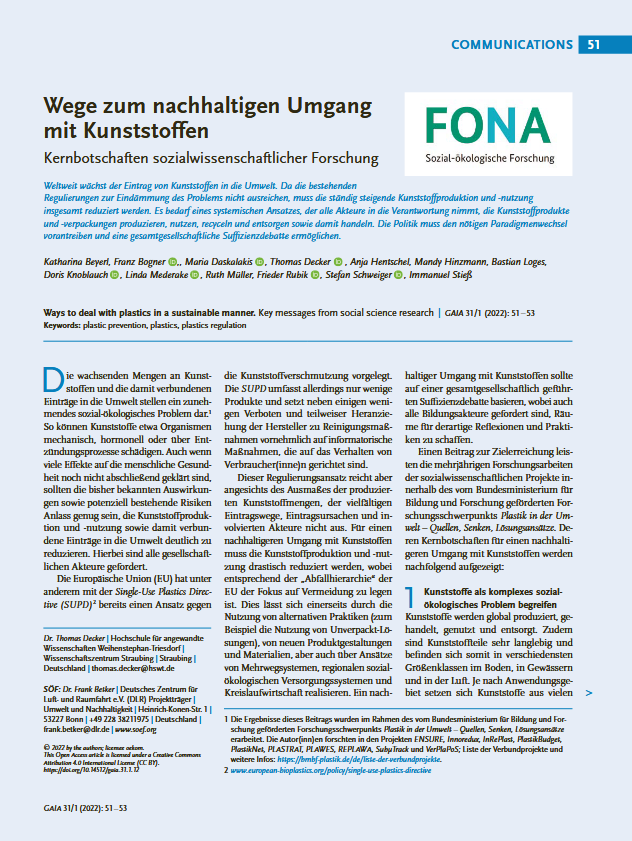
This brochure summarizes the most important key messages from 20 joint research projects and seven cross-cutting topics of the German research focus "Plastics in the Environment". The brochure is structured along the life cycle of plastics and includes five sections: Green Economy, Consumption, Recycling, Fresh-water Ecosystems, and Saltwater Ecosystems.
The publication summarizes the key messages from all 20 joint research projects and the seven cross-cutting topics of the German research focus "Plastics in the Environment". Structured by main topics, the central results are presented in order to derive recommendations for various addressees. More than 70 researchers and practitioners from across the research focus have jointly co-authored the key messages.
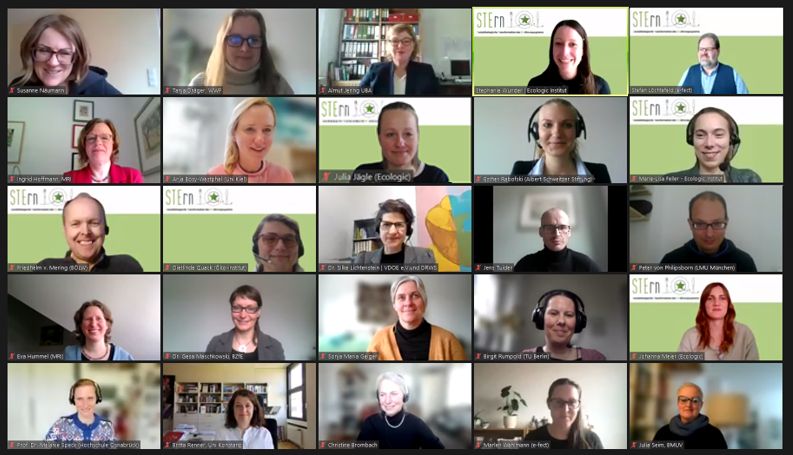
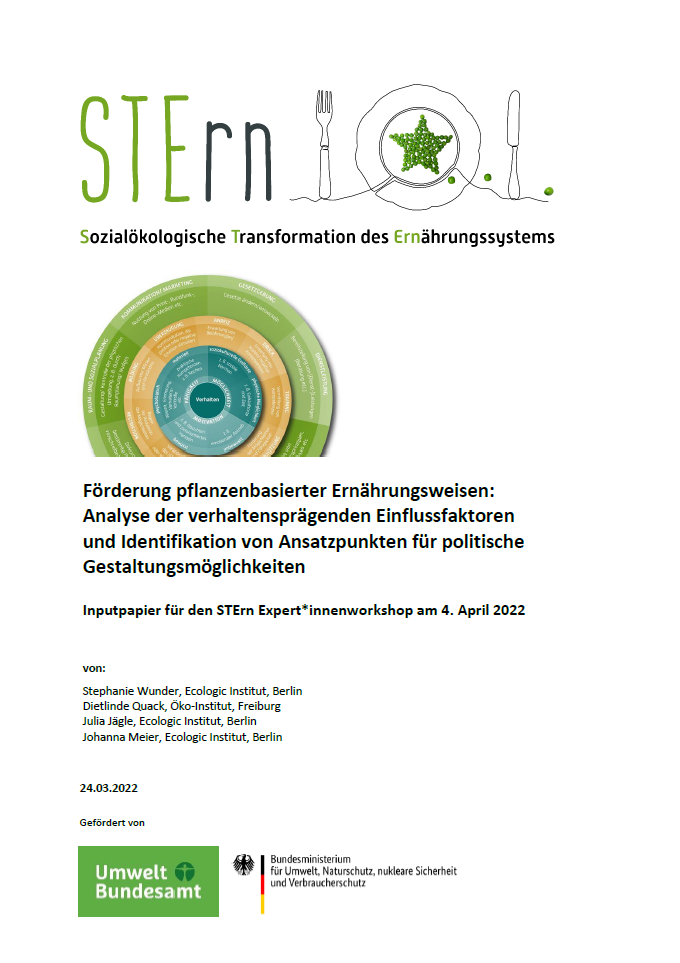
On the 4 April 2022 another online workshop on the socio-ecological transformation of the food system in Germany took place as part of the STErn project led by Ecologic Institute. The aim of the event was to discuss with 35 experts main behavioral drivers that are relevant for increasing diets that are more plant-based and declining the consumption of animal products. On this basis, policy options in Germany were evaluated and discussed.
The emission of plastics into the environment is growing worldwide. Since existing regulations are not sufficient to curb the problem, the ever-increasing plastic production and use must be reduced overall. A systemic approach is needed that holds all actors responsible who produce, use, recycle, dispose and trade in plastic products and packaging. Policymakers must drive forward the necessary paradigm shift and facilitate a debate on sufficiency in society as a whole.
The transition to renewable energies and persistent bottlenecks in the German transmission grid represent key challenges for the German electricity supply system in terms of the need for security of supply. A so-called capacity mechanism could be an important solution to this. On behalf of the four German transmission system operators (TSOs) Amprion GmbH, TenneT TSO GmbH, 50Hertz Transmission GmbH and TransnetBW GmbH, the foundations of a capacity mechanism for the German electricity market that is compatible with the European legal framework for the energy market and European state aid law are therefore to be developed. In an interdisciplinary research team led by Consentec, the Ecologic Institute is responsible for examining energy law issues in the project.
This final report assesses the Extended Producer Responsibility (EPR) provisions of the SUP-Directive with a view to its implementation in the Member States. The focus of this analysis lays on those aspects that represent novelties as compared to other EU legislation on EPR, and thus raise legal questions that have not been addressed before, especially regarding the cleaning up of litter from relevant SUP products.
R. Andreas Kraemer, founder of the Ecologic Institute and co-chair of the investment committee of the Ökovision Fund, puts it in a nutshell: "Neither nuclear power nor coal can replace gas or oil from Russia, and right now it is becoming clear how important energy efficiency and renewable energies are. We at Ökovision are counting on this and see no reason to reconsider our strict criteria". The article in the magazine "Finanztest" also shows that there are large grey areas in sustainable investment because criteria are formulated and applied differently. Especially with index funds or ETFs, investors cannot be sure how their money is invested.
This paper discusses main behavioral drivers that are relevant for increasing diets that are more plant-based. The analysis of influencing factors aims to identify effective starting points where policy instruments can be applied in Germany to achieve changes in dietary patterns across the population as effectively as possible and to reduce the consumption of animal products. The result is a pre-structured collection of potentially effective policy approaches.
The consumption of dairy, eggs and meat causes damage to the environment in various places in the supply chain, such as climate change, eutrophication and the emission of harmful substances such as ammonia (which contributes to nitrogen problems) and particulate matter. The TAPP Coalition (True Animal Protein Price Coalition) requests a European-oriented policy proposals to pass on the price of dairy, eggs and meat so that it reflects the actual costs to society and to calculate these for economic and environmental effects for the EU-27 involving two case studies for Germany and France.
The central objective of the work presented in this report was to assess the European Commission's Strategic Long-Term Vision and supplementary materials and reflect on them in light of state-of-the-art sector analyses.
On the afternoons of 29 and 30 June 2022, a two-part online workshop was held as part of the project "Information and teaching materials for an environmentally conscious use of human pharmaceuticals". The workshop was titled "Embedding the topic 'Pharmaceuticals in the Environment' in pharmaceutical and medical university teaching as well as in continuing education and professional training", and discussed with stakeholders different approaches to foster the uptake of this topic in teaching curricula.
In the framework of the scientific accompanying research (PlastikNet) of the research focus "Plastics in the Environment – Sources • Sinks • Solutions" (Plastik in der Umwelt – Quellen • Senken • Lösungsansätze) Ecologic Institute coordinates 20 joint research projects, which deal with plastics in the environment funded by the Federal Ministry for Education and Research (Bundesministerium für Bildung und Forschung, BMBF). This fact sheet series condenses the joint research project findings and presents them consistently in the project design.
As the war in Ukraine escalates, the climate crisis continues. But environmental policy in particular could build important bridges, reminds Dr. Camilla Bausch Scientific & Executive Director of Ecologic Institute. In an interview with Elisabeth von Thadden, she discusses, among other things, the environmental impact of the war and the dichotomy over Ukraine's demand to the secretariats of thirteen major international environmental agreements to exclude Russia from relevant decision-making bodies and suspend Russian membership in the agreements.