This policy brief examines how current climate-action rewarding mechanisms address – or fail to address – organic farming as a systemic and climate-resilient approach. It analyses existing monetary, regulatory and supportive instruments at EU level, with a particular focus on the Common Agricultural Policy (CAP) and the Carbon Removal and Carbon Farming (CRCF) Regulation.
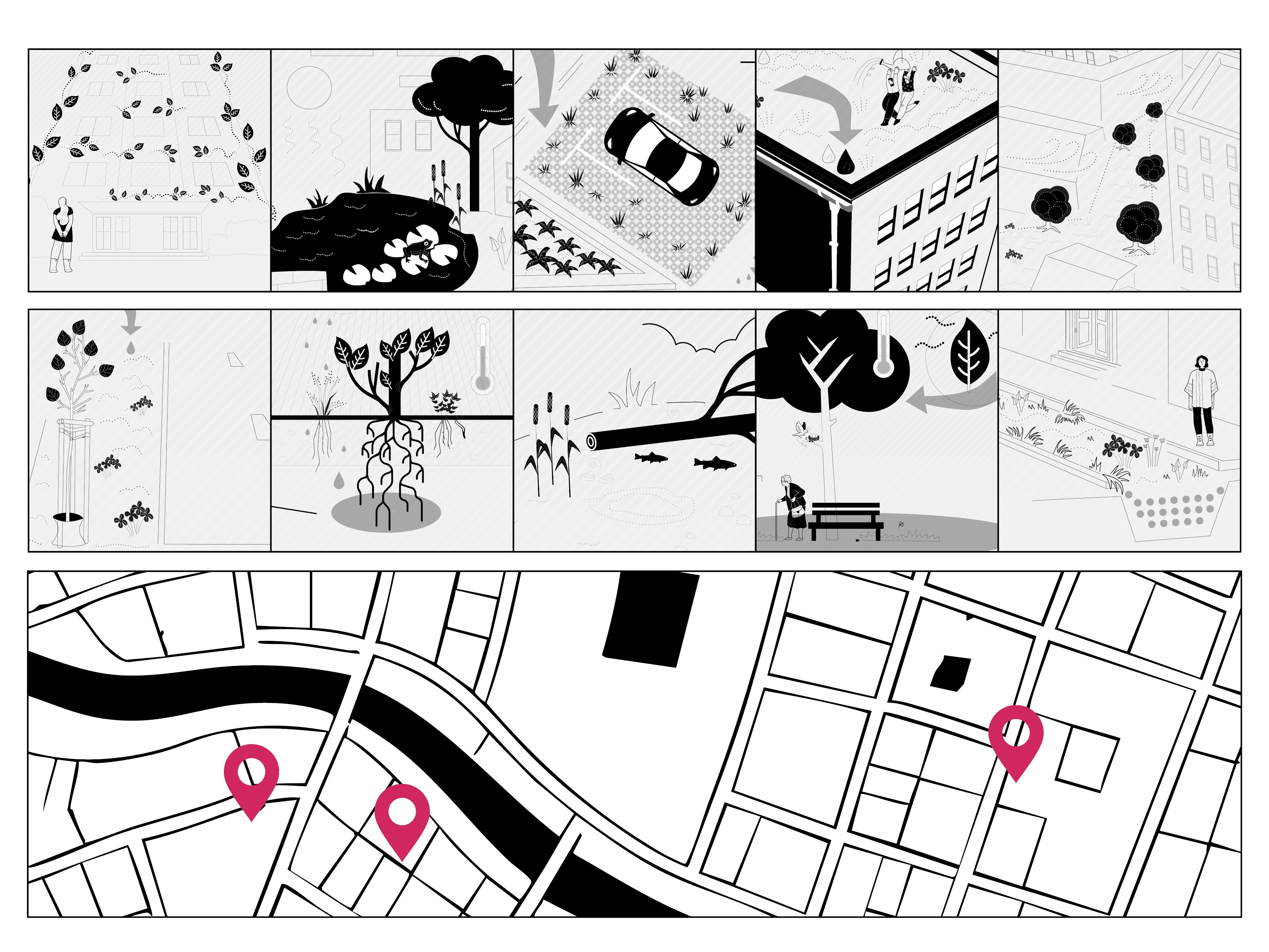
The aim of the analysis is to assess stormwater management measures not only in terms of their hydraulic performance and costs but also to systematically capture their additional ecological, social and economic benefits.
This report contributes to a better understanding of the economic implications of climate change adaptation across the European Union. Its central objective is to analyse three key dimensions: the costs of adapting to climate change, the costs of inaction, and current levels of adaptation funding. The analysis focuses on three climate-sensitive sectors of strategic importance for the EU economy and society: transport, energy, and agriculture.
Humanity has already exceeded six of the nine planetary boundaries, with climate change, biodiversity loss, and pollution pushing the Earth system beyond its safe operating space. Because these boundaries interact through complex feedback loops, surpassing one accelerates pressures on the others, creating cascading effects that amplify environmental degradation. This interconnected dynamic is driving a systemic triple planetary crisis, or polycrisis, that undermines ecological resilience and threatens long-term human well-being. Addressing it requires integrated, cross-sectoral approaches that tackle shared drivers and deliver co-benefits across environmental and socio-economic domains.
Climate change is exacerbating drought, low water levels, and heavy rainfall in German river basins, posing new challenges for agriculture, forestry, water management, ecosystems, and municipal planning. Against this backdrop, the project KliMaWerk investigated how the landscape water balance can be made climate-resilient through integrated, practical strategies and measures. The KliMaWerk final report summarises the key findings and strategic conclusions.
Nature-based solutions are central to climate change adaptation. Urban green spaces and waterbodies can reduce heat in cities, for example. How can local authorities implement such measures despite limited resources? This paper presents financing options based on practical examples – from crowdfunding to green bonds – and assesses which ones are suitable and when. It also provides recommendations on how the federal and state governments can provide support.
This poster summarises key findings from the socio-economic assessment of blue-green infrastructure measures conducted within the AMAREX project. The analysis covers 21 decentralised measures such as infiltration swales, tree pits, and green or retention roofs.
Europe's agricultural sector holds tremendous potential to advance climate and environmental goals, but realizing that potential depends on the right mix of funding and targeted support. A new report led by Ecologic Institute, together with partners in the Climate Farm Demo (CFD) project, introduces a framework to better understand and navigate the wide variety of rewarding mechanisms that encourage farmers to adopt climate-smart practices.
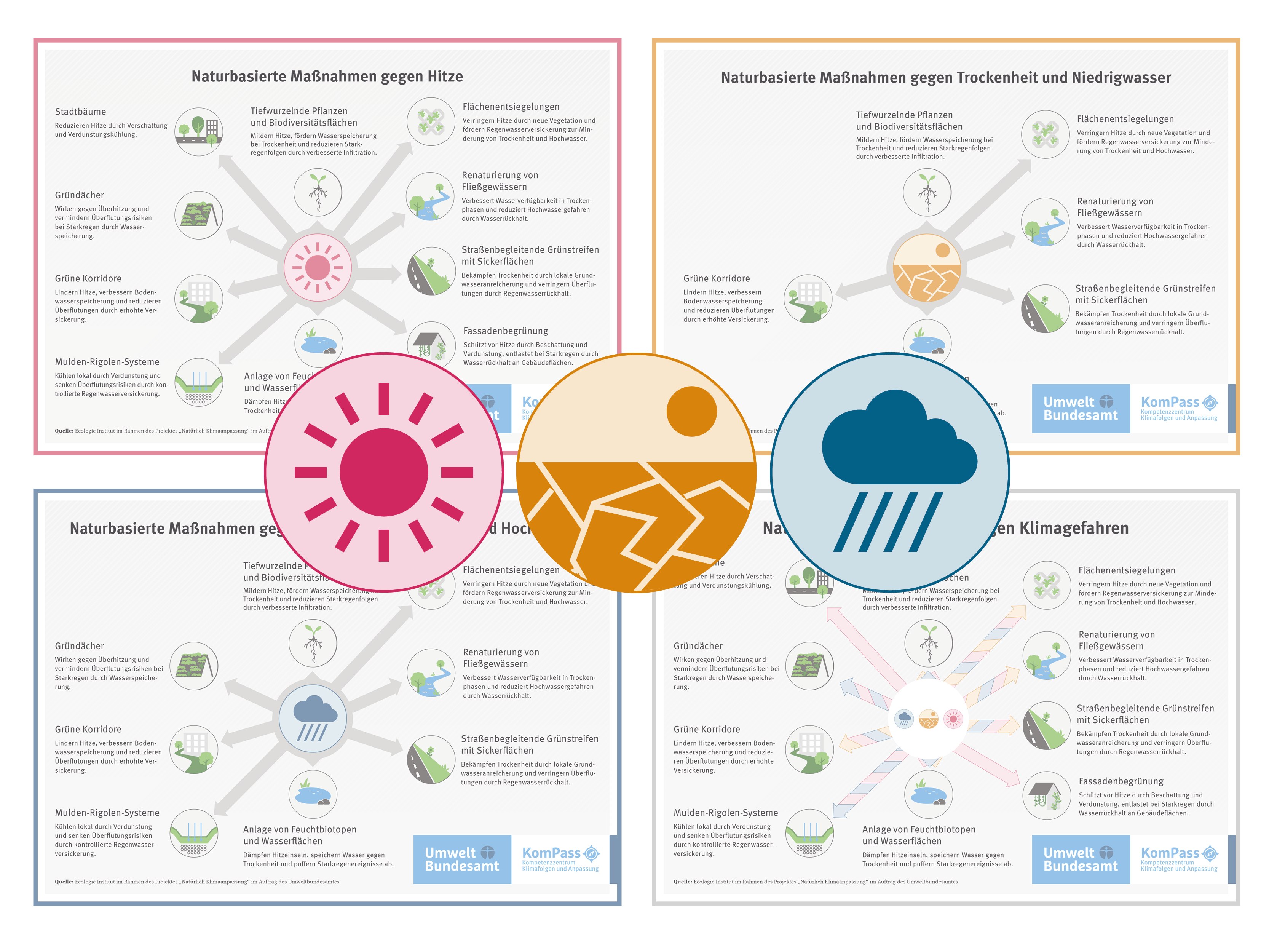
The study, developed under the ReFoPlan project "Natürlich Klimaanpassung! Resiliente naturbasierte Lösungen für Kommunen", provides an overview of the current state of NbS implementation for municipal climate adaptation in Germany. It identifies key barriers that hinder local action – from limited resources to conflicting interests – and highlights strategies and tools that can help overcome them.
In this Policy Brief of the EU-funded NICHES project, Benjamin Kupilas (Ecologic Institute) and David Alejandro Camacho Caballero (UAB) examine how cities like Barcelona, Berlin, and Rotterdam can shape the transition to sustainable urban water systems through Nature-based Solutions (NBS). The core question is which governance models, participatory processes, and methodological approaches are needed to embed NBS effectively into urban storm- and wastewater management strategies.
This brief explores how transitioning to a Nature-Positive Economy requires transforming tourism from a driver of environmental degradation into a force for ecosystem restoration. It was developed under the EU research project GoNaturePositive!
In this policy brief, Ida Meyenberg and Evgeniya Elkina analyze which governance approaches enable the successful implementation of nature-based solutions (NBS) for managing combined sewer overflows (CSO) in cities. The central question is what institutional, procedural, and financial enabling conditions municipalities and water authorities need, to integrate NBS effectively into urban stormwater management strategies. The Ecologic Institute was project lead in the NICHES project and chiefly responsible for the governance and best-practice analysis in five European and North American cities, deriving from it practice-oriented recommendations.
This sectoral brief examines how EU policy and practice can steer forestry toward a nature-positive economy. It was developed under the EU research project GoNaturePositive!
This ETC-BE Report examines how targeted water-saving interventions can bolster the resilience of both ecosystems and key economic sectors in the face of climate change. The central question is: Which technical, economic and governance levers can unlock the water-savings potential in agriculture, electricity production, manufacturing and public water supply, and how can these be operationalized? Gerardo Anzaldúa and Levin Scholl (Ecologic Institute) explored how the industrial sector in Europe is dealing with this question, and provided critical insights on potentials and enablers.
Complementing the policy guidance "Mainstreaming climate and environmental objectives in EU funding programmes in the post-2027 period," this illustrated brochure showcases diverse examples of nature-based solutions (NbS) across water, urban, transport, agriculture, and marine sectors.
Rewetting peatlands – but how? This new guide provides an overview of the key steps involved in planning, financing and authorising peatland protection projects in Lower Saxony, as well as the associated measures. Commissioned by the Federal Agency for Nature Conservation, the brochure features contributions from Felix Dengler and Ulf Stein on behalf of the Ecologic Institute.
Nature-based solutions, such as green spaces or river restoration, can make a valuable contribution to municipal climate adaptation. The new topic page 'Nature-based climate adaptation' on the Federal Environment Agency's website highlights different aspects of such approaches and offers municipalities targeted support in their planning and implementation. In addition to information on the legal framework and funding issues, it also contains practical examples and helpful publications. Ecologic Institute designed and implemented the content of the website on behalf of the Federal Environment Agency.
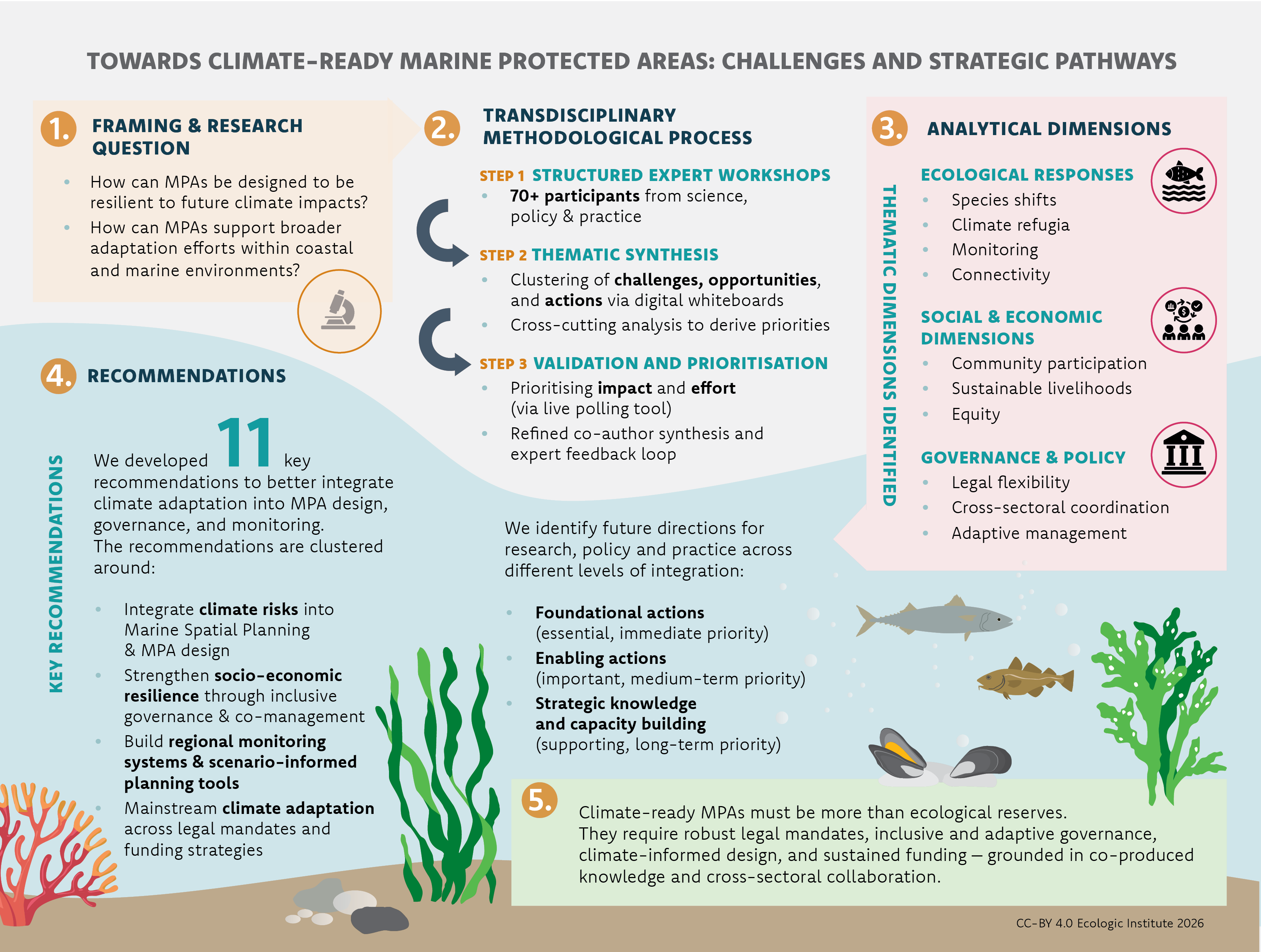
This review explores the potential synergies between marine conservation and climate adaptation strategies, which are critical for addressing climate change impacts in European coastal and marine areas. The article, published in Frontiers in Marine Science, identifies and evaluates integrated approaches that support both marine ecosystem protection and climate adaptation.
This video, produced within the REACHOUT project, focuses on the Fluvial Flooding hazard, and showcases how climate service tools can be applied in real-world urban policy challenges. It serves as a visual guide to help municipal representatives, local consultants, and service providers understand and implement these tools effectively.
This video, produced within the REACHOUT project, focuses on the Urban Heat climate hazard, and showcases how climate service tools can be applied in real-world urban policy challenges. It serves as a visual guide to help municipal representatives, local consultants, and service providers understand and implement these tools effectively.
D3.6 presents an expanded set of over 15 climate service tools developed within the REACHOUT project. Aligned with the Triple-A framework, the tools support cities across all adaptation phases and have been tested through co-creation with seven European City Hubs. The report highlights practical applications, integration potential, and readiness levels—laying the groundwork for a future digital platform.
As part of the EU-funded REACHOUT project, a comprehensive suite of climate service tools has been developed to support cities in addressing climate adaptation challenges. The newly released Guidelines for Climate Service Tools provide a structured overview of more than 20 technical and soft tools, as well as supporting consultancy services, all integrated into the Triple-A Toolkit – a web-based platform designed to enhance urban climate resilience. The tools address the full policy cycle of adaptation by covering the phases of Analysis, Ambition, and Action, and have been tested and refined through extensive co-creation with seven European City Hubs.
Stories have the unique potential to inspire change, shape perceptions, and foster understanding across diverse audiences. This collection of stories, developed as part of the INTERLACE project, aims to convey the profound emotional and cultural importance natural surroundings have for local communities and showcase the power of collective action.
The symposium "The future task of a near-natural landscape water balance" of the Federal Agency for Nature Conservation (BfN) was organized by Ecologic Institute and took place on 18 April 2024, in Bonn. This publication summarises the most important contents of the conference as well as the research and implementation needs identified.
This interactive infographic shows what the future could look like in 20 to 30 years - in two scenarios: one with resolute climate protection and another scenario that leaves everything as it is. The intention is to make the consequences of climate change more tangible and to illustrate the urgency of climate protection measures.
Soils are vital for climate mitigation, storing substantial carbon. This report, co-authored by Ecologic Institute's Hugh McDonald, Aaron Scheid and Dr. Ana Frelih-Larsen, examines funding approaches to promote climate-friendly soil management in Europe, focusing on two models: action-based and result-based. Action-based funding supports specific activities but doesn't ensure measurable outcomes, while result-based funding ties payments to verified results, encouraging innovation but involving higher costs and monitoring. Result-based funding approaches can be challenging in the context of soil carbon, with offsetting approaches found to be particularly risky.
Germany is under increasing water stress, despite rising precipitation and extreme weather. The core issue lies not in rainfall quantity, but in the inability of our anthropogenically modified landscape to retain water. The Handbook of Agricultural Measures for Enhancing Water Retention, Water Quality and Biodiversity addresses this challenge head-on. Developed with farmers and advisors in mind, it presents field-tested and scientifically evaluated nature-based solutions for agricultural water management. These measures do not compete with productivity—they ensure long-term agricultural viability in a changing climate.
The report, "Overcoming policy, financial, social, and economic barriers to pondscape NBS for climate change mitigation and adaptation", has been released as part of the PONDERFUL project. Commissioned under the European Union's Horizon 2020 Research and Innovation Programme, this synthesis report refines and presents the final PONDERFUL framework – a comprehensive strategy for scaling up pondscapes as effective nature-based solutions (NbS).
The report ‘From Ideas to Action’ presents the strategy papers of the seven INTERLACE partner cities, which were developed in close cooperation with local stakeholders in Europe and Latin America. These papers highlight tailor-made strategies for nature-based solutions (NbS), including the revitalisation of urban parks in Chemnitz and the development of a search engine for green infrastructure projects in Kraków. The aim is to effectively address the unique challenges of each city, such as climate change, biodiversity loss and social inequality.
The analysis by Ariadne project partners examines Germany's climate foreign policy during the current legislative period. Beyond the international context, they also consider the organizational structure within the German government and the responsible ministries. The researchers conclude that Germany has been able to set the pace for international climate policy by transferring the responsibility for international climate policy to the Foreign Office and creating the role of Special Envoy for International Climate Policy. In contrast, the record of Germany's engagement in bilateral and plurilateral formats has yielded mixed results.
The INTERLACE project, funded by Horizon 2020, exemplifies innovative transdisciplinary approaches to tackling urban challenges through nature-based solutions (NBS). By fostering stakeholder engagement, developing practical tools, and supporting ecosystem restoration, the project empowers cities across Europe and Latin America to implement sustainable NBS. McKenna Davis and Benedict Buebfrom Ecologic Institute provided key insights into the project's progress and outcomes.
The technical handbook of the PONDERFUL project shows how ponds and pond landscapes can be used as Nature-Based Solutions (NBS) to tackle societal challenges such as climate change, biodiversity loss and water scarcity. The PONDERFUL handbook provides practice-oriented guidelines for dealing with these valuable ecosystems and shows how ponds can be integrated into existing landscapes so that nature and people benefit equally.
Der Bericht "Integrating Nature-Based Solutions in Policy and Planning. Findings and Lessons from INTERLACE Cities" (dt.: Erkenntnisse und Lektionen aus den INTERLACE-Städten), fasst die Erfahrungen der sieben Partnerstädte in Europa und Lateinamerika zusammen. Er richtet sich an politische Entscheidungsträger:innen und Stadtplaner:innen, die naturbasierte Lösungen (NbS) systematisch in ihre städtischen Planungs- und Governance-Strukturen einbinden möchten. Dabei betont die Publikation die Bedeutung inklusiver Beteiligungsprozesse sowie den Einsatz moderner Daten- und Finanzierungsinstrumente, um NbS auf eine breitere Ebene zu skalieren.
The recently published guide "Using ponds and pondscapes as nature-based solutions" is a practical guide for policy makers. The guide provides detailed recommendations on using ponds and pondscapes as nature-based solutions, in particular to adapt to climate change and promote biodiversity. In addition to the policy dimension, it contains practical suggestions for monitoring, management and restoration of ponds.
Urban areas across the globe are facing unprecedented challenges – pollution, climate change, urban sprawl – and traditional solutions are falling short. Join the Interlace project's free online course to discover how nature-based solutions offer a promising approach to help create resilient, sustainable cities.
The final report of the WADKlim project outlines how climate change affects water availability in Germany and what measures must be taken to meet these challenges. Combining analysis of scientific literature, modeling and the development of practical solutions, the report offers valuable ideas for dealing with water scarcity and water use conflicts. The implementation of further measures, such as water retention in the countryside, will be crucial to mitigating the effects of climate change in Germany.