
Sozioökonomische Bewertung für Maßnahmen zum Management von Regenwasser: Kosten und Nutzen blau-grüner Infrastrukturen
- Publication
- Citation
Tröltzsch, J., Dicke, F., Schritt, H., Stein, U. (2026): Sozioökonomische Bewertung für Maßnahmen zum Management von Regenwasser: Kosten und Nutzen blau-grüner Infrastrukturen. Ergebnisse des Projekts: Anpassung des Managements von Regenwasser an Extremereignisse (AMAREX). Ecologic Institut, Berlin.
Climate change is increasingly intensifying extreme events in urban areas, including heavy rainfall and flooding as well as heatwaves and droughts. In this context, adaptive and multifunctional stormwater management through blue-green infrastructure (BGI) is gaining importance. This report presents the results of the socio-economic analyses conducted within the research project AMAREX – Adaptation of Stormwater Management to Extreme Events.
The aim of the analysis is to assess stormwater management measures not only in terms of their hydraulic performance and costs but also to systematically capture their additional ecological, social and economic benefits.
In total, 20 stormwater management measures were analysed, differing in their objectives and design. These include conventional stormwater management measures (RWB), measures optimised for heavy rainfall events (RWB+), and measures with water storage capacity designed to address drought conditions (RWB-N). The analyses draw, among other sources, on hydrological modelling carried out by project partners for two urban pilot areas in Berlin and Cologne.
Methodologically, the report combines three core assessment steps. First, an impact framework was developed to systematically illustrate the direct and indirect effects of stormwater management measures on the water cycle, the environment, urban climate, human health and social aspects. Second, a multi-criteria analysis was applied, integrating ecological, social, economic, water-related and implementation-oriented criteria. Third, selected cost and benefit components were monetised to reflect the overall societal value of the measures within a cost-benefit analysis.
The results demonstrate that measures integrating green elements and water storage capacities deliver particularly high co-benefits. These include positive impacts on urban climate regulation and biodiversity, enhanced recreational and aesthetic value, and improved resilience to heat and drought. By contrast, measures without green components tend to perform significantly worse, especially with regard to social and environmental criteria.
Overall, the report emphasises the importance of integrated and holistic assessment approaches for stormwater management planning. It shows that blue-green infrastructure not only contributes to flood risk reduction, but also plays a crucial role in creating climate-resilient cities with an increased quality of life.
Contact

- Language
-
German
- Authorship
- Funding
-
Federal Ministry of Research, Technology and Space (BMFTR), Germany - Published by
-
Ecologic Institute, Germany - Year
- Dimension
- 74 pp.
- Project
- Project ID
- Table of contents
-
Click to show full table of contents
- Keywords
-
blue-green infrastructure, stormwater management, adaptive stormwater management, urban flooding, heavy rainfall events, extreme weather events, climate change adaptation, climate-resilient cities, socio-economic assessment, costs and benefits, cost-benefit analysis, multi-criteria analysis, urban water management, flood risk reduction, urban climate regulation, drought resilience, heat resilience, ecosystem services, biodiversity, urban resilience, multifunctional infrastructure, holistic assessment approach, water storage capacity, rainwater management, climate adaptation measuresGermany, Berlin, Cologne, urban areas, citiessocio-economic analysis, impact framework, multi-criteria analysis, cost-benefit analysis, monetisation of costs and benefits, hydrological modelling, comparative assessment, integrated assessment approach, indicator-based evaluation, scenario-based analysis, evaluation of co-benefits, systems-based assessment, urban climate impact assessment
Dicke, Flora; Tröltzsch, Jenny; Schritt, Hannes; 2025: Sozio-ökonomische Analyse Blau-Grüner Infrastrukturmaßnahmen zur Regenwasserbewirtschaftung. Poster, Berlin: Ecologic Institut.

Nature's Integration in Cities' Hydrologies, Ecologies and Societies (NICHES)
- Duration
-
-
- Funding
-
Federal Ministry of Education and Research (BMBF), Germany VDI/VDE Innovation + Technik, Germany
Kupilas, Benjamin & David Alejandro Camacho Caballero 2025: Transitioning to Sustainable Urban Water Systems: Insights from Barcelona, Berlin, and Rotterdam (Policy Brief, NICHES Project). Ecologic Institute and Autonomous University of Barcelona.
Meyenberg, Ida & Elkina, Evgeniya 2025: What Makes Nature-Based Solutions Work? Governance Approaches for Managing Combined Sewer Overflows (Policy Brief, NICHES Project). Ecologic Institute.
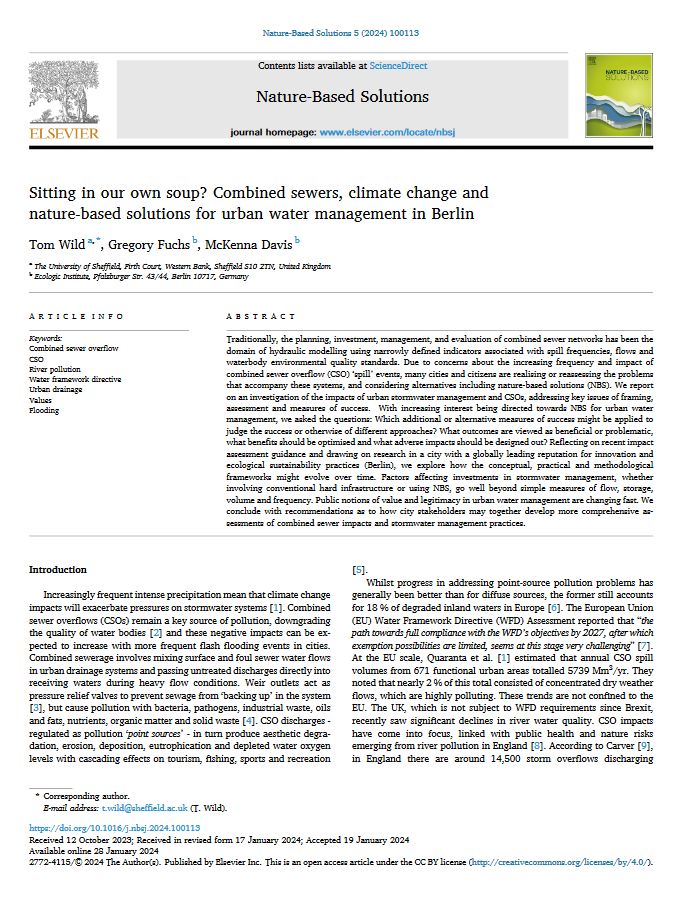
Wild, Tom; Gregory Fuchs & McKenna Davis (2024) 'Sitting in our own soup? Combined sewers, climate change and nature-based solutions for urban water management in Berlin' Nature-Based Solutions 5 (2024), p. 10113. doi:10.1016/j.nbsj.2024.100113.
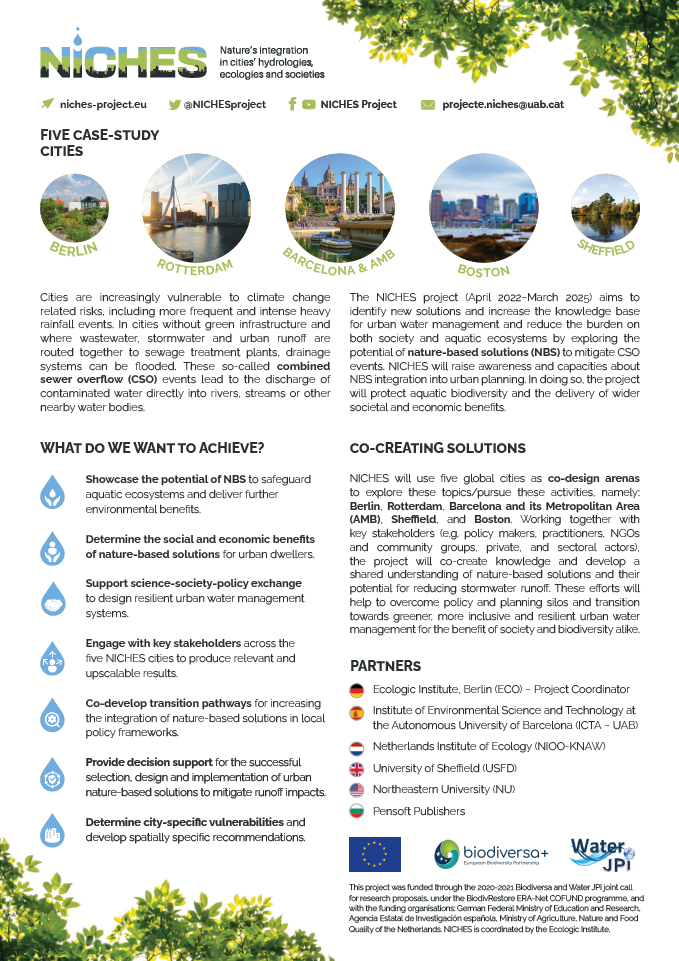
NICHES Consortium (2023). Nature's Integration in Cities' Hydrologies, Ecologies and Societies (NICHES). Flyer A4