
Photo by Chirag Saini on Unsplash, Cover © German Environment Agency, 2025
Integrated Approaches to Addressing the Triple Planetary Crisis: Country Best Practices
Lessons learned from Brazil, Colombia, Japan, New Zealand, Panama, Rwanda and Sweden
- Publication
- Citation
Iwaszuk, E.; Spantzel, T.; Kroos, F.; Knoblauch, D. (2025): Integrated Approaches to Addressing the Triple Planetary Crisis: Country Best Practices. Lessons learned from Brazil, Colombia, Japan, New Zealand, Panama, Rwanda and Sweden. Policy paper. Climate Change 81/2025, German Environment Agency: Dessau-Roßlau. https://doi.org/10.60810/openumwelt-8106
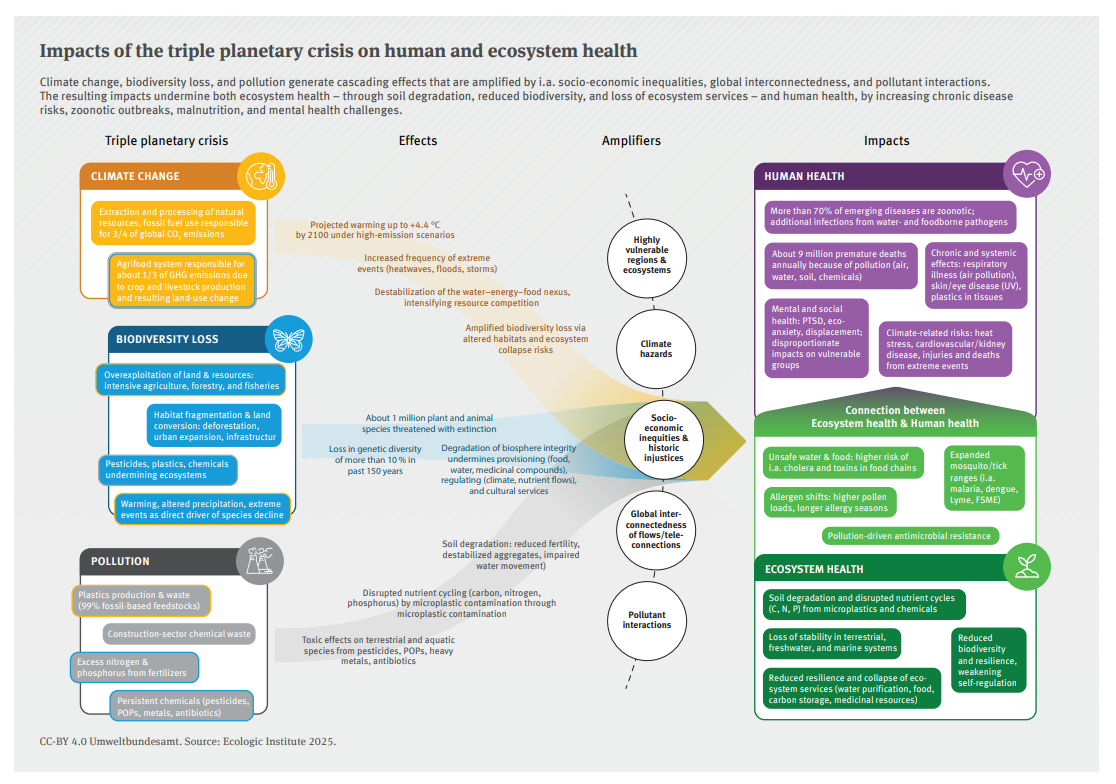
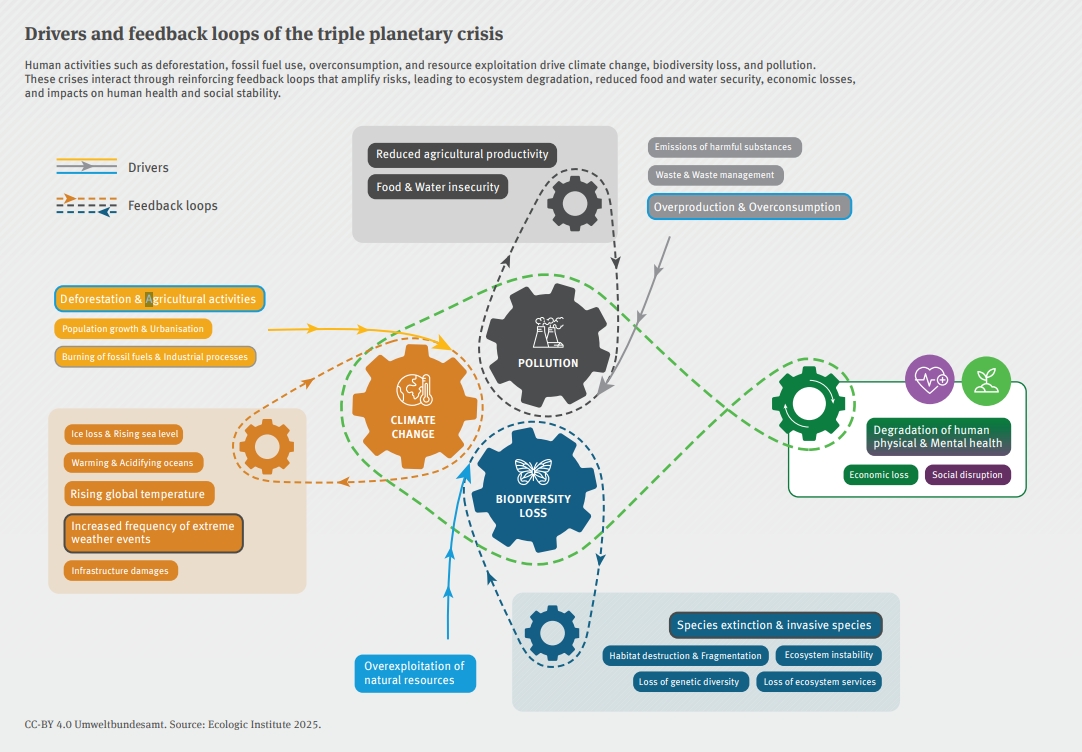
Humanity has already exceeded six of the nine planetary boundaries, with climate change, biodiversity loss, and pollution pushing the Earth system beyond its safe operating space. Because these boundaries interact through complex feedback loops, surpassing one accelerates pressures on the others, creating cascading effects that amplify environmental degradation. This interconnected dynamic is driving a systemic triple planetary crisis, or polycrisis, that undermines ecological resilience and threatens long-term human well-being. Addressing it requires integrated, cross-sectoral approaches that tackle shared drivers and deliver co-benefits across environmental and socio-economic domains.
Integrated Approaches: An International Comparison
The report examines how seven countries, including Brazil, Rwanda, Colombia, Sweden, Japan, New Zealand, and Panama, integrate climate, biodiversity, and pollution policies within their national strategies. By analysing national climate and biodiversity plans and strategies as well as governance mechanisms in seven geographically and socio-economically diverse countries, the report assesses if and how climate, biodiversity, and pollution policies are connected, and how the institutional coordination and implementation processes share their effectiveness.
Identifying Barriers to Implementation
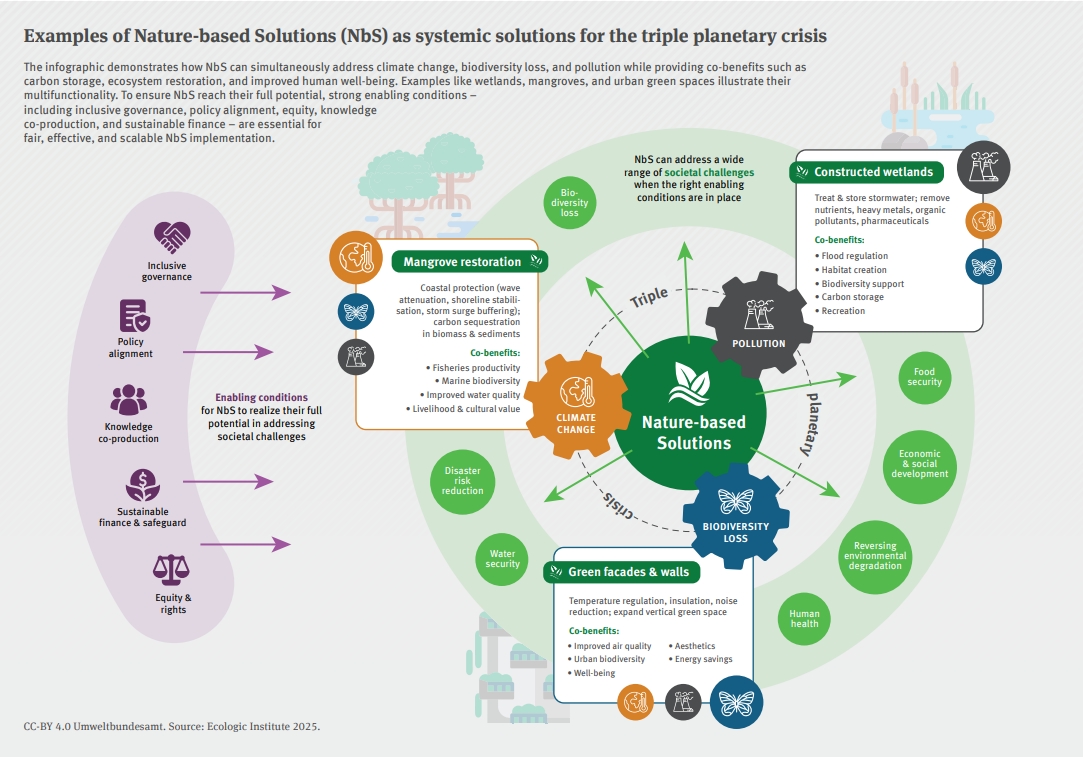
Across all cases, countries increasingly adopt integrated concepts such as nature-based solutions, circular economy approaches, and ecosystem-based planning, generating co-benefits for climate action, biodiversity, and resilience. Yet implementation remains uneven, constrained by gaps in financing, capacity, and coordination. Strengthening institutional coherence and aligning governance, data, and finance systems will be essential to scale integrated solutions and accelerate sustainable transformation.
Contact

- Language
-
English
- Authorship
- Funding
-
German Environment Agency (UBA), Germany - Published by
-
German Environment Agency (UBA), Germany - Year
- Dimension
- 49 pp.
- ISSN
-
1862-4359
- DOI
- Project
- Project ID
- Table of contents
-
Click to show full table of contents
- Keywords
-
climate crisis, biodiversity loss, planetary boundaries, pollution impacts, environmental resilience, integrated policy solutions, nature-based solutions, circular economy, sustainable transformation, ecological governance
Brazil, Colombia, Japan, New Zealand, Panama, Rwanda and Swedencross-country comparative analysis, policy and strategy document review, governance and institutional mapping, evaluation of implementation and effectiveness, assessment of co-benefits and integrated solutions
Burgos Cuevas, Natalia et al. (2025): Moving from interconnected crises to systemic solutions. Resource efficiency, nature-based solutions, and systemic transformation as responses to the complexity of the triple planetary crisis. German Environment Agency: Dessau-Roßlau. https://doi.org/10.60810/openumwelt-8108.
Knoblauch, D., Felthöfer, C., Heni, Y., Burgos Cuevas, N., & Best, A. (2025). The Interconnected Challenges of Climate Change, Biodiversity Loss and Environmental Pollution: Drivers, Interdependencies and Impacts of the Triple Planetary Crisis. Interim report, Climate Change 82/2025. German Federal Agency. https://doi.org/10.60810/openumwelt-8107.
Felthöfer, C., Knoblauch, D., & Best, A. (2025). The interconnected challenges of climate change, biodiversity loss and environmental pollution: Drivers, interdependencies and impacts of the triple planetary crisis (Fact sheet). German Federal Agency. https://doi.org/10.60810/openumwelt-8070
Burgos Cuevas, Natalia et al. (2025): Moving from interconnected crises to systemic solutions. Resource efficiency, nature-based solutions, and systemic transformation as responses to the complexity of the triple planetary crisis. Fact sheet. German Environment Agency: Dessau-Roßlau. https://doi.org/10.60810/openumwelt-8102.
Umweltbundesamt 2025: Drivers and feedback loops of the triple planetary crisis. Infographic.