Photo by Jahoo Clouseau
The Role of the LULUCF Sector in Reaching Carbon Neutrality in 2050
Visions for the LULUCF sector in EU Member States’ Long-Term climate Strategies
- Event
- Date
-
- Location
- online
Achieving climate neutrality in the EU requires emission removals, which are tightly linked to the land-use, land-use change, and forestry (LULUCF) sector. Emerging technologies are also being sought to remove emissions by other means, e.g., carbon capture and storage (CCS), carbon capture and utilisation (CCU), direct air capture (DAC) and biotechnology and carbon capture (BECCS). But how much importance do EU Member States assign to the LULUCF sector, and to what extent do they explore its contribution to reaching climate neutrality?
This webinar presented and discussed the findings of a report by SEI Tallinn. The analysis, conducted as part of the Climate Recon 2050 project, analysed the role of the LULUCF sector in Member States’ Long-Term Strategies (LTSs). Although the majority of LTSs published so far address the topic, the extent to which countries with significant potential in the sector explore its contribution to climate neutrality varies, even among Member States with significant needs for modernisation of their existing legacy networks.
The report described the current situation, highlighted key challenges and shortcomings of LTSs, and proposed a way forward for integrating the LULUCF sector into climate neutrality strategies.
Contact

- Funding
-
Federal Ministry for Economic Affairs and Climate Action (BMWK), Germany European Climate Foundation (ECF), International - Organizer
-
Ecologic Institute, Germany - Partner
-
WiseEuropa (WiseEuropa), Poland The Energy Policy Group (EPG), Romania Jožef Stefan Institute (JSI), Slovenia Stockholm Environment Institute (SEI), Sweden - Team
-
Paula SchöberleinNora Kögel
- Date
-
- Location
- online
- Language
-
English
- Project
- Project ID
- Keywords
-
Climate, LULUCF, CCS, CCU, DAC, BECCS, land use, forestry, low-carbon, long-term climate strategies, LTSs, NECPs, National Energy and Climate Plans, EU, European Union, climate, strategy, 2050, long-term, decarbonization, CO2, Paris Agreement, emissions reductions, greenhouse gas emissions, GHG, governance, mainstreaming, climate and energy goals, member states, policymakers, climate actionEurope, Central and Eastern Europedialogue, knowledge sharing, webinars
Digital Event:Getting to Low-carbon District Heating
- Date
-
- Location
- online
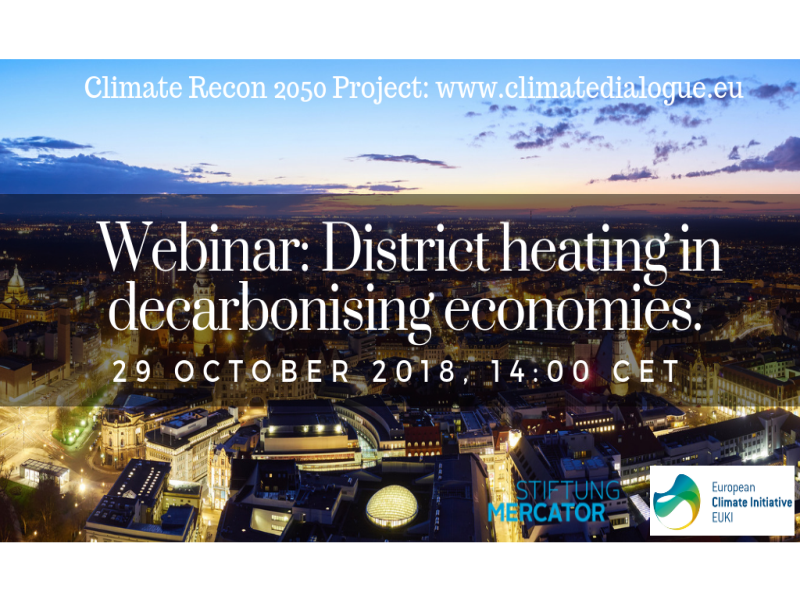
Digital Event:District Heating in Decarbonising Economies
- Date
-
- Location
- online
Workshop:Dialogues on Long-Term Climate Strategies
- Date
-
-
- Location
- Copenhagen, Denmark
Workshop:Fourth Meeting of the Policymaker Platform (PMP4)
- Date
-
-
- Location
- Berlin, Germany
Dialogue on Pathways and Policies for a Climate-neutral EU (Climate Recon 2050)
- Duration
-
-
- Funding
-
European Climate Foundation (ECF), International