
ICAP Online Seminar on Emissions Trading: Latin America and the Caribbean
- Event
- Date
-
-
- Location
- online
Emissions trading is a market-based instrument for climate change mitigation. From the EU to Mexico and from China to California, more and more jurisdictions around the world use emissions trading as a tool to achieve their climate goals. As of 2022, around 17% of the world's emissions are covered by ETS. In Latin America and the Caribbean, Mexico has been the first country to introduce an emissions trading system. Several countries have taken steps towards developing domestic carbon markets, including Brazil, Costa Rica, Panama and Peru. Other countries opted for a carbon tax, such as Argentina, Chile, Colombia and Uruguay, but in some instances are also considering carbon market elements to complement the tax.
To support the development and application of emissions trading systems in the region, from 27 February to 3 March 2023, the International Carbon Action Partnership (ICAP) convened an online seminar, focusing on Latin America and the Caribbean. As an entry-level training, the one-week seminar introduced participants to the basic concepts and key elements of emissions trading. Drawing on examples and experiences from existing systems, the seminar explained the main design choices for setting up an ETS and conveyed solutions for their implementation.
Participation
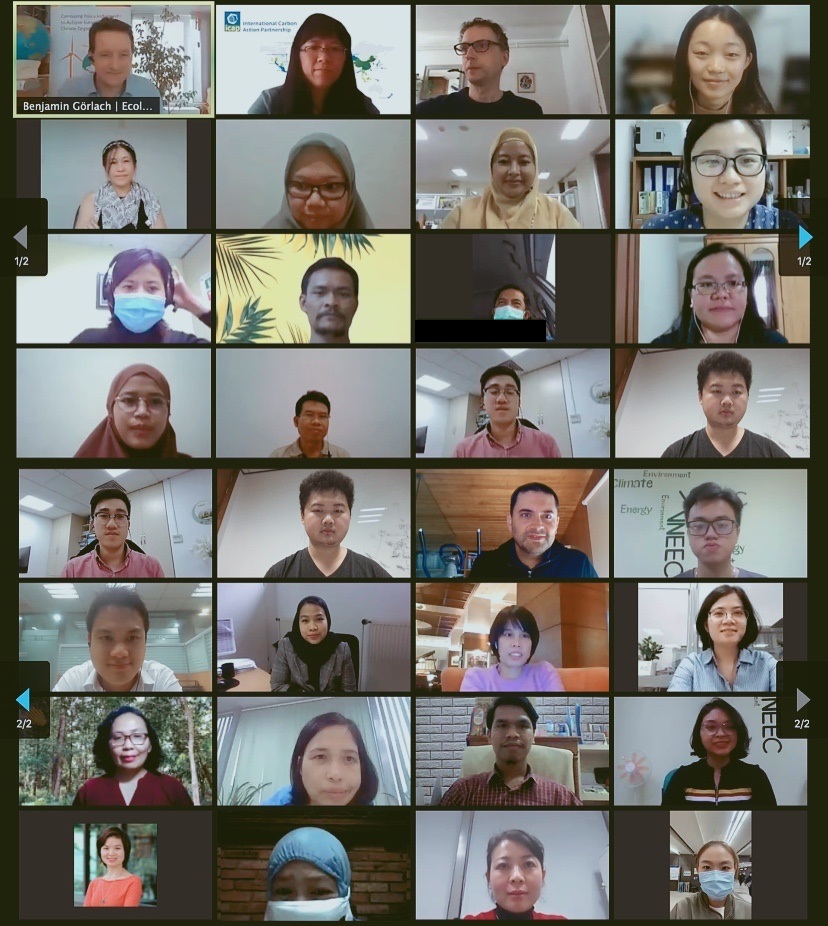
The seminar targeted up to 30 selected participants, who were selected to ensure a balance of professional backgrounds, nationalities and gender. Applicants were invited from entry-level to mid-career staff from the public sector, private sector, civil society and academia, particularly those with roles and responsibilities related to domestic climate policy but little prior knowledge of emissions trading. Good command of English was required for successful participation. Participation was free, and participants received a certificate for the course, but there was a competitive selection process.
Applications were welcomed from countries all across Latin America and the Caribbean – both from current residents of these countries and from nationals of these countries living outside the region.
Participants of previous ICAP trainings were advised that the curriculum overlapped with the training they have received, as this was designed to be an entry-level activity. The organisers were allowed the right to prioritise applicants that have not benefitted from previous trainings.
Contact