Weiterentwicklung des "Monitoringsystem Bioökonomie" unter besonderer Berücksichtigung von Aspekten des vorsorgenden Umweltschutzes
- Publication
- Citation
Best, Aaron et al. 2025: Weiterentwicklung des "Monitoringsystem Bioökonomie" unter besonderer Berücksichtigung von Aspekten des vorsorgenden Umweltschutzes. Abschlussbericht. Umweltbundesamt: Dessau-Roßlau.
Against the backdrop of the new German Bioeconomy Strategy (BMEL & BMBF 2020), this study outlines how a monitoring system needs to be designed to assess whether the transformation towards a bio-based economy is progressing in line with sustainability goals and the protection of natural systems. The report is aimed at policymakers, public authorities and the expert community, summarising the key findings and recommendations from several years of project work.
Monitoring gaps and environmental challenges
The analysis of existing monitoring and indicator systems at the international, European and national levels shows that central environmental aspects of the bioeconomy are still insufficiently captured. This is particularly evident for biodiversity and ecosystem health, sustainable biomass potentials, spatially disaggregated land-use data, environmental impacts in exporting countries and indirect land-use change. Expert interviews confirm these gaps and highlight the need to relate bioeconomy developments more explicitly to planetary boundaries, regional environmental limits and potential trade-offs – for example in the field of bioenergy.
Key Indicators for Strengthening Precautionary Environmental Protection
Building on this stocktake, the project develops a set of approaches and indicators that can strengthen the ecological dimension of existing bioeconomy monitoring. These include indicators on sustainable biomass potentials, potential biodiversity loss, spatial representation of land-use changes, circular use of biogenic materials and pollutant and particulate emissions associated with the bioeconomy. In addition, the study discusses systemic life-cycle analyses, the integration of planetary boundaries and the further development of the footprint approach. All proposals were assessed using the RACER criteria and further refined in an expert workshop.
Seven action areas for a future-proof bioeconomy monitoring system
The report consolidates its findings into seven action areas for policymakers and monitoring practitioners. Recommendations include: a more comprehensive, multi-layered monitoring concept that explicitly incorporates precautionary environmental protection; the definition of quantitative sustainability targets for biomass use; expanding the footprint-based approach to include additional environmental indicators; stronger spatial differentiation to identify hotspots; the integration of scenarios and “hypothetical pressure indicators”; closer alignment with other strategies and monitoring frameworks (e.g. EU Bioeconomy, Agenda 2030, biodiversity, circular economy); and targeted work on identified research gaps. In doing so, the report provides concrete pathways for how bioeconomy monitoring can help ensure that the transition to a bio-based economy is ecologically robust.
Contact

- Language
-
German
- Authorship
- Funding
-
German Environment Agency (UBA), Germany - Published by
-
German Environment Agency (UBA), Germany - Year
- Dimension
- 342 pp.
- ISSN
-
1862-4804
- DOI
- Project
- Project ID
- Table of contents
-
Click to show full table of contents
- Keywords
-
sustainable biomass, precautionary environmental protection, biodiversity, ecological sustainability, sustainable economy, bioeconomy strategy, environmental indicators, biomass utilization, environmental monitoring, resource management, planetary boundaries, ecosystem protection, environmental impacts, indicator systems, transformation to a biobased economyGermanyExpert interviews, Monitoring, RACER criteria, Footprint approach, Life cycle analysis, Life Cycle Assessment, systemic LCA, integrated LCA, DPSIR concept, Scenario analysis, Sankey diagrams, Indicator evaluation, Monitoring concepts, Spatial analysis, Hotspot analysis, Screening analysis, Indicator taxonomy, Trend analysis
Martin Möller, Viviana López, Rasmus Prieß, Tobias Schleicher, Katja Hünecke, Klaus Hennenberg, Franziska Wolff, Zoritza Kiresiewa, Marius Hasenheit, Patrick Schröder, Prof. Dr. Bernward Gesang (2020). Nachhaltige Ressourcennutzung – Anforderungen an eine nachhaltige Bioökonomie aus der Agenda 2030/SDG-Umsetzung. Abschlussbericht. Umweltbundesamt: Dessau-Roßlau.
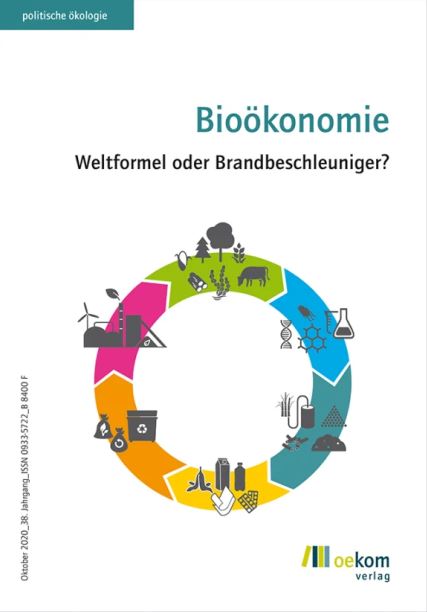
Wolff, F., Kiresiewa, Z. and Möller, M., (2020): Handlungsoptionen einer nachhaltigen Bioökonomiepolitik: Wo ein Wille ist, ist auch ein Weg. In: politische ökologie. Volume 162 (03 - 2020) – Bioökonomie.