
Ramiro de la Vega

Ramiro de la Vega

Msc (Public Economics)
BA (Economics and Politics)

Researcher

Team
Topics

Ramiro de la Vega works as Researcher at Ecologic Institute, Berlin. His research focuses on European energy and climate policy and its associated social impacts. Ramiro is a native German and Spanish speaker and fluent in English and Italian.

During his work at Ecologic Institute, Ramiro contributed to several projects supporting Europe’s clean-energy transition. He was involved in an analysis for the European Environment Agency on how renewables, electrification and system flexibility can help the EU meet its 2030 targets. He also worked on a European Climate Initiative (EUCI) project that seeks to accelerate methane reductions in Romania and Czechia by enhancing the implementation of the EU-Methane Emission Regulation. He further contributed to a multi-country study for the European Climate Foundation examining how selected EU Member States are transposing key EU energy legislation.

In the field of climate policy, Ramiro is involved in the European Climate Neutrality Observatory (ECNO) as well as the European Fair Transition Observatory (EFTO), two distinct indicator-based initiatives that track Europe’s progress toward climate neutrality. His work includes research for the German Environment Agency on strengthening carbon-leakage protection in the EU’s Carbon Border Adjustment Mechanism. He also carried out an independent evaluation of Bread for the World’s Climate Policy Unit, examining how the unit strengthens the demands and concerns of vulnerable countries in the Global South and promotes more equitable international climate finance.

Prior to working at Ecologic Institute, he worked as Research Assistant at Deutsche Gesellschaft für Verbraucherstudien (DtGV). There, he analysed and executed consumer studies within the context of sharing-economy and private retirement plans.

Ramiro is currently pursuing a PhD at Philipps University Marburg, where he analyses the role of governmental institutions in mobilising climate finance in the Global South. He holds a Master's degree in Public Economics (MSc) from Freie Universität Berlin, with a specialisation in environmental policy and the economics of climate change. He completed his Bachelor's degree in Economics and Politics at Hochschule für Technik und Wirtschaft Berlin.

Contact Ramiro de la Vega by Email

The data sent will only be processed for the purpose of processing your request. You will find further information in our privacy notice.

Selected projects by Ramiro de la Vega
 

Image by Tom from Pixabay

The European Union is entering a new phase of climate and energy policymaking. As ambition increases for 2040 and 2050, the EU’s climate governance framework must evolve accordingly. This project supports the European Commission in carrying out a comprehensive impact... Read more

Impact Assessment of the Governance Regulation Revision

Duration
-
Funding
 

Children stand amidst floodwaters in the Haor region near Sylhet, Bangladesh – an area regularly affected by monsoon floods. Climate change is increasingly amplifying risks to livelihoods, health, and food security.

|

Photo by shiak khan on Unsplash

The impacts of the climate crisis particularly affect people in vulnerable situations around the world – including children, women, Indigenous communities, and low-income households. Although these groups have contributed the least to global warming, they are... Read more
 

The image is taken from Freepik.com

Methane, a potent greenhouse gas with a short-term global warming potential significantly higher than CO2, contributes to about 30% of global warming. Tackling methane emissions is critical for the EU to meet its climate targets for 2030. The EU Methane Emission... Read more
 

Image taken from Freepik.com

Although the Carbon Border Adjustment Mechanism (CBAM) is set to transition from its preparatory to its implementation phase next year, its current form contains several loopholes that undermine its effectiveness. The aim of CBAM is to reduce carbon leakage – that is,... Read more
 

© Canva 2024

The "Clean Energy for All Europeans" package introduced provisions on a more flexible and market-based price competition by Directive (EU) 2019/944 on common rules for the internal market for electricity (DIR) and Regulation (EU) 2019/943 on the internal market for... Read more
 

W.carter, CC0, via Wikimedia Commons

This project, funded by the Environmental Defense Fund Europe, identifies and develops EU policy opportunities to mitigate methane (CH4) and hydrogen (H2) emissions from the energy sector. Methane is a highly impacting greenhouse gas, second only to CO2. CH4... Read more
 

Bild von Gerd Altmann auf Pixabay

The project aims to facilitate a focused, well-founded and trustful exchange between leading German environmental organisations and think tanks on the climate agenda of the G7 and the G20. The aim is to invite persons to the expert dialogue who have distinguished... Read more
 

© Zoritza Kiresiewa

What characterized a monitoring system that effectively considered aspects of precautionary environmental protection? The aim of this project was to answer this question with regard to the new German bioeconomy strategy.The German government aimed at a transformation... Read more
 

© Arne Riedel

To help manage the transition to climate neutrality, European countries have increasingly turned to dedicated climate advisory bodies. Although these come in many shapes and sizes, these institutions provide a sound evidence base for policy-making and can further... Read more
 

Photo by Lukas on Pexels

With the National Climate Initiative (NKI), the Federal Environment Ministry has been supporting climate protection projects throughout Germany since June 2008, contributing to the achievement of Germany's climate protection goals. During this time, the NKI's guidelines... Read more
Selected publications by Ramiro de la Vega
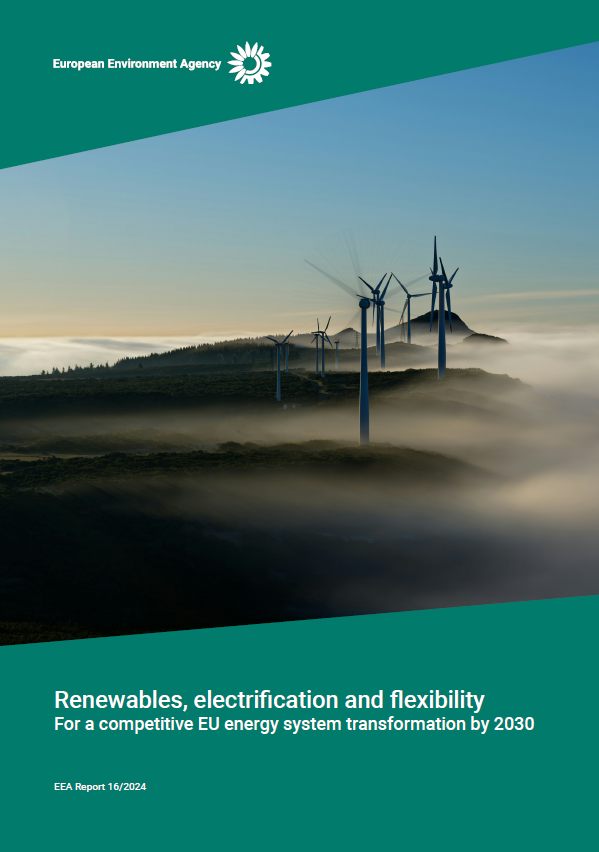
 
Cover of the EEA report "Renewables, electrification and flexibility for a competitive EU energy system transformation by 2030"
© European Environment Agency, 2025
The European Union has committed to becoming climate-neutral by 2050. On the way to climate neutrality, however, it must first meet its interim 2030 target, which requires a profound transformation and decarbonisation of the energy system – comprising the electricity,... Read more

European Environment Agency, Renewables, electrification and flexibility for a competitive EU energy system transformation by 2030, Publications Office of the European Union, 2025, https://data.europa.eu/doi/10.2800/4558900


Foto von shiak khan auf Unsplash, cover: Ecologic Institut

This report evaluates the focus of Bread for the World on climate policy between 2023 and 2025. It examines how the organisation strengthens the rights and needs of vulnerable population groups within the context of international climate policy, demonstrating how... Read more

Schöberlein, Paula; de la Vega, Ramiro; Knoblauch, Doris (2025): Kurs Klimagerechtigkeit: Wie Brot für die Welt die Bedürfnisse der ärmsten und verletzlichsten Bevölkerungsgruppen in der internationalen Klimapolitik stärkt. Evaluierung des Themenschwerpunkts Klimapolitik bei Brot für die Welt Deutschland. Ecologic Institut, Berlin.
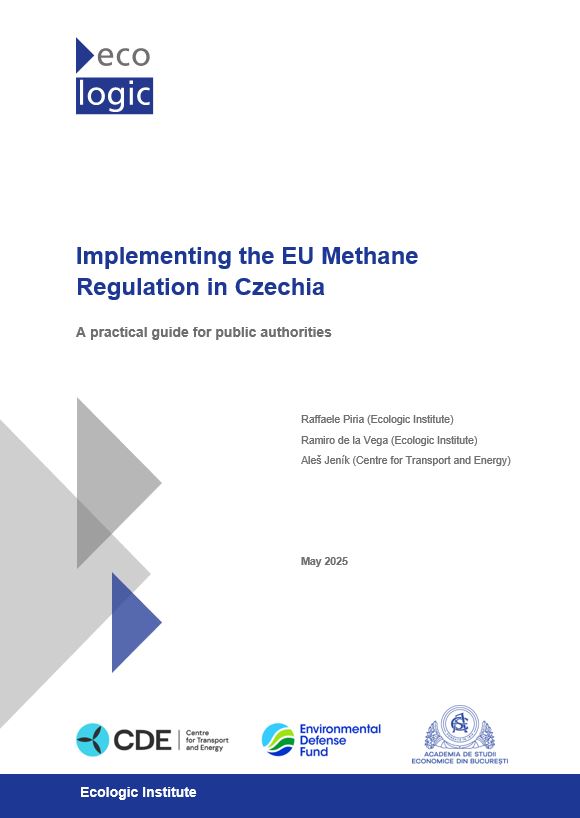
 
Cover page of a policy guide titled "Implementing the EU Methane Regulation in Czechia – A practical guide for public authorities." Authors: Raffaele Piria and Ramiro de la Vega (Ecologic Institute), Aleš Jenik (Centre for Transport and Energy). Published in May 2025. Logos of the Ecologic Institute, CDE, Environmental Defense Fund, and ASE Bucharest are shown at the bottom.

© Ecologic Institute, 2025

The quality of national implementation of the EU Methane Regulation (EU-MER) across Member States is essential for achieving the EU's climate targets and demonstrating global leadership. Methane (CH₄) is a potent greenhouse gas with a strong short-term warming... Read more

Piria, Raffaele, Ramiro de la Vega, Aleš Jeník (2025): Implementing the EU Methane Regulation in Czechia. Ecologic Institute, Berlin.
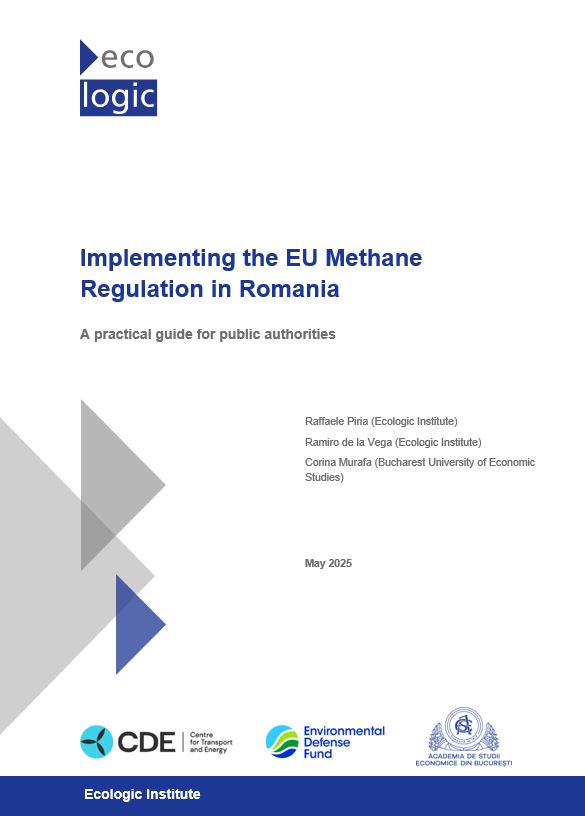
 
Cover page of a policy guide titled "Implementing the EU Methane Regulation in Romania – A practical guide for public authorities." Authors: Raffaele Piria and Ramiro de la Vega (Ecologic Institute), Corina Murafa (Bucharest University of Economic Studies). Published in May 2025. Logos of the Ecologic Institute, CDE, Environmental Defense Fund, and ASE Bucharest are shown at the bottom.

© Ecologic Institute, 2025

The quality of national implementation of the EU Methane Regulation (EU-MER) across Member States is essential for achieving the EU's climate targets and demonstrating global leadership. Methane (CH₄) is a potent greenhouse gas with a strong short-term warming potential... Read more

Piria, Raffaele, Ramiro de la Vega, Corina Murafa (2025): Implementing the EU Methane Regulation in Romania. Ecologic Institute, Berlin.


The image is taken from Freepik.com, Cover: Ecologic Institute, 2025

The EU Methane Emissions Regulation (EU-MER) sets out strong principles on penalties for non-compliance, but these must be transposed into national law by each Member State.This paper examines the penalty provisions in the draft Czech implementing law submitted on 11... Read more

Piria, Raffaele, Ramiro de la Vega, Aleš Jeník: Czechia's Draft Penalty Rules for Violations of the EU Methane Regulation. Ecologic Institute, 2025, Berlin.


The image is taken from Freepik.com, Cover: Ecologic Institute, 2025

The EU Methane Emissions Regulation (EU-MER) sets out strong principles on penalties for non-compliance, but these must be transposed into national law by each Member State.This paper examines the penalty provisions in the draft Romanian implementing law proposed by the... Read more

Piria, Raffaele, Ramiro de la Vega – reviewed by Corina Murafa: Romania's Draft Penalty Rules for Violations of the EU Methane Regulation. Ecologic Institute, 2025, Berlin.


Photo: Canva.com, Cover: UBA, 2025

The Carbon Border Adjustment Mechanism (CBAM) imposes a carbon price on imports of selected products into the EU market, with the aim of creating a level playing field between domestic production and imports. According to Annex I of Regulation 2023/956, which... Read more

Montrone, Lorenzo et al. 2025: Inclusion of downstream products in CBAM. Assessment and operationalisation of relevant criteria. Interim report. German Environment Agency: Dessau-Roßlau.


Photo: Zoritza Kiresiewa, Cover: UBA, 2025

Against the backdrop of the new German Bioeconomy Strategy (BMEL & BMBF 2020), this study outlines how a monitoring system needs to be designed to assess whether the transformation towards a bio-based economy is progressing in line with sustainability goals and the... Read more

Best, Aaron et al. 2025: Weiterentwicklung des "Monitoringsystem Bioökonomie" unter besonderer Berücksichtigung von Aspekten des vorsorgenden Umweltschutzes. Abschlussbericht. Umweltbundesamt: Dessau-Roßlau.
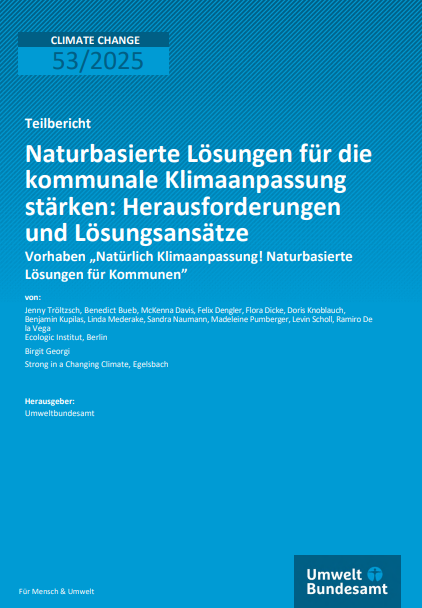
 
cover page

© German Federal Environment Agency, 2025

Cities and towns across Germany are increasingly facing the impacts of climate change – from heatwaves and floods to biodiversity loss.A new report by Ecologic Institut and Birgit Georgi, commissioned by the German Federal Environment Agency (UBA), explores how nature... Read more

Tröltzsch, J., Bueb, B., Davis, M., Dengler, F., Dicke, F., Knoblauch, D., Kupilas, B., Mederake, L., Naumann, S., Pumberger, M., Scholl, L., De la Vega, R., & Georgi, B. (2025). Naturbasierte Lösungen für die kommunale Klimaanpassung stärken: Herausforderungen und Lösungsansätze. Umweltbundesamt. https://doi.org/10.60810/openumwelt-7902


© European Climate Neutrality Observatory, 2025

This ECNO report assesses transparency and policy information in the final National Energy and Climate Plans (NECPs) of four EU countries: France, Ireland, Italy, and Sweden. The report evaluates whether these plans provide a sufficient blueprint for achieving national... Read more

Lalieu, Simon et al. 2025: Delivering 2030 climate targets. A snapshot of the transparency and policy information gaps of Member States' NECPs. Report of the project European Climate Neutrality Observatory (ECNO).
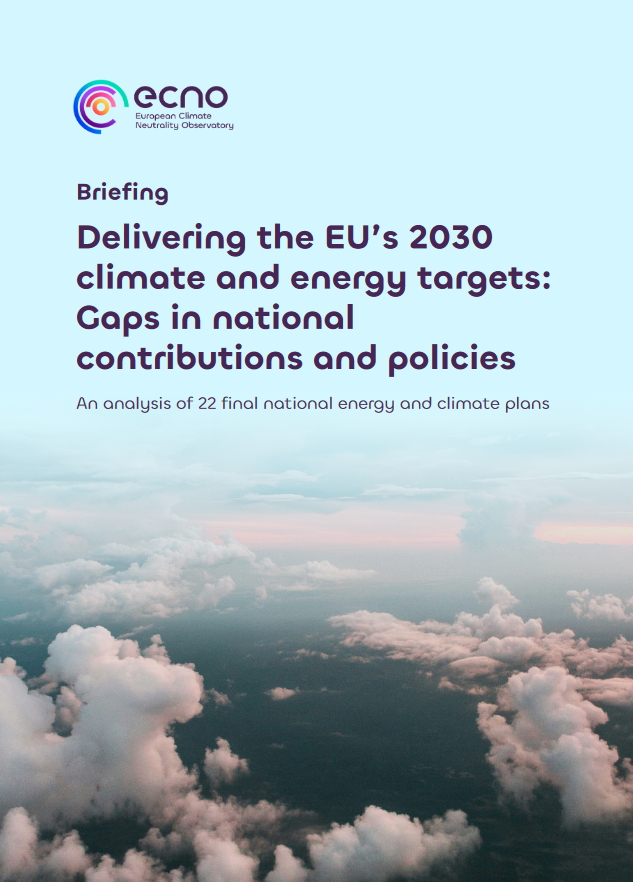
 
**Alt text:**   Cover of a briefing titled "Delivering the EU’s 2030 climate and energy targets: Gaps in national contributions and policies" by the European Climate Neutrality Observatory, showing a cloudy sky viewed from above.

© ECNO, 2025

A new analysis of 22 updated National Energy and Climate Plans (NECPs) shows that many EU Member States are falling short of the bloc's 2030 climate targets. This briefing, led by Ecologic Institute in collaboration with the New Climate Institute and Reform Institute,... Read more

Velten, Eike Karola et al. 2025: Delivering the EU's 2030 climate and energy targets: Gaps in national contributions and policies. An analysis of 22 final national energy and climate plans. European Climate Neutrality Observatory (ECNO).
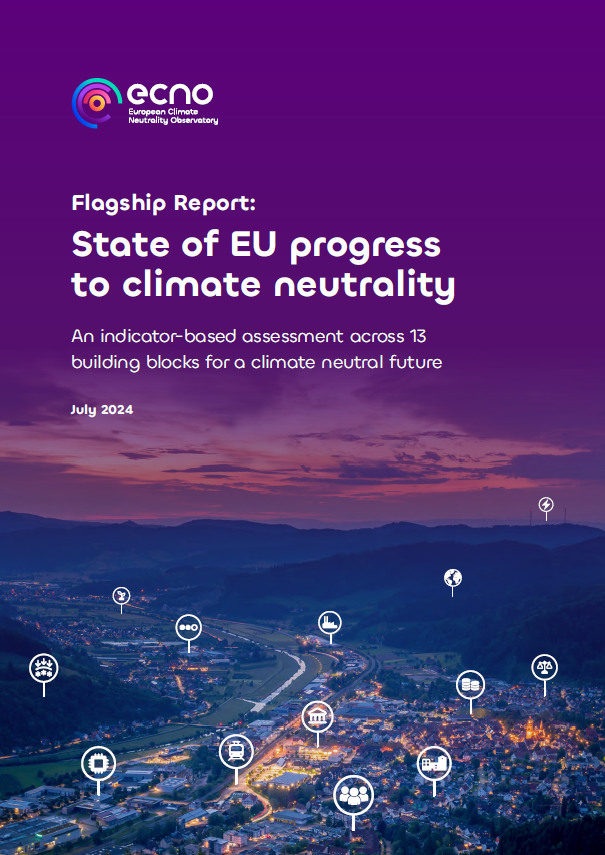
 
The image is a cover page for a report titled "State of EU progress to climate neutrality." The cover features the following elements: Title: The title "State of EU progress to climate neutrality" is prominently displayed in bold white text on a deep purple background. Subtitle: Below the title, the subtitle reads, "An indicator-based assessment across 13 building blocks for a climate neutral future." Date: The date "July 2024" is shown below the subtitle.

©European Climate Neutrality Observatory (ECNO) 2024

The EU is making promising progress on the road to climate neutrality but needs to keep up the pace to achieve the goal. This is the result of the second progress report by the European Climate Neutrality Observatory (ECNO), which has analysed developments in over 100... Read more

Velten, Eike Karola et al. 2024: Flagship Report: State of EU progress to climate neutrality. An indicator-based assessment across 13 building blocks for a climate neutral future. European Climate Neutrality Observatory (ECNO).
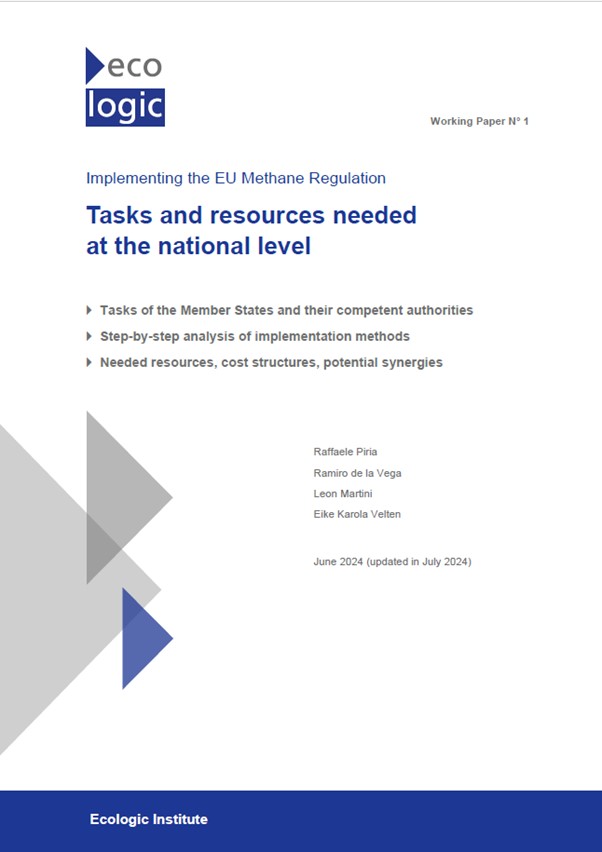
 
Updated cover page

Ecologic Institute

The EU Methane Regulation (EU-MER) is crucial for reducing methane emissions from the energy sector, thereby enhancing our chances at achieving the climate targets. This paper describes the tasks of the Member States' responsible ministries and competent authorities,... Read more

Piria, Raffaele, Ramiro de la Vega, Leon Martini and Eike Karola Velten 2024: Implementing the EU Methane Regulation, Working paper N° 1. Tasks and resources needed at the national level. Ecologic Institute, Berlin. Available at: https://www.ecologic.eu/19718
 
Cover of Ecologic institute's report "Analysis of the implementation of EU provisions for the clean energy transition in selected Member States"

© Ecologic Institute 2024

Since 2019 the European Union has introduced a range of new laws as part of its "Clean Energy for All Europeans" package. In 2022, the RePower EU Plan was launched with the aim of accelerating the deployment of renewable energy in response to the Russian invasion of... Read more

Sina, Stephan et al. 2024: Analysis of the implementation of EU provisions for the clean energy transition in selected Member States. Ecologic Institute, Berlin.
 
Cover of the report

© Ecologic Institute

To achieve international climate goals, a green hydrogen market must emerge over the coming decades. Green hydrogen will be a key component in the transition to climate neutrality, especially in sectors where direct electrification using renewable energy is not feasible... Read more

Görlach, Benjamin, Michael Jakob and Ramiro de la Vega (2022): Pathways Towards a Global Market for Green and Sustainable Hydrogen. Need for Action and Policy Options. Ecologic Institute, Berlin.
 
Cover of a report titled 'Evaluation 2020/2021 of the Innovative Climate Protection Projects under the National Climate Initiative (NKI)', commissioned by the German Federal Ministry for Economic Affairs and Climate Action. Featuring logos from associated research institutes like IFEU, ICE, Öko-Institut, Ecologic, Prognos, and Fraunhofer ISI, with 'Prof. Dr. Stefan Klinski' noted as the author.

© Oeko-Institut 2023

The latest evaluation of the innovative climate protection projects for the period 2020 to 2021 is now available. During this evaluation period, the projects accomplished an additional 0.41 million metric tonnes of CO2 reductions, alongside notably higher indirect... Read more

Velten, Eike Karola, de la Vega, Ramiro, Kögel, Nora (2023): Evaluation 2020/2021 des Förderaufrufs „Innovative Klimaschutzprojekte“ im Rahmen der Nationalen Klimaschutzinitiative (NKI). Bericht zum Vorhaben Evaluation, Begleitung und Anpassung bestehender Förderprogramme sowie Weiterentwicklung der Nationalen Klimaschutzinitiative (NKI). Ecologic Institute: Berlin.
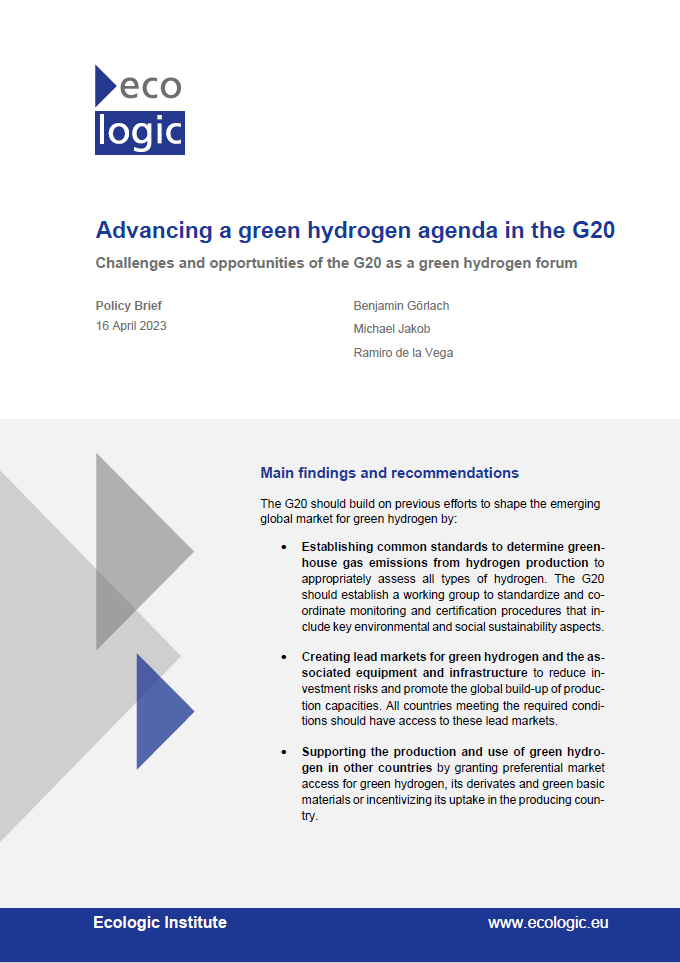
 
Cover page of the policy brief "Advancing a Green Hydrogen Agenda in the G20" with the main finding and recommendations

© Ecologic Institute

This policy brief aims to support the work of NGOs and think tanks by developing elements of a green hydrogen agenda for the G20. Based on an analysis of the heterogeneous interests and agenda of the G20 countries, the first part discusses the challenges and... Read more

Benjamin Görlach, Michael Jakob, Ramiro de la Vega (2023): Advancing a green hydrogen agenda in the G20. Challenges and opportunities of the G20 as a green hydrogen forum. Ecologic Institute, Berlin
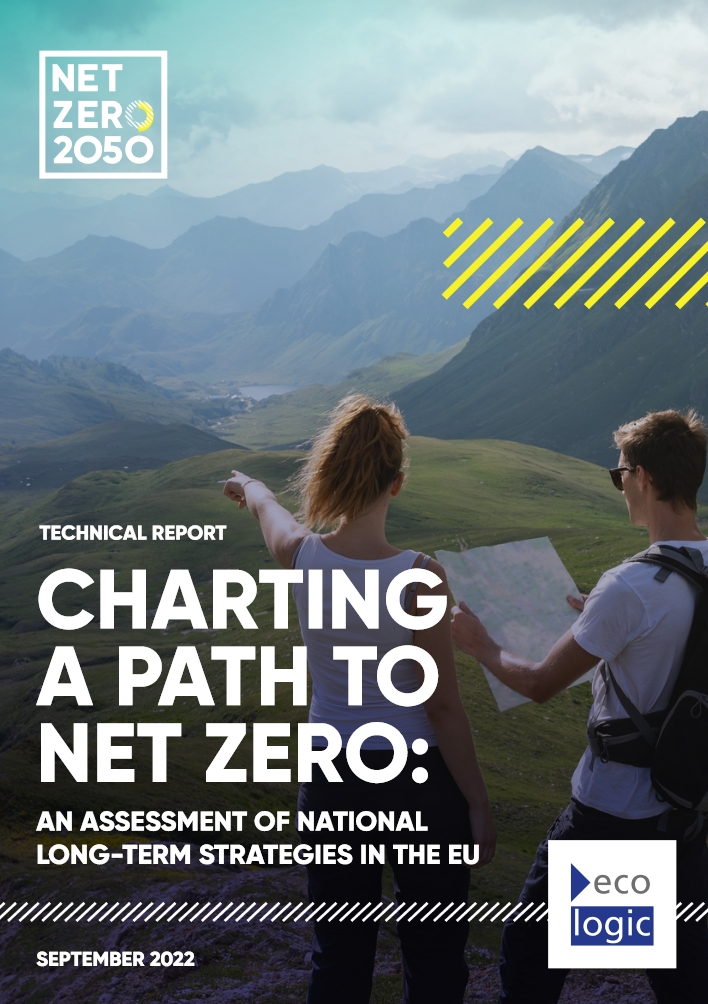
 
Cover of the publication with net zero 2050 and Ecologic logo. Background image: Two young hikers in the mountains holding a map and looking down into the valley.

© Ecologic Institute

This report presents the findings from an assessment of 22 long-term strategies (LTSs) of the EU Member States available as of March 2022. It is complemented by a briefing that summarizes the key findings and recommendations, as well as an overview of the underlying... Read more

Velten, Eike Karola, Nick Evans, Deyana Spasova, Matthias Duwe, Ramiro de la Vega, Laurens Duin, and Harrison Branner (2022): Charting a path to net zero: An assessment of national long-term strategies in the EU. Ecologic Institute, Berlin.