© Ecologic Institute, 2026
Toward Nature-Positive Finance
Ecologic Institute at Biodiversa+ Expert Workshop
- Event
- Date
-
- Location
- Paris, France
On 10 June 2026, Ecologic Institute participated as invited experts in the Biodiversa+ workshop “Toward Nature-Positive Finance: Scientific Foundations for Action”, bringing scientific perspectives into the evolving field of biodiversity finance. The invitation-only event convened representatives from central banks, financial institutions, investors, the European Commission, business coalitions, and the research community to explore how scientific knowledge and emerging methodologies can help identify and manage nature-related risks, inform decision-making, and redirect financial flows toward biodiversity-positive outcomes.
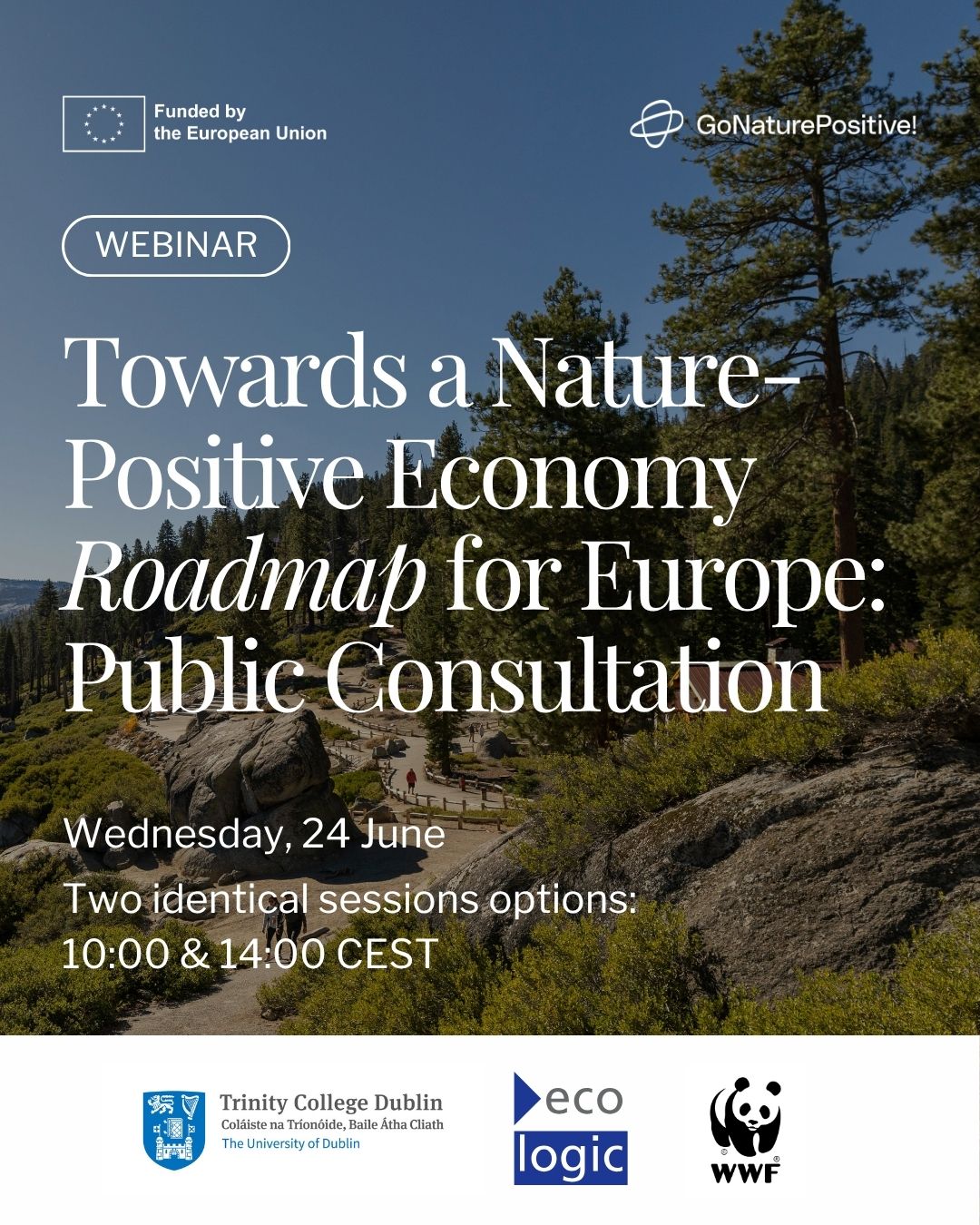
As part of the workshop, Ecologic Institute’s Teresa Spantzel and Dr. Benjamin Kupilas co-organised a dedicated session on the EU Nature Restoration Regulation (NRR). The session focused on the challenge of securing long-term financing for large-scale ecosystem restoration and highlighted the close links between nature, the economy, and societal well-being. Participants discussed the broader need to transition towards a nature-positive economy that reduces environmental impacts while actively improving the state of nature. This vision is being advanced through the Horizon Europe-funded GoNaturePositive! project, in which Ecologic Institute is a partner. The restoration of ecosystems underpins a nature-positive economy, a priority that is being reflected in the NRR and the development of National Restoration Plans (NRPs). The implementation of these restoration measures will strongly depend on long-term, credible financing mechanisms to support implementation over the coming decades. Given growing pressure on public funding, mobilising private capital for restoration is becoming increasingly important in restoration finance.
A particular highlight of the session was the launch of the Biodiversa+ policy brief “Enabling Public-Private Partnerships (PPPs) to Finance EU Nature Restoration”, which was co-authored by Dr. Benjamin Kupilas through the BiodivRestore Knowledge Hub. The brief explores the role that PPPs could play in financing nature restoration across Europe and outlines a series of recommendations for policymakers involved in implementing the NRR and developing NRPs and emphasises the need for enabling conditions such as clear rules, long-term contracts, credible monitoring, and risk-sharing mechanisms to make restoration finance more scalable and effective.
The workshop also explored nature credits as an emerging nature-related financial instrument. McKenna Davis participated in the session, contributing to discussions on the conditions needed for these instruments to support credible and effective biodiversity outcomes. Participants also highlighted the importance of learning from both the successes and shortcomings of carbon markets, including the need for robust governance frameworks, transparent methodologies, credible monitoring and verification systems, and clear approaches for demonstrating additionality and ensuring the long-term durability of biodiversity outcomes. Ecologic Institute’s contributions to the workshop draw on expertise developed across research on ecosystem restoration and the NRR, including assessing the potential costs of the NRR, supporting the drafting of the German National Restoration Plan, and enhancing synergies in Alpine nature restoration planning, as well as the EU funding programmes. Through its engagement, Ecologic Institute continues to strengthen the links between science, policy, and finance in support of EU biodiversity objectives and the effective implementation of the NRR.
The workshop concluded with discussions around a joint statement on “Nature-related risks: from scientific evidence to financial decision-making”, which reaffirmed the commitment of participating institutions to accelerate the transition towards nature-positive finance by aligning financial flows with biodiversity goals and strengthening the role of science in informing policy and financial decisions.


Contact

- Funding
-
European Commission, Directorate-General Research & Innovation (DG Research & Innovation), International - Organizer
-
European Biodiversity Partnership (Biodiversa+), International Banque de France, France BiodivRestore Knowledge Hub, International French Foundation for Biodiversity Research (FRB), France - Partner
-
Ecologic Institute, Germany - Team
- Date
-
- Location
- Paris, France
- Language
-
English
- Project
- Project ID
- Keywords
-
nature-positive finance, biodiversity finance, nature-related risks, biodiversity loss, ecosystem services, sustainable finance, biodiversity restoration, natural capital, biodiversity policy, science-finance interfaceEuropenature-related risk assessment, environmental accounting, biodiversity accounting, biodiversity modelling, scenario analysis, biodiversity indicators, methodological validation, stakeholder engagement, Indigenous knowledge integration, decision-support tools
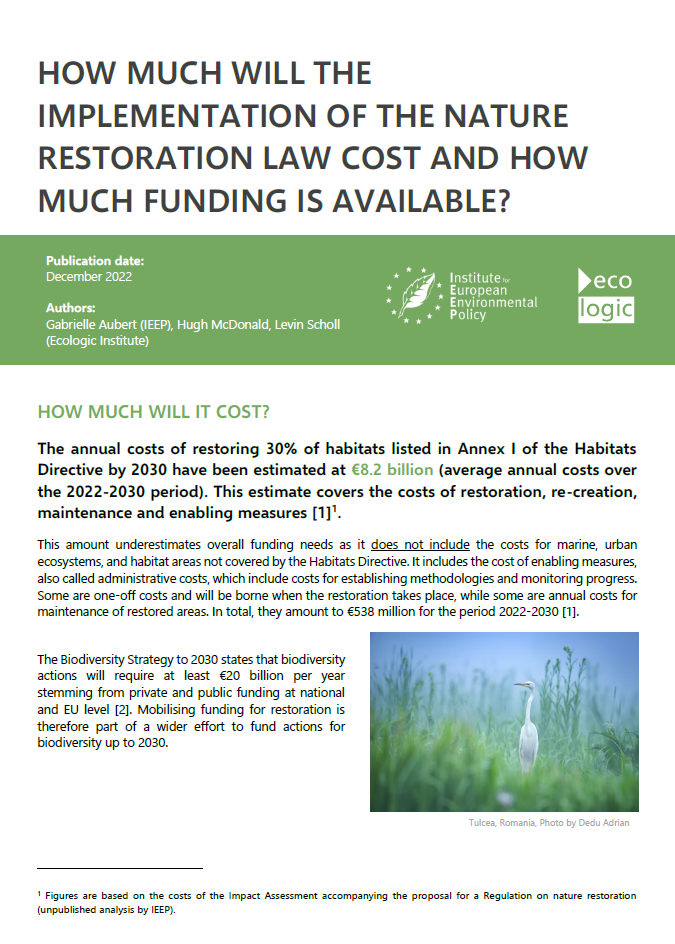
Aubert, Gabrielle; Hugh McDonald, Levin Scholl 2022: How much will the implementation of the Nature Restoration Law cost and how much funding is available? IEEP, Ecologic Institute: Brussels, Berlin.
Supporting the National Implementation of Nature Restoration Targets
- Duration
-
-
- Funding
-
Federal Agency for Nature Conservation (BfN), Germany
Spantzel, Teresa; McKenna Davis; Dr. Benjamin Kupilas 2025: Enhancing Synergies in Alpine Nature Restoration Planning. Online Workshop Results. Ecologic Institute: Berlin.
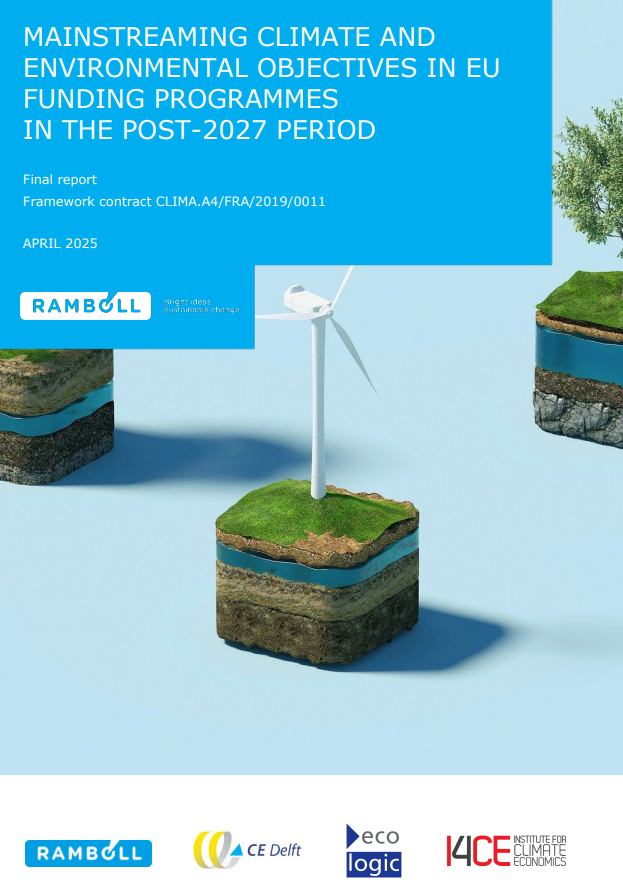
European Commission: Directorate-General for Climate Action, CE Delft, Ecologic Institute, I4CE – Institute for Climate Economics and Ramboll Management Consulting, Mainstreaming climate and environmental objectives in EU funding programmes in the post-2027 period – Final report, Publications Office of the European Union, 2025, https://data.europa.eu/doi/10.2834/5817834
Kupilas, B., Burgos, N., Davis, M., Elkina, E., McDonald, H. (2025). Mapping policy and co-operative initiative landscapes for systemic change towards a nature-positive economy (Deliverable 1.3). GoNaturePositive! Horizon Europe Grant Agreement No. 101135264, European Commission. https://doi.org/10.5281/zenodo.15309698 Available at: https://www.gonaturepositive.eu/resources