
Photo: Canva.com, Cover: Elsevier, 2026
Environmental Pharmaceutical Index – a practical information, classification and dissemination system for medication in Germany
- Publication
- Citation
Woitaske-Proske, C., Hein, A., Vidaurre, R., Heni, Y., Peifer, C., Gassner, U., & Maack, G. (2026). Environmental Pharmaceutical Index – a practical information, classification and dissemination system for medication in Germany. Sustainable Chemistry and Pharmacy, 52, 102439. https://doi.org/10.1016/j.scp.2026.102439
Pharmaceutical residues enter the environment worldwide through excretion after use and improper disposal and can cause significant ecotoxicological effects while also contributing to the pollution of water resources used for drinking water production and food production. Although pharmaceuticals are indispensable for public healthcare, their environmental impacts are rarely considered during prescribing or dispensing. A newly developed Environmental Pharmaceutical Index (EPI) aims to integrate environmental information systematically into pharmaceutical and medical decision-making. The objective is to balance therapeutical needs and environmental impacts by supporting the selection of therapeutically equivalent medicines with lower environmental impacts without compromising patient care.
A practical environmental information, classification and dissemination system
The proposed Environmental Pharmaceutical Index consists of three interconnected components: an environmental information system, an environmental classification system, and a dissemination system. The information system is designed to collect substance-based environmental information, primarily from Environmental Risk Assessments (ERA) conducted during the European marketing authorisation process. The authors propose using the German Environment Agency's ChemInfo database as the central information platform. Based on the outcomes of the ERA risk assessment and hazard assessment, the system introduces a practical traffic light classification with the categories red, yellow, green and grey. This classification enables healthcare professionals to compare active pharmaceutical ingredients (APIs) within the same indication group and to identify substances of environmental concern while maintaining transparency regarding the underlying scientific evidence.
International experience informed the German concept
The concept builds on an evaluation of existing environmental information and classification systems in Sweden, Finland and Scotland. The study combined scoping literature reviews, qualitative stakeholder interviews, expert panel meetings, stakeholder workshops, and a feasibility analysis. The results demonstrate that environmental information is most effective when it is integrated directly into existing therapeutic decision-making processes rather than requiring additional information searches during routine clinical practice. Accordingly, the proposed dissemination strategy includes integration into pharmacy and doctors' office management software, therapeutic guidelines, formularies, and other established healthcare information systems to support environmentally informed prescribing and dispensing.
Supporting eco-directed pharmaceutical prescribing
The Environmental Pharmaceutical Index is intended to complement established therapeutic decision-making rather than replace it. Environmental aspects should only influence the choice of treatment where multiple therapeutically equivalent treatment options are available. Therapeutic efficacy, patient safety and clinical appropriateness remain the primary considerations. In the long term, the authors identify opportunities to integrate environmental information into market authorisation, reimbursement decisions, discount agreements of health insurance companies, labelling, and therapeutic guidelines. By combining a scientifically robust environmental information system with practical dissemination approaches, the proposed concept aims to facilitate eco-directed pharmaceutical prescribing and reduce the environmental burden of pharmaceuticals in Germany.
The study "Environmental Pharmaceutical Index – a practical information, classification and dissemination system for medication in Germany" was carried out by researchers from Christian-Albrechts-University of Kiel, the German Environment Agency (Umweltbundesamt, UBA), the Ecologic Institute, and Augsburg University.
Contact

- Language
-
English
- Authorship
- Funding
-
German Environment Agency (UBA), Germany - Published in
- Sustainable Chemistry and Pharmacy
- Published by
-
Elsevier, International - Year
- ISSN
-
2352-5541
- DOI
- Project
- Project ID
- Table of contents
-
Click to show full table of contents
- Keywords
-
Pharmaceuticals in the environment, sustainable pharmacy, sustainable prescribing, environmental classification system, pharmaceuticals in the environment, environmental pharmacology, environmental risk assessment, pharmaceutical residues, water protection, sustainable healthcare, environmental classification of pharmaceuticalsGermanyScoping Review, literature search, qualitative interviews, stakeholder analysis, feasibility study, concept development, Environmental Risk Assessment (ERA)
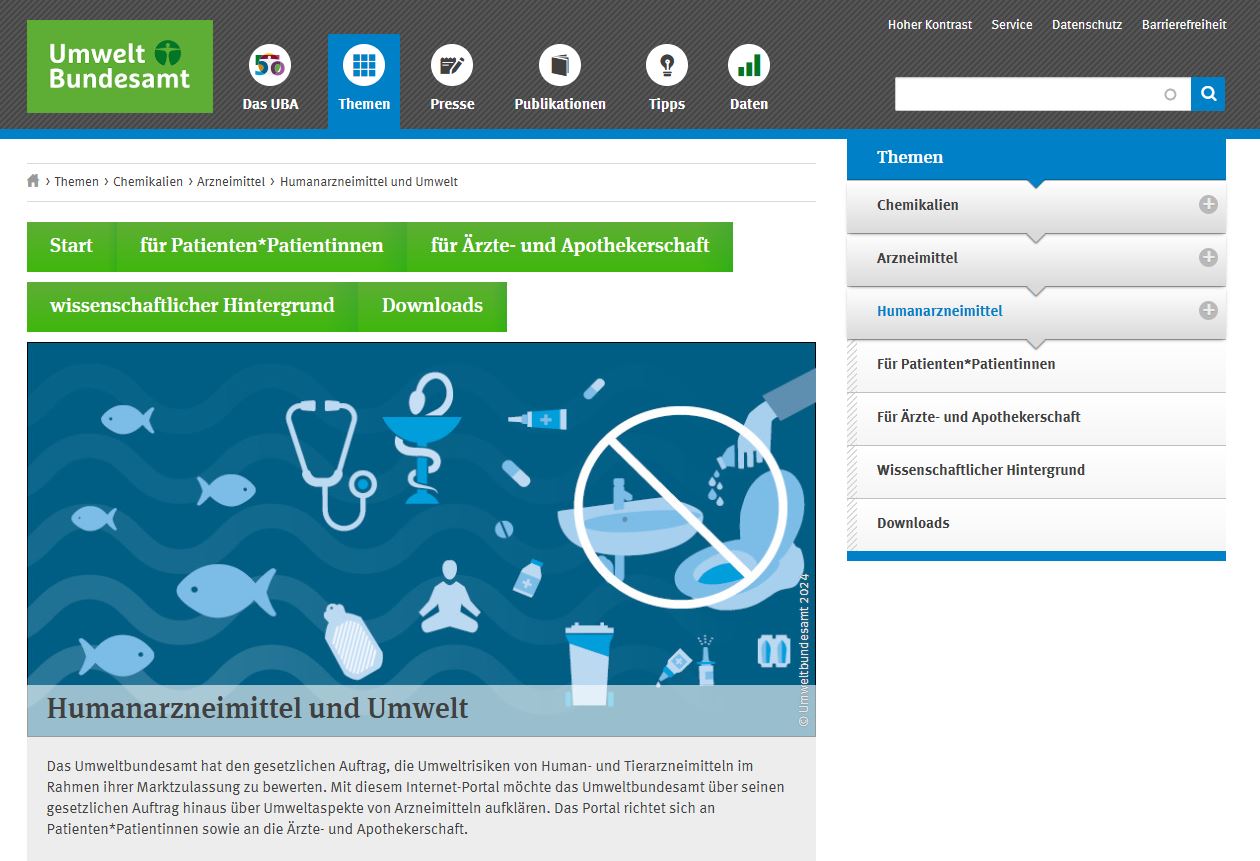
German Environment Agency (Ed.) 2025: Pharmaceuticals and the Environment. Internet portal. Dessau-Roßlau. URL: www.uba.de/en/hmp
Information and Teaching Materials for an Environmentally Conscious Use of Pharmaceuticals
- Duration
-
-
- Funding
-
German Environment Agency (UBA), Germany
Effects of pharmaceuticals on the environment
- Duration
-
-
- Funding
-
German Environment Agency (UBA), Germany