How can sustainability be firmly embedded in the education of medical and pharmaceutical professionals? A research article in the International Journal of Sustainability in Higher Education explores this question in the German context. The authors identify structural barriers that currently hinder the systematic integration of sustainability and present a political roadmap for higher education, vocational training and continuing professional development.
The EU’s Carbon Removals and Carbon Farming (CRCF) Regulation has established a framework for the certification of carbon farming. Yet credible certificates alone will not create demand. In an article published in Ökologisches Wirtschaften, Aaron Scheid of Ecologic Institute explains why binding climate targets for the agricultural sector are also needed.
Although pharmaceuticals are indispensable for public healthcare, their environmental impacts are rarely considered during prescribing or dispensing. A newly developed Environmental Pharmaceutical Index (EPI) aims to integrate environmental information systematically into pharmaceutical and medical decision-making. The objective is to balance therapeutical needs and environmental impacts by supporting the selection of therapeutically equivalent medicines with lower environmental impacts without compromising patient care.
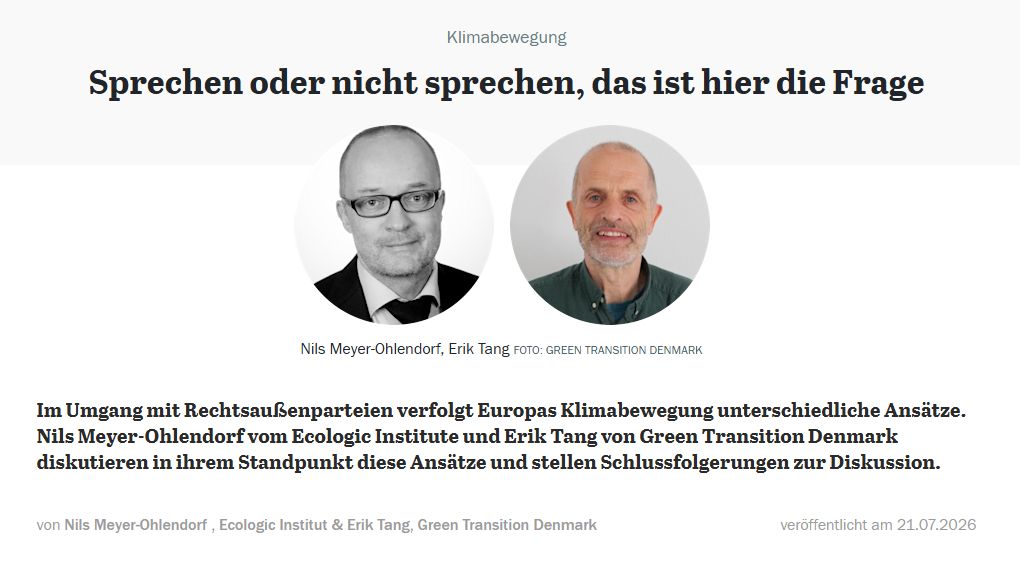
Europe’s climate movement has adopted different approaches to engaging with far-right parties. In this Tagesspiegel opinion piece, Nils Meyer-Ohlendorf of the Ecologic Institute and Erik Tang of Green Transition Denmark discuss these approaches and draw conclusions. The views expressed are solely those of the authors.
The European Commission’s proposed Omnibus Simplification Package aims to streamline the authorisation of pesticides and reduce regulatory burdens within the European Union. However, a new Policy Forum article published in Science argues that the proposal could significantly weaken environmental risk assessment procedures and increase risks to biodiversity and human health. According to the authors, the current EU pesticide framework already contains important gaps, including insufficient consideration of impacts on many non-target organisms, cumulative effects of multiple pesticides, and sublethal ecological impacts. Rather than addressing these shortcomings, the Omnibus proposal may exacerbate them.
In this article Dr. Stephan Sina provides an overview of the key provisions of the Directive, with a focus on water protection offences, and examines, based on the planned implementation in Germany, the extent to which the Directive facilitates the prosecution of water crime. This is also of interest to Switzerland, as the Council of Europe Convention on the Protection of the Environment through Crime Law, adopted in 2025, is modelled on the Directive.
A new Roundtable published by The Nature of Cities asks a central question for the planning and implementation of nature-based solutions: whose voices shape decisions, and who remains unheard? Curated by McKenna Davis of Ecologic Institute and Natalia Andrea Burgos Cuevas of the IUCN, the Roundtable brings together 29 contributors from around the world to reflect on what meaningful inclusion, co-creation and environmental justice can look like in practice.
To assess current knowledge and identify future research priorities, approximately 40 experts from academia, policy institutions, and the science–policy interface convened in Berlin in September 2025 for an international workshop on the Arctic land–ocean carbon cycle. The outcomes of these discussions have now been published in a meeting summary co-authored by Arne Riedel Escobar of Ecologic Institute, providing a roadmap for future research and policy engagement.
Nature-based solutions (NbS) at the landscape scale are increasingly recognised for their role in supporting biodiversity, enhancing ecological connectivity and contributing to climate change adaptation. However, their assessment and implementation remain complex. This article examines these challenges using the concept of pondscapes – networks of ponds and their surrounding terrestrial habitats – as a case for landscape-scale NbS.
This article examines how innovations in stakeholder engagement can contribute to sustainability transitions in water governance. Based on a systematic review of 61 studies, the paper shows that engagement approaches take diverse forms and often combine multiple governance modes. Public authorities frequently act as initiators, while civil society actors play a central role in many cases.
Drawing on structured expert workshops across Europe, this study identifies key scientific, governance, and socio-economic conditions for making MPAs “climate-ready”. The findings highlight that resilient MPAs must be ecologically robust, socially inclusive, supported by coherent governance frameworks, and adaptable to changing ocean conditions.
Coastal wetlands deliver critical ecosystem services but remain highly degraded by anthropogenic and climatic pressures. This study presents an integrated structural, functional, and socio-economic assessment of Marjal dels Moros, a managed Mediterranean brackish marsh in eastern Spain, to evaluate restoration effectiveness and inform climate-based management. Six subsites representing well-preserved, altered, and restored conditions were analyzed for water and sediment properties, microbial community composition, and greenhouse gas (GHG) fluxes, alongside a multi-criteria socio-economic evaluation of restoration scenarios.
Myanmar is a global biodiversity hotspot, home to over 570 freshwater fish species and many endemics. Yet its rivers face mounting pressure from pollution, land-use change and declining water quality. This study co-authored by Ecologic Institute's Dr. Benjamin Kupilas offers novel insights into how tropical fish communities respond to these stresses.
This guest article by Christoph Heinrich, published in the Table.Forum Biodiversity (Table.Media), outlines the central importance of biological diversity for the functioning of ecosystems and for human livelihoods.
This paper analyses the European Union's (EU) policy framework, alongside international and regional agreements relevant to wetland conservation and restoration, focusing on coastal ecosystems. Drawing on policy content analysis, it assesses how 36 EU policies and multilateral agreements support or limit coastal wetland restoration and conservation efforts in Europe.