
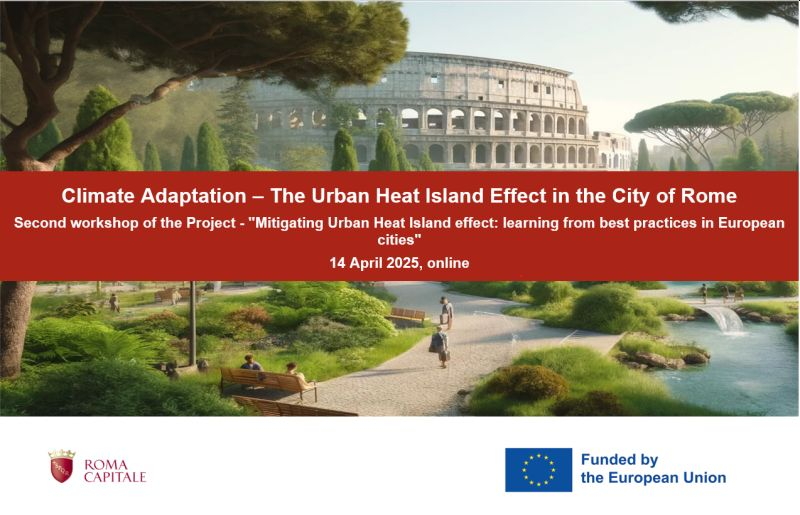
Climate Adaptation – The Urban Heat Island Effect in the City of Rome
Draft action plans for the mitigation of the urban heat island effect in two pilot areas
- Publication
- Citation
European Union. 2025. Climate adaptation – The Urban Heat Island effect in the city of Rome. D4 – Draft action plans for the mitigation of the urban heat island effect in two pilot areas. Brussels: European Union.
As heatwaves become more frequent and intense across Europe, cities face growing risks to public health, infrastructure and quality of life. These risks are amplified by the urban heat island effect: densely built-up areas with sealed surfaces and limited vegetation can become significantly hotter than their surroundings. Reducing this effect is therefore a central part of urban climate adaptation.
This report presents practical action plans for mitigating urban heat in two pilot areas of Rome: Centocelle–Alessandrino and the historic city centre. The two areas reflect contrasting urban conditions, from residential neighbourhoods facing socio-economic challenges to densely used public spaces and tourist routes in the city centre.
From heat-risk analysis to practical interventions
The publication translates heat-risk analysis into proposed measures for selected streets, squares and public spaces. The pilot areas were identified using information on heat exposure, social vulnerability, local physical conditions and implementation feasibility, supported by consultation with Roma Capitale and the municipalities concerned.
The report includes:
- site-specific action plans for the two pilot areas;
- packages of measures combining greening, shading, permeable and reflective surfaces, improved pedestrian spaces and climate shelters;
- guidance on responsibilities, implementation barriers, financing and possible funding sources;
- a monitoring and evaluation framework;
- recommendations for applying the approaches in other parts of Rome.
Microclimate modelling was used to assess how selected interventions could affect air and surface temperatures, humidity and thermal comfort. The report also considers costs, expected benefits, maintenance needs and the wider contribution of the measures to wellbeing, biodiversity and more liveable public spaces.
Examples from Vienna, Athens, Barcelona, Valencia, London and Berlin provide further insights into how European cities are addressing urban heat through planning, greening, climate shelters, rainwater management and participatory approaches.
Ecologic Institute co-authored the report as part of a consortium led by PwC EU Services with ENEA and Roma Tre University. Ecologic Institute led the benchmarking of urban heat mitigation approaches in European and Italian cities. This work contributed evidence on transferable practices and implementation conditions for the development of the Rome action plans.
Contact

- Language
-
English
- Authorship
- Funding
-
Directorate-General for Structural Reform Support (DG REFORM), International - Published by
- Year
- Dimension
- 146 pp.
- Project
- Project ID
- Table of contents
-
Click to show full table of contents
- Keywords
-
urban heat island, extreme heat, climate adaptation, urban resilience, nature-based solutions, urban greening, climate shelters, thermal comfort, heat vulnerability, public spaceRome, Italy, Vienna, Athens, Barcelona, Valencia, London, BerlinInternational best practice benchmarking, comparative policy analysis, comparative case study analysis, multi-criteria assessment, scoring framework development, indicator-based evaluation, good practice assessment, transferability assessment, gap analysis, governance analysis, evidence synthesis, and policy recommendation development
Ecologic Institute 2025: Tackling Urban Heat: tools for city planners. Video. Online: https://youtu.be/dQsADGjNqsU
Ecologic Institute 2025: Increasing Flood Resilience: tools for city planners. Video. Online: https://youtu.be/nIPD_DnoOq0.
Climate Adaptation Naturally!
- Duration
-
-
- Funding
-
German Environment Agency (UBA), Germany
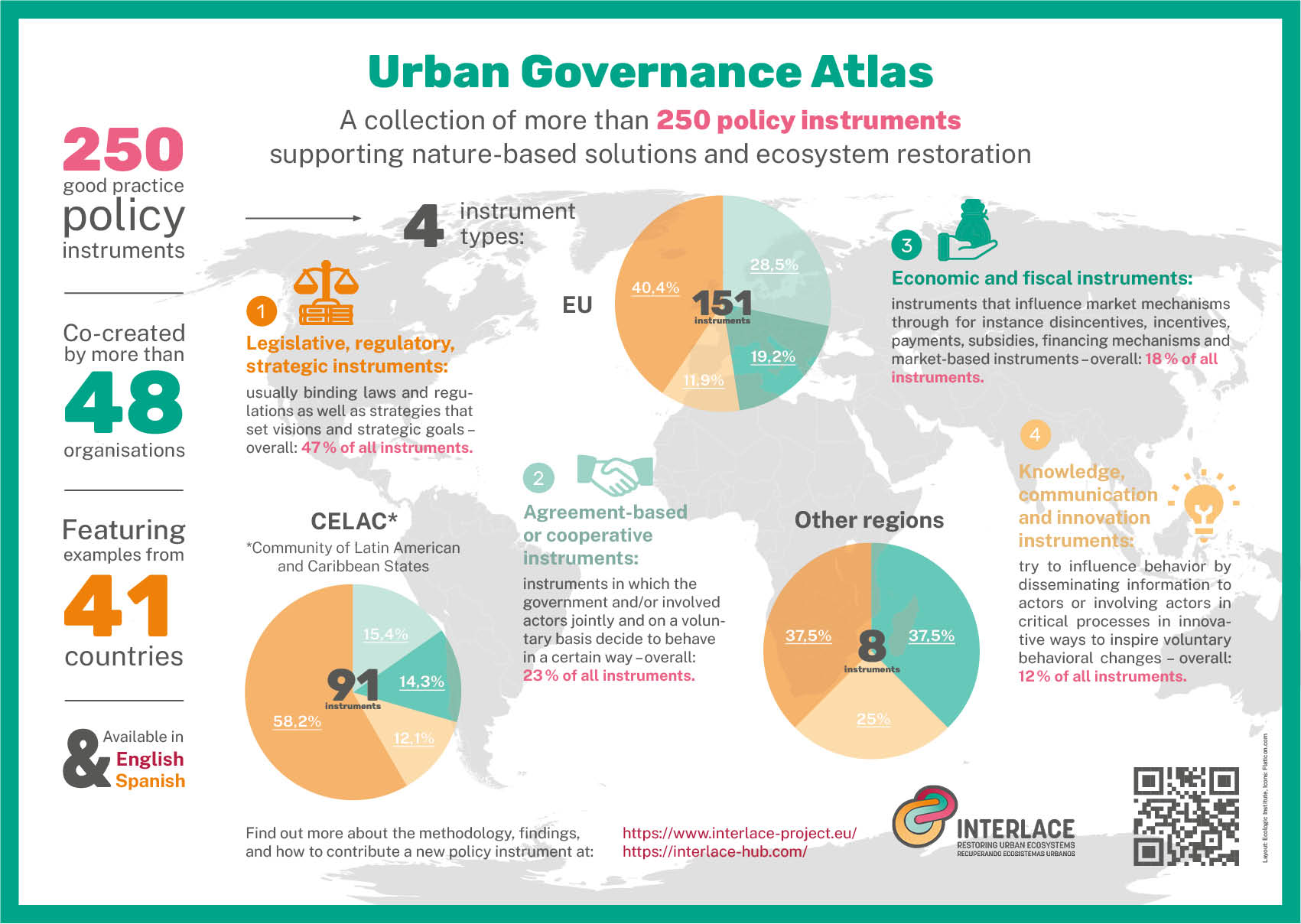
INTERLACE project consortium 2023: Urban Governance Atlas. Interactive database. Published on 11 May 2023. Online: https://interlace-hub.com/urban-governance-atlas.
Mederake, Linda; Bueb, Benedict; Felthöfer, Charlotte (2026): Naturbasierte Klimaanpassung mit Stadtkarten. Ein Leitfaden für Kommunen. Herausgegeben vom Umweltbundesamt, Fachgebiet I 2.8 – Vorsorgende Umsetzungsstrategien und Instrumente der Klimawandelanpassung, Aktionsprogramm Natürlicher Klimaschutz. Dessau-Roßlau. ISSN 2363-832X.