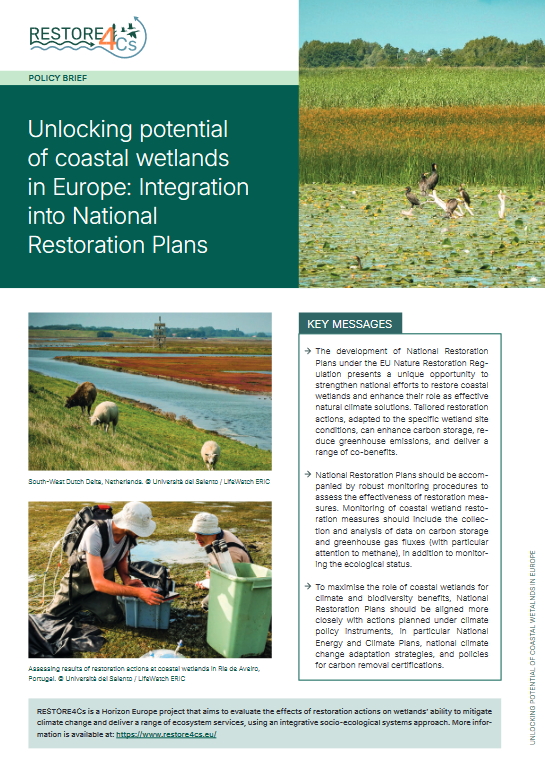
© Ecologic Institute, 2026. Cover: RESTORE4Cs. Background photo: Herbert Aust on Pixabay.
European Coastal Wetland Indicators
A proposal for monitoring policy processes across space and time
- Publication
- Citation
Otero, M. M., Abdul Malak, D., Sanchez A., Schröder, C., Kampa, E., Bueb B., Elkina, E., Guelmani, A., Camacho, A., Marangui, C., Lillebø, A., 2025. European Coastal Wetland Indicators: A proposal for monitoring policy process across space and time. Policy brief. Restore4Cs project.
Protecting and restoring coastal wetlands is embedded in several European environmental and climate policies. But assessing whether these efforts are succeeding requires comparable information on how wetlands are changing over time. A RESTORE4Cs policy brief proposes a common set of indicators to make progress measurable across Europe.
Eight indicators for a common monitoring framework
The proposed framework comprises eight policy indicators covering key dimensions of coastal wetland conservation and restoration. These include the extent and representativity of coastal wetlands in protected areas, changes in ecosystem condition, restoration progress, vulnerability to climate-related hazards, greenhouse gas emissions and removals, agricultural management and funding.
Each indicator is linked to quantitative metrics. Restoration progress, for example, could be assessed through the area of wetlands restored or under restoration, changes in hydrological connectivity and improvements in water quality. Climate mitigation can be monitored by tracking greenhouse gas emissions and removals associated with wetland conversion and restoration.
Combining spatial data with field observations
The authors propose combining remote sensing, GIS, modelling and data analysis with in situ measurements. This would allow changes in wetland extent and condition to be monitored across large areas while retaining information that requires observations on the ground.
A harmonised approach could also reduce fragmentation between reporting requirements and help connect monitoring under different EU policies, including the Nature Restoration Regulation, the Habitats and Water Framework Directives, and climate policy.
From policy targets to measurable progress
The proposed indicators are intended to provide a basis for assessing whether conservation and restoration measures are delivering the intended results. Establishing common baselines and periodically applying comparable indicators would make it possible to track changes over time and evaluate progress against European targets.
The policy brief 'European Coastal Wetland Indicators: A proposal for monitoring policy processes across space and time' was developed within the Horizon Europe project RESTORE4Cs.
Contact