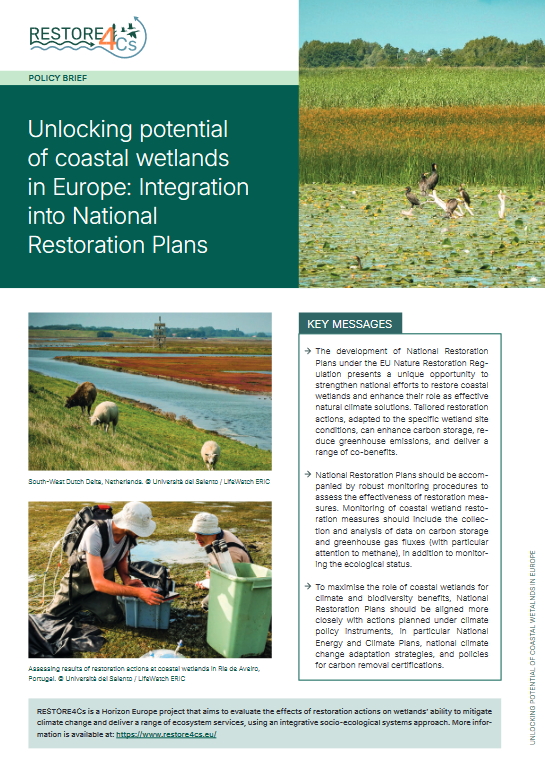
© Ecologic Institute, 2026. Cover: RESTORE4Cs. Background photo: Herbert Aust on Pixabay.
Advancing Policy Integration Across Mediterranean Countries
Aligning with the Barcelona Convention and International Commitments Through a Common Evidence-Based Strategy
- Publication
- Citation
Otero, M. M., Abdul Malak, D., Sanchez A., Schröder, C., 2025. Advancing Policy Integration Across Mediterranean Countries: Aligning with the Barcelona Convention and International Commitments Through a Common Evidence-Based Strategy. Policy brief. Restore4Cs project.
Mediterranean countries share commitments to protect and restore coastal wetlands, but progress is monitored through a range of regional, European and international frameworks. A common evidence base could make these efforts more coherent. A RESTORE4Cs policy brief proposes a harmonised set of indicators to help countries track progress while aligning reporting under the Barcelona Convention with wider biodiversity and climate commitments.
A common framework for Mediterranean wetlands
The proposed approach builds on the Integrated Monitoring and Assessment Programme (IMAP) under the Barcelona Convention, while establishing links with Ramsar, relevant EU policies and international biodiversity and climate targets.
Seven overarching indicator areas are proposed for the 2030 Mediterranean agenda. They cover the extent of coastal wetlands within protected areas, the representativeness and ecological condition of wetland habitats, restoration progress, vulnerability to climate-related hazards, greenhouse gas abatement from land-use change and restoration, and funding.
Each indicator is accompanied by measurable parameters. These range from changes in habitat extent and hydrological connectivity to pollutant concentrations, restoration area and greenhouse gas emissions and removals. By linking these metrics to existing IMAP Common Indicators, the framework is designed to strengthen rather than duplicate established monitoring.
Connecting regional and international commitments
A shared monitoring framework could help Mediterranean countries assess progress consistently and coordinate action across policy frameworks. This is particularly relevant because coastal wetlands contribute simultaneously to biodiversity conservation, climate mitigation and adaptation, water quality and disaster risk reduction.
The timeline presented on page 3 illustrates how targets under the Barcelona Convention already converge between 2025 and 2035, including commitments on ecosystem restoration, protected areas, pollution and climate resilience. A common set of indicators could provide the evidence needed to assess these interconnected objectives.
Better data for coordinated action
The policy brief also highlights the potential of high-resolution satellite imagery, drones and artificial intelligence to complement existing monitoring. Combined with field observations and cooperation between countries, research organisations, local institutions and communities, these technologies could improve the quality and consistency of information available for decision-making.
The policy brief 'Advancing Policy Integration Across Mediterranean Countries: Aligning with the Barcelona Convention and International Commitments Through a Common Evidence-Based Strategy' was published in 2025 by M. M. Otero, D. Abdul Malak, A. Sanchez and C. Schröder within RESTORE4Cs.
Contact