This report documents the results of three social-empirical research phases, which were carried out as work package 3 in the project "Trend Radar Resource Policy". In each case, citizens from all social milieus were surveyed within the framework of Moderated Research Online Communities on their assessment of trends identified in the project that are relevant to the use of natural resources and on the acceptance of political measures to conserve resources. The results show a high level of willingness to do more individually to protect natural resources, but also the expectation that politicians will create binding framework conditions for this.
The guideline "More sustainability through coupled infrastructures" presents a comprehensive approach on how municipalities can make their infrastructure systems more sustainable through innovative sector coupling. It emphasizes the role of new technical possibilities and the need for a systemic perspective in order to fully exploit the potential of infrastructures and focus on long-term sustainability.
The goal of the final workshop was to discuss options for action with representatives from the Berlin House of Representatives and various Senate administrations in order to jointly outline which measures and implementation steps would be effective.
Publication:Knowledge for Future – The Environment Podcast
Who allocates arable land in Germany, how can farmers lease or buy it, and what are the reasons behind its significant price increase? Charlotte Thielmann from detektor.fm explores these questions together with experts from the field.
Climate protection for 1.5 degrees calls for fundamental changes in many areas, but not in Germany's democracy. Nils Meyer-Ohlendorf discusses the relationship between climate protection and democracy in an article for the Tagesspiegel.
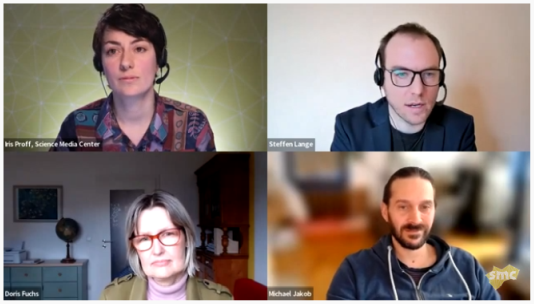
The economies and populations that are the main contributors to the climate crisis are least affected by the consequences. People in the Global South are already exposed to drought, forest fires, flooding and water shortages. According to the UN, there were some 270 million migrants worldwide in 2020. Recent forecasts predict that the climate crisis will force up to 1.2 billion people to leave their home countries by 2050. On 1 December 2021; the issue of "Migration and Climate Crisis: Challenges and Perspectives" was discussed. The discussion based on inputs by Writer Parag Khanna and human rights and environmental activist Kumi Naidoo from South Africa. The full recording of the event is available online.
Berlin has set ambitious standards for the prevention of CO2 emissions, with significantly stricter targets in the new Climate Protection Act (EWG Bln). What are the targets and opportunities, and what are still the major challenges and barriers? In order to become climate-neutral, it is imperative that the building sector be given greater consideration. The Climate Protection Act and the Berlin Energy and Climate Protection Program (BEK) 2030 emphasize the exemplary role of the public sector in this area. This means that public buildings such as school buildings are a key factor. In the districts' renovation roadmaps, schools sometimes account for more than 80 percent of the buildings that need to be renovated for energy efficiency in the next few years.
This study examines current proposals for the further expansion of photovoltaics and analyses the solutions used in Spain, the Netherlands and Austria. It shows that the two central goals – accelerating the PV expansion and involving residents – are in tension with each other, at least in the short term.
As part of the STErn project led by Ecologic Institute, an online-workshop on the socio-ecological transformation of the food system in Germany with a focus on the protein transition took place on 30 November 2021 together with 35 experts in that field. The aim of the event was to discuss possible indicators that can help to politically anchor and monitor the necessary change in dietary patterns towards more plant-based and less animal-based proteins.
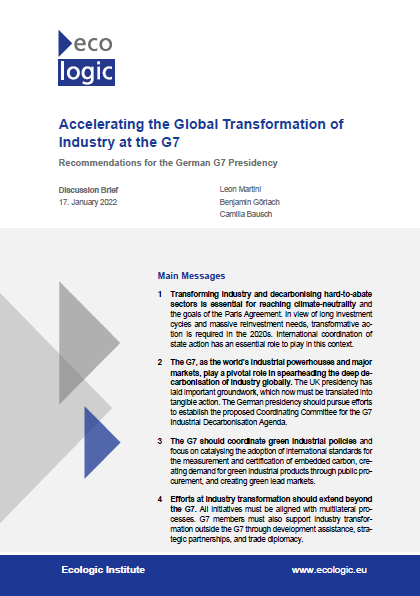
From sector coupling to hydrogen, from the implementation of the Climate Protection Legislation to the European Green Deal: Achieving climate neutrality requires coordinated and effective policy management across individual departments. Climate policy is a cross-cutting task, because all sectors, from power generation to industry, buildings, transport and agriculture, must become greenhouse gas neutral without delay. Experts from the Ariadne Copernicus project, which is funded by the German Federal Ministry of Education and Research (BMBF), have examined central problems of government control of German climate policy and presented options for solutions. The paper was also sent to negotiators of the coalition talks in the run-up to publication.
Building on the kick-off event of the "Private Households" dialog forum held in June 2021, another dialog forum was held on 25 November 2021, focusing on the topic of impact. In addition to the goal of networking relevant practitioners and facilitating an exchange of experiences, this dialog forum focused on the effective and successful planning and implementation of measures against food waste. In this result documentation, you will find a summary of the reflection as well as figures of the survey results.
On the 25 November 2021, more than 70 actors dealing with food waste reduction in Germany met for an exchange on how to plan and implement measures that create an impact. The event was part of the so-called "Dialogue Forum Private Households" that is part of the German Strategy for Food Waste Reduction.
In the coming years, the course must be set for the necessary transformation toward a society and economy that is in keeping with the needs for future generations. Science, and sustainability research in particular, has a responsibility to support this change with its resources. But what must science resemble in order to find practicable answers to the most urgent questions of the future? And what demands does this place on the research policy agenda?
This event is part of the "Knowledge for Change" series of events celebrating Ecornet's 10th anniversary.
Ten years ago, leading independent institutes of environmental and sustainability research in Germany joined forces to form the Ecological Research Network (Ecornet) in order to bring their combined knowledge to bear on the scientific landscape and society. With their practice-oriented, transdisciplinary research, the Ecornet institutes have been accompanying - and actively shaping - socio-ecological change for decades.
This paper discusses which indicator is suitable to concretize the change of dietary styles towards less animal and more plant-based products – here called "protein transition" – for political and scientific discourse. The results presented are part of the work of the research project "Socio-ecological Transformation of the Food System" (acronym STErn) carried out on behalf of UBA/BMU.
The economies and populations that are the main contributors to the climate crisis are least affected by the consequences. With the European Green Deal, the EU claims for itself a pioneering role in climate protection, but does it have solutions ready that do justice to the structural inequality and unfair distribution of social, economic and political opportunities between the communities that populate the earth? In the online event on 24 November 2021 the discussion drew on Concepts for Climate Justice, featuring Maria Fernanda Espinosa, Ecuadorian diplomat, politician, academic and former president of the 73rd UN-General Assembly. We are looking forward to your registration. The full recording of the event is available online.