The TrueFoodS project, funded under the European FutureFoodS Partnership, aims to make Europe’s post-harvest systems more sustainable, equitable, and resilient. The project adopts an integrated Food Systems Approach that considers environmental, economic, social, and regulatory dimensions.
The 2026 Market Information Talks aim to systematically address key challenges along these value chains and to develop practical solutions together with stakeholders. Building on the dialogues held in previous years, the 2026 series places a stronger emphasis on infrastructure needs.
The model regions programme "Eating Better in the Region" promotes innovative approaches to healthy and sustainable nutrition across Germany. Ecologic Institute and Technopolis Germany evaluate the extent to which the ten funded model regions achieve the five central funding objectives – ranging from increasing the use of organic products in out-of-home catering to reducing food waste – and what impacts they generate. The results serve to evaluate the funding initiative and provide insights and recommendations for the long-term continuation and transferability of successful approaches to other regions.
This project supports Carbon Market Watch to address the specific challenges of integrating temporary sequestration credits into EU agri-food climate policy. In assessing the policy options currently under discussion – emissions trading systems, mandatory climate standards, and public procurement – and examines the implications of CRCF use within these frameworks. The project also provides recommendations on how temporary carbon sequestration can be supported in a way that is environmentally credible, practically feasible, and aligned with broader EU climate objectives.
The project NormTransform seeks to quantify emission reduction potentials and the impacts of reduced meat consumption (measured in kg/CO2) in Austria, induced through advertisement campaigns.
The research project analyses the need for integrated strategies in order to ensure sustainable development and preserve the basis of life. The project focuses on analysing the challenges and interactions between the three crisis areas and the question of how measures can be designed to create synergies between climate protection, biodiversity conservation and the reduction of environmental pollution. More crises are being added, e.g. land degradation and food security.
The Ecologic Institute is providing expert support for the transformation process for the future of Hamburg's agricultural sector – in close cooperation with the project team from urban catalyst and Prof Antje Stokman (HCU Hamburg). It is developing proposals for guidelines, goals, measures and indicators as a basis for the participatory strategy process.
The EU agri-food sector is central to achieving EU climate neutrality, but emissions from agriculture have not fallen fast enough and the sector also faces growing climate risks, as well as environmental, social and economic pressures. Against this backdrop, the European Scientific Advisory Board on Climate Change (ESABCC) commissioned technical support to help assess how EU policy can better strengthen mitigation, adaptation and resilience in the agri-food system.
The Brandenburg Action Plan for Organic Agriculture has been implemented since 2022 and aims to increase the proportion of organically farmed land in the state to 20 per cent by 2024. As part of the Action Plan for Organic Agriculture, product-related market information meetings will be organised to bring together market players from the agricultural and food sectors and discuss current developments, challenges and opportunities. These talks are key to strengthening the regional organic value chain and promoting dialogue between producers, processors and marketers.
The consumption of dairy, eggs and meat causes damage to the environment in various places in the supply chain, such as climate change, eutrophication and the emission of harmful substances such as ammonia (which contributes to nitrogen problems) and particulate matter. The TAPP Coalition (True Animal Protein Price Coalition) requests a European-oriented policy proposals to pass on the price of dairy, eggs and meat so that it reflects the actual costs to society and to calculate these for economic and environmental effects for the EU-27 involving two case studies for Germany and France.
Ecologic Institute designed and facilitated the participatory process for the development of the Brandenburg Food Strategy. Through a multi-stage dialogue, stakeholders from government, business, academia, and civil society jointly developed objectives and measures for a sustainable food system.
What are possible alternatives to synthetic chemical pesticides without promoting the renaissance of genetic engineering? This brief study intends to provide an overview of the current state of science on possible alternatives to synthetic chemical pesticides and to be understandable for non-experts.
Agri-food systems in Central Eastern Europe are key to achieving the EU climate goals. To deliver these goals, strategic planning and integrated policies are needed that will enable reduced emissions, increased carbon removals, and at the same time support biodiversity and adaptation. Ambitious climate targets for the agri-food sector are needed, as well as alignment of the national strategic plans under the Common Agricultural Policy with climate targets and the European Green Deal objectives.
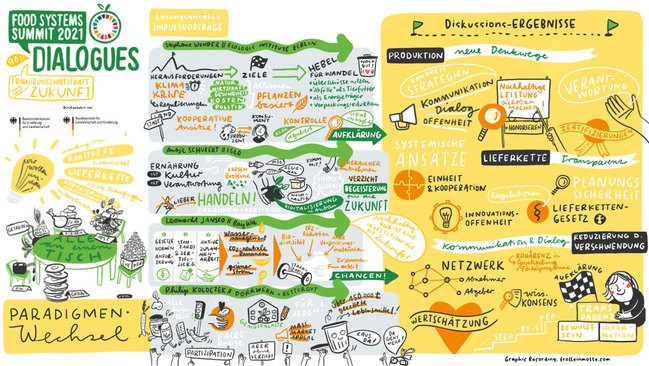
In the forefront of the UN Food Systems Summit, Germany held the National Dialogue on "Pathways to Sustainable Food Systems" in June 2021 with more than 400 participants. This dialogue will be continued in 2022. Two of the five core topics of the dialogue dealt with a) a more plant-based diet in the future and b) the food economy of the future. The project "Summary and Outlook of the National Dialogue 2021 'Pathways to Sustainable Food Systems'" analyses the results achieved in these areas and develops conclusions for the further process on this basis.
The European Consumer Food Waste Forum is a multi-disciplinary forum set up in October 2021 by the Joint Research Centre, which seeks to enable the EU's transition to a sustainable food system by finding solutions and developing tools that help to reduce food waste at the consumer level, including household and food services. Stephanie Wunder and 15 other practitioners and researchers will identify and develop multi-dimensional tools to curb consumer food waste, considering both the motivation of consumers as well as their ability and opportunity to change related behaviour. The tools will be multi-level addressing both the role of consumers and that of other key players engaged in food waste reduction. These will contribute to the work of the EU Platform on Food Losses and Food Waste and that of other players to help reduce consumer food waste.