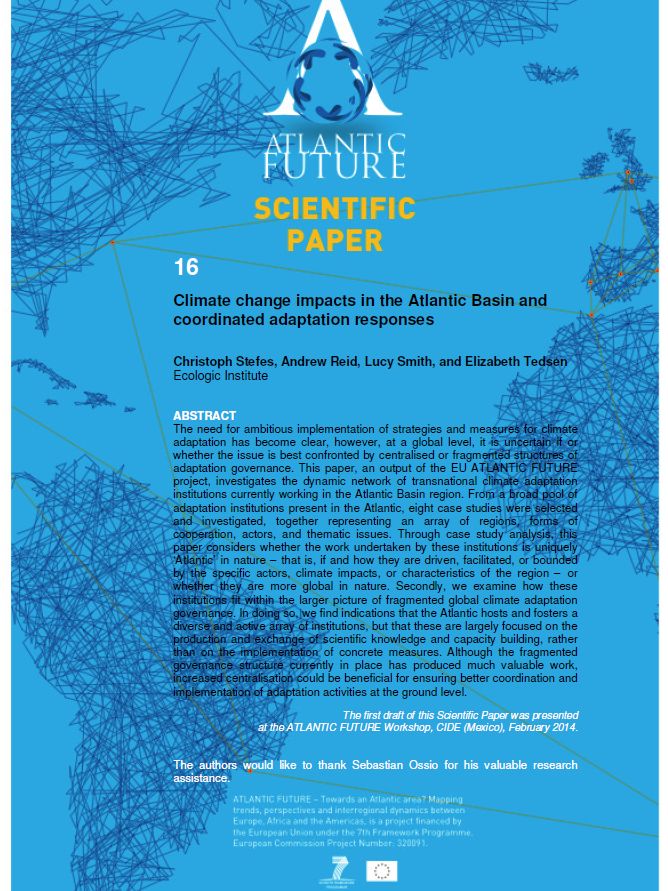
Stefes, Christoph; Andrew Reid; Lucy Smith et. al. 2014: Climate Change Impacts in the Atlantic Basin and Coordinated Adaptation Responses. ATLANTIC FUTURE scientific paper no. 16, Berlin.
This collection of country reports assesses climate and energy policies in all 28 Members States of the European Union (EU). The reports support the DG CLIMA of the European Commission in its contributions to the European Semester. Focusing on the period between February 2013 and November 2013, the reports provide insight into national policy developments and progress towards the achievement of the EU’s climate and energy targets. The reports are available for download.
In this analysis for the French Institute of International Relations (IFRI), Camilla Bausch, Matthias Duwe and Benjamin Görlach discuss how the outlook for an ambitious climate and energy have shifted with the start of Angela Merkel's third term in office, and the new political constellation. The authors discuss both the challenges at the national level, Germany's possible role in the EU climate and energy policy, and the effect on international climate negotiations. The analysis is available for download.
This study, launched in October 2012, seeks to identify performing EPR schemes for different waste streams (e.g. ELV, WEEE, Batteries, Packaging, Paper, Used Oil) and prepare detailed case studies, in order to identify common characteristics across schemes, which could serve as a guide for improving the effectiveness of such schemes. The study should allow the Commission to formulate new proposals to ensure an optimal use of EPR schemes. The study is available for download.
Chapman, Sophie; Martijn Wilder; Alfred Gichu et al. 2014: Creating an Enabling Legal Framework for REDD+ Investments in Kenya. Baker & McKenzie, Cambridge Centre for Climate Change Mitigation Research, Cambridge.
Based on a comprehensive analysis of the existing regulatory framework and its gaps, the authors of Ecologic Institute identify general options and specific recommended actions for the effective governance of geoengineering. A key consideration is that the recommendations can be implemented in practice.
An important part of the work for the "European Union Action to Fight Environmental Crime" (EFFACE) project, coordinated by Ecologic Institute, is the analysis of the costs and impacts of environmental crime. The work includes the collection and analysis of data and information on the extent and the impacts of environmental crime and attempts to estimate the economic costs of the different types of environmental crime. The report "Understanding the Damages of Environmental Crime" is available for download.
The fourth RADOST annual report provides a comprehensive overview of activities and results of the RADOST project in the period from April 2012 to January 2013. The richly illustrated volume describes the state of research and networking in the six focus areas of coastal protection, tourism and beach management, water management and agriculture, ports and maritime economy, conservation and land use as well as renewable energies. The report is available for download.
After five years of research and dialog about climate change and adaptation along the German Baltic Sea coast, the RADOST project (Regional Adaptation Strategies for the German Baltic Sea Coast) presents its most important findings in this final report. Thanks to a joint effort between research institutions, businesses, public administrations, and civil society, adaptation strategies and measures were developed. The final report is available for download.
Deliverable B of the two-part report on "Multilevel Governance of our Natural Capital" provides a set of recommendations targeting Member States and local and regional authorities. These aim to support the achievement of the EU Biodiversity Strategy’s targets for 2020 and the implementation of CBD Decision X/22. The recommendations are the result of an analysis that was based on the findings from an online survey and desk research. The document presents a set of headline recommendations and elaborates on each recommendation with a more detailed explanation and illustrative examples.
The report was prepared by Ecologic Institute and ICLEI. It was conducted for the Committee of the Regions (CoR) to inform the CoR's contribution to the review of the EU Biodiversity Strategy and contribute to the monitoring of the implementation of CBD Decision X/22 within the Member States. The main task of the study was the collection and analysis of information from the 28 Member States and their regions and cities on the involvement of local and regional authorities in the implementation of the EU Biodiversity Strategy and CBD Decision X/22. The report is available for download.
Davis, M; Rouillard, J; Lukat, E; Stein, U; Tröltzsch, J; Vidaurre, R. (2014). Compilation of best practice examples and experiences of adaptation plans. Deliverable D4.1, BeWater, FP7 project no. 612385 -SIS.2013.1.2-1 European Commission, 67 pp.
To achieve the Europe 2020 goals the EU installed the European semester, a yearly cycle of European policy coordination. Although it was supposed to effect the national level, it also influenced regional and local developments. Thus economic and fiscal governance in the European Union were boosted. This report presents two concepts for an indicator which measures regional progress.
Wunder, Stephanie; Martin Hirschnitz-Garbers; Timo Kaphengst 2014: Ressourceneffizienz und Flächeninanspruchnahme. Nexus-Papier 2 im Projekt Ressourcenpolitik: Analyse der ressourcenpolitischen Debatte und Entwicklung von Politikoptionen (PolRess). www.ressourcenpolitik.de