
Aaron Scheid

Aaron Scheid

MSc (Global Change Management)

Coordinator Agriculture & Soils
Senior Fellow

Team
Topics

Aaron Scheid is a senior agricultural policy expert with extensive experience at the science-policy interface of EU agricultural and land use policy. At Ecologic Institute, he coordinates the Agriculture & Soils team and leads work on the agriculture-climate nexus with a specific focus on carbon removals and carbon farming and the agriculture-water nexus with a specific focus on climate resilient agricultural landscapes and peatland rewetting. Aaron Scheid works in German and English.

Aaron Scheid brings along a comprehensive understanding of public and private incentive and financing mechanisms for climate-smart agriculture with a core focus on the EU Common Agricultural Policy (CAP). Aaron Scheid leads the project MoorNet (research and technical support for the implementation of the national peatland protection strategy Germany and networking of stakeholders) and the report on Leveraging the Common Agricultural Policy to Accelerate Livestock Emission Reductions. In addition, he contributes to the following projects: Guidelines for Climate-Resilient Landscapes and the three Horizon Europe projects Climate Farm Demo, Carbon Farming Monitoring and Registry (CAFAMORE) and Biodiversity And Landscape restoration through Agricultural systems for Nature Conservation and resilient farm Economies (BALANCE). Furthermore, he is a member of the EU Expert Group on Carbon Removals.

Before joining Ecologic Institute, Aaron Scheid worked as a research assistant for a member of the German Parliament, focusing on policies related to agriculture, forestry and fisheries in the time period from 2018 until 2021. His work was dedicated mainly to the committee for food and agriculture.

Aaron Scheid has completed a master's degree in Global Change Management at the Eberswalde University for Sustainable Development (HNEE). He wrote his thesis on small scale farmers' adaptation measures to fuelwood scarcity in central Tanzania in cooperation with the Leibniz Centre for Agricultural Landscape Research (ZALF).

Contact Aaron Scheid by Email

The data sent will only be processed for the purpose of processing your request. You will find further information in our privacy notice.

Selected projects by Aaron Scheid
The Guidance on Climate Resilient Landscapes project, financed by DG CLIMA, will develop actionable guidance to strengthen climate resilience in Europe's rural landscapes. With floods, droughts, heatwaves, and wildfires becoming more frequent and severe, landscapes need... Read more

Guidance on Climate Resilient Landscapes

Duration
-
Funding
 

© Sandra Naumann

Peatlands are ecosystems for a variety of specialised plant and animal species and serve as important natural carbon reservoirs. They also have a regulating effect on the water and nutrient balance and a cooling evaporation effect, which is important for the local and... Read more
 
CFD Logo

CFD Logo

|

Copyright: Climate Farm Demo Consortium

Climate Farm Demo is a unique pan-European network of Pilot Demo Farmers covering 28 countries and all pedo-climatic areas. Its overall aim it to accelerate the adoption of Climate Smart Farming (CSF) practices and solutions by farmers and all actors of the Climate... Read more

A European-wide Network of Pilot Farmers for a Carbon Neutral Europe (Climate Farm Demo)

Duration
-
Funding
 

cafamore.eu

Carbon farming is increasingly considered in EU climate and land-use policy, but its uptake is constrained by persistent challenges related to monitoring, reporting and verification (MRV), baseline setting, and trust in certificates. Fragmented data sources,... Read more

Carbon Farming Monitoring and Registry (CAFAMORE)

Duration
-
Funding
 
Carbon farming holds great promise as a business model that rewards land managers for implementing practices that contribute to mitigating climate change. Actions that increase soil carbon sequestration and storage offer mitigation potential while posing a number of... Read more

Building Momentum and Trust to Achieve Credible Soil Carbon Farming in the EU (CREDIBLE)

Duration
-
Funding
Selected publications by Aaron Scheid
 

Photo: DiAuras, CC BY-SA 4.0, via Wikimedia Commons, Cover: Climate Farm Demo project, 2026

This policy brief examines how current climate-action rewarding mechanisms address – or fail to address – organic farming as a systemic and climate-resilient approach. It analyses existing monetary, regulatory and supportive instruments at EU level, with a particular... Read more

Scheid, Aaron et al. (2026): Incentivizing systemic and climate-resilient farming approaches through rewarding mechanisms. Barriers, challenges and recommendations. Policy brief of the Horizon Europe project "A European-wide network of pilot farmers implementing and demonstrating climate smart solutions for a carbon neutral Europe".


© Foto: Yulian Alexeyev via Unsplash; Cover: Climate Farm Demo, 2025

Europe's agricultural sector holds tremendous potential to advance climate and environmental goals, but realizing that potential depends on the right mix of funding and targeted support. This report, led by Ecologic Institute together with partners in the Climate Farm... Read more

Scheid, Aaron; Pazmino Murillo, Julia; McDonald, Hugh et al. (2025): Incentivizing farm-level climate action through rewarding mechanisms. A categorization framework. Deliverable of the Horizon Europe project "A European-wide network of pilot farmers implementing and demonstrating climate smart solutions for a carbon neutral Europe".


Photo: Shumwai,CC BY-SA 4.0, via Wikimedia Commons, cover: Ecologic Institute, 2025

This report, by Ecologic Institute and Öko-Institut, explores how potential EU policy instruments – such as the proposed Agricultural Emissions Trading System (AgETS), Mandatory Climate Standards (MCS), and public procurement programmes – can integrate carbon farming... Read more

McDonald, H., Siemons, A., Fallasch, F., Gardiner, J., Scheid, A., Scheffler, M., and Wiegman, K. (2025). Temporary carbon units from carbon farming and EU agri-food climate policy: Assessment of risks, opportunities, and alternatives for promoting temporary carbon sequestration. Ecologic Institute, Berlin.


Photo: Canva.com, Cover page: Ecologic Institute, EDF, IEEP, 2025

Cutting Livestock Emissions: Can the CAP Deliver? EU agriculture is on the front line of environmental and economic challenges. Farmers face mounting climate pressures while struggling to secure fair livelihoods. Livestock production alone makes up about 65% of the... Read more

Scheid A, Hart K, Pazmino J, Riedel A, Tremblay L-l, Durrant L (2025) Leveraging the Common Agricultural Policy to accelerate livestock emission reductions – examples from five Member States, Ecologic Institute and IEEP
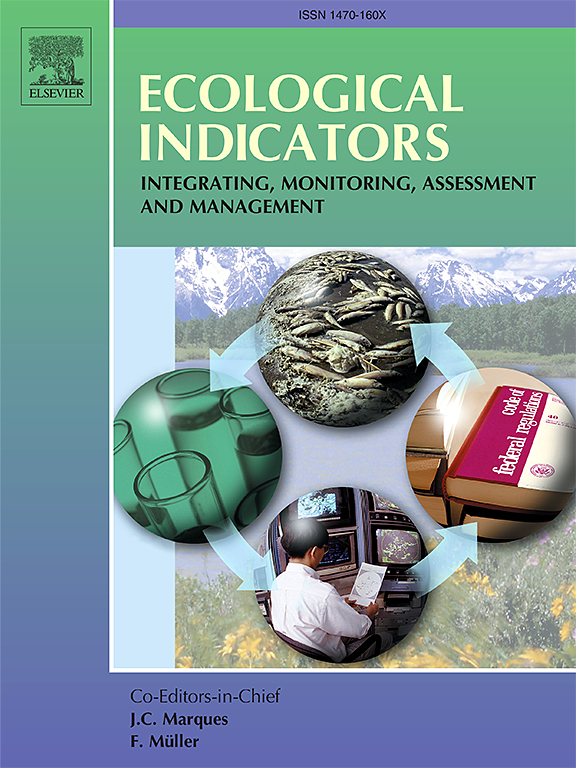
 
Cover of the journal 'Ecological Indicators' from Elsevier. The title is: 'Ecological Indicators: Integrating, Monitoring, Assessment and Management'. The cover shows four pictures connected by arrows: a picture of laboratory bottles, a picture of dead fish, a picture of a man in front of several computer monitors and a picture of a book entitled 'Codex Federal Regulations'. Snow-covered mountains can be seen in the background. The publishers are J.C. Marques and F. Müller.

© 2024 Elsevier B.V.

Peatlands provide numerous important ecosystem services, including climate regulation through carbon sequestration and storage, water regulation, nutrient retention and wildlife habitat. Despite their importance, healthy peatlands worldwide are being reduced and... Read more

Tanneberger, Franziska et al. (2024) 'Quantifying ecosystem services of rewetted peatlands − the MoorFutures methodologies' Ecological Indicators 163 (2024), p. 112048. doi: 10.1016/j.ecolind.2024.112048.
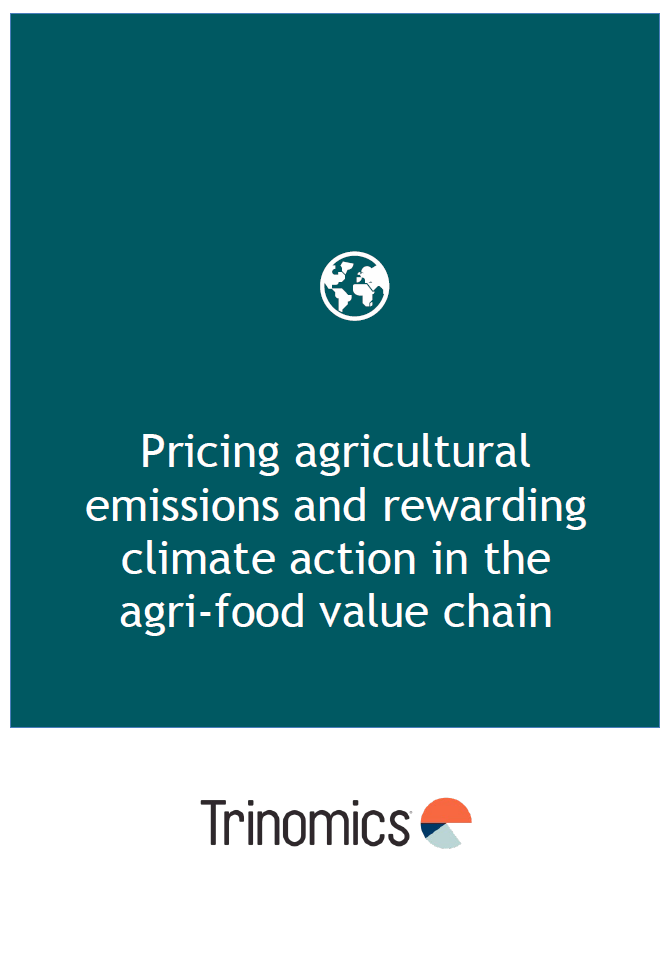
 
Report cover with a deep teal background. At the top, a small white circular logo with a stylized image of the Earth. Below the logo, in large, white, sans-serif font, the title 'Pricing agricultural emissions and rewarding climate action in the agri-food value chain'. At the bottom of the cover, the company logo 'Trinomics' with its characteristic half-circle colored graphic.

© Trinomics 2023

The agriculture and land sectors must mitigate greenhouse gas emissions for the EU to meet its climate targets. In a new report published by the European Commission's DG CLIMA, Ecologic Institute, IEEP, and Trinomics investigate how an emissions trading system (ETS)... Read more

Bognar, Julia et al. 2023: Pricing agricultural emissions and rewarding climate action in the agri-food value chain. Rotterdam: Trinomics.
 
Cover Page of Report on: Environment and climate assessment of Germany’s CAP Strategic Plan

© IEEP

This report identifies and assesses the likely contribution of Germany's CAP Strategic Plan to climate mitigation and adaptation, natural resources, and biodiversity protection. Overall, the findings are that there is potential for an ambitious CAP 2023-2027 period with... Read more

Scheid, A. and S. Ittner (2023) 'Assessment of the German CAP Strategic Plan: environmental and climate contributions', Policy report, Institute for European Environmental Policy and Ecologic Institute
 
Cover of the policy paper "Transforming EU land use and the CAP: a post-2024 visioni"

© IEEP

Discussions are getting underway on the post-2027 CAP – covering the period up to 2034 – with the Commission's proposals expected in July 2025. These will be drawn up by a new EU administration following the 2024 EU elections. It is in this context that this paper makes... Read more

Baldock, D. and Bradley, H. (2023) ‘Transforming EU land use and the CAP: a post-2024 vision', Policy Paper, Institute for European Environmental Policy
 
Cover of the report "Carbon farming co-benefits. Approaches to enhance and safeguard biodiversity"

© Ecologic Institute

On 19 December 2022, at the COP15 in Montreal, 196 countries historically agreed on the post-2020 Global Biodiversity Framework, which sets global biodiversity targets to stop and reverse biodiversity loss by 2030. In coherence with the proclaimed UN decade for... Read more

Scheid, Aaron et al. 2023: Carbon farming co-benefits: Approaches to enhance and safeguard biodiversity. Berlin, Brussels: Ecologic Institute, IEEP.
 
Cover of the report "Role of soils in climate change mitigation"

© German Environment Agency

This report examines the mitigation potential of climate friendly soil management practices at global, EU and German level, along with key management measures, their co-benefits and trade-offs, and implementation challenges. Globally, soils store two to three times... Read more

Frelih-Larsen, Ana et al. 2022: Role of soils in climate change mitigation. Interim Report. Climate Change 56/2022. German Environment Agency: Dessau-Roßlau.
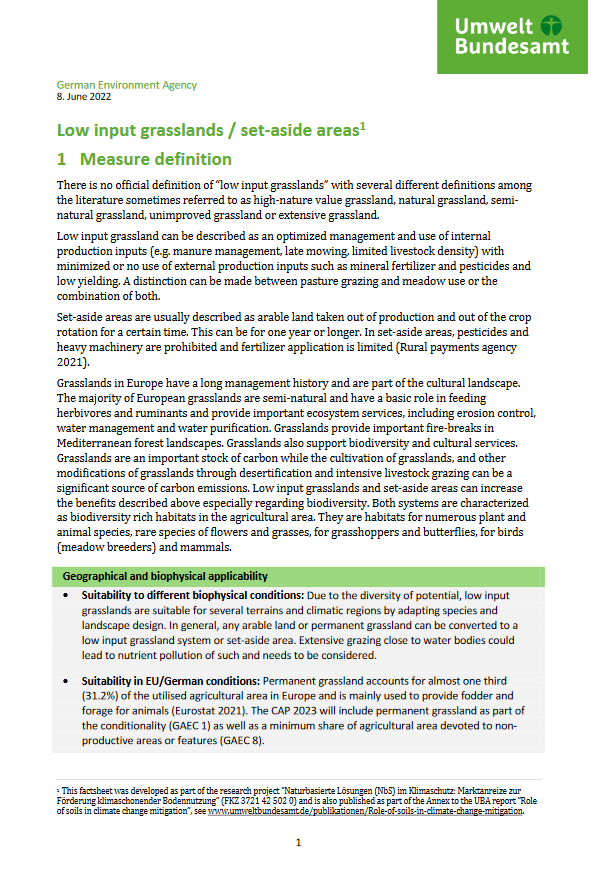
 
Cover of the fact sheet "Low input grasslands / set-aside areas"

© German Environment Agency

Scheid, Aaron et al. 2022: Low input grasslands / set-aside areas. Factsheet. German Environment Agency: Dessau-Roßlau. ... Read more

Scheid, Aaron et al. 2022: Low input grasslands / set-aside areas. Factsheet. German Environment Agency: Dessau-Roßlau.
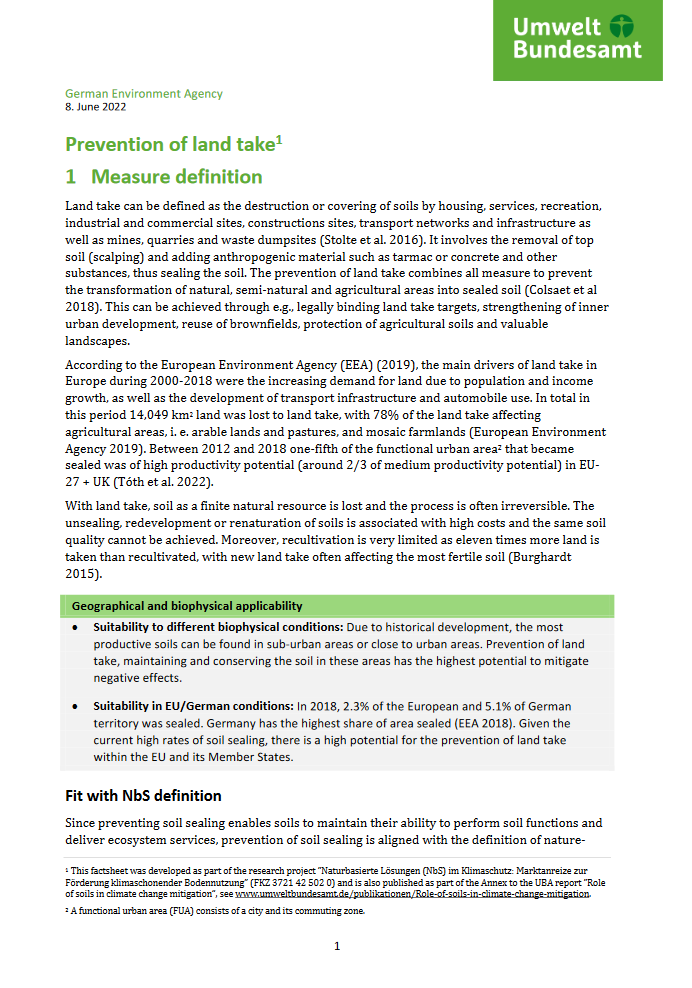
 
1st page of the fact sheet "Prevention of land take"

© German Environment Agency

Scheid, Aaron et al. 2022: Prevention of land take. Factsheet. German Environment Agency: Dessau-Roßlau. ... Read more

Scheid, Aaron et al. 2022: Prevention of land take. Factsheet. German Environment Agency: Dessau-Roßlau.
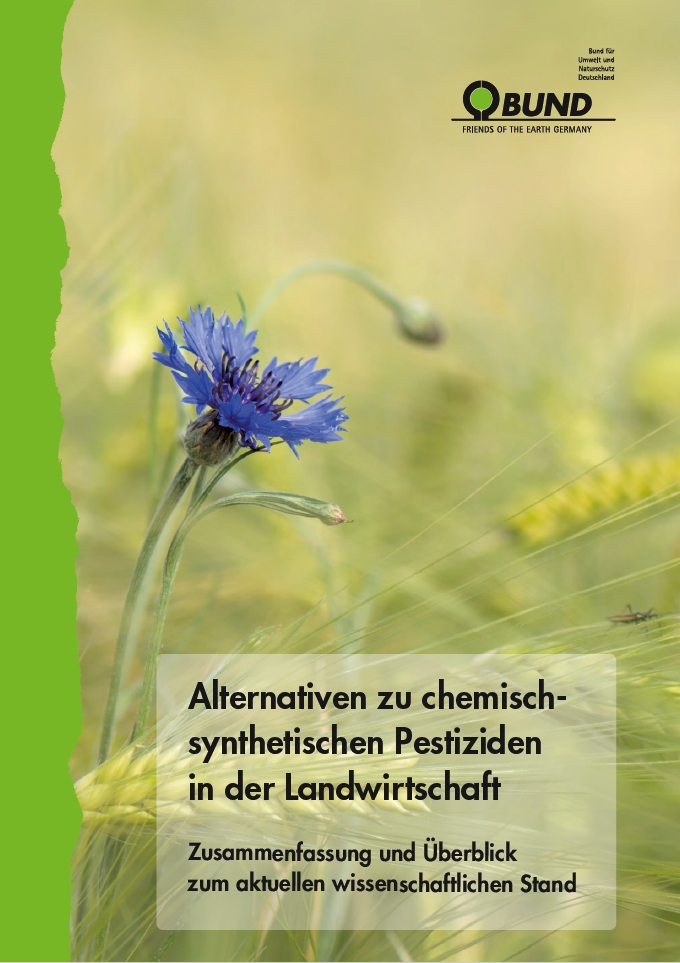
 
Cover of the study "Alternativen zu chemisch-synthetischen Pestiziden in der Landwirtschaft. Zusammenfassung und Überblick zum aktuellen wissenschaftlichen Stand", with logo of BUND. Background image: Cornflower in a grain field

© Bund für Umwelt und Naturschutz Deutschland e.V. (BUND) – Friends of the Earth Germany

What are the alternatives to the use of fungicides, herbicides and insecticides? What potential do they have, and what are the preconditions for their use? Which farming measures minimize weed and parasite infestations? What can be used to attract beneficial insects?... Read more

Scheid, Aaron; May Hobeika; Antonia Riedel 2022: Alternativen zu chemisch-synthetischen Pestiziden in der Landwirtschaft. Zusammenfassung und Überblick zum aktuellen wissenschaftlichen Stand. Berlin: Bund für Umwelt und Naturschutz Deutschland e.V. (BUND)
 
Cover of the Think2030 policy brief "Towards a Transformative Sustainable Food System Legislative Framework"

© Think Sustainable Europe

This Think 2030 policy brief proceeds in five parts. Section 1 defines what a sustainable agri-food system should look like according to the scientific literature and how an Sustainable Food System (SFS) law could bring EU food systems more in line with the evidence.... Read more

Baldock, David et al. 2022: Towards a Transformative Sustainable Food System Legislative Framework. Think2030 Policy Brief.
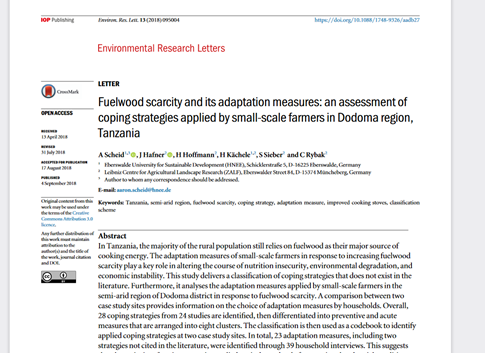
 
Screenshot of the article

copyright: IOP Science

In Tanzania, the majority of the rural population still relies on fuelwood as their major source of cooking energy. The adaptation measures of small-scale farmers in response to increasing fuelwood scarcity play a key role in altering the course of nutrition insecurity,... Read more

A Scheid et al 2018 Environ. Res. Lett. 13 095004
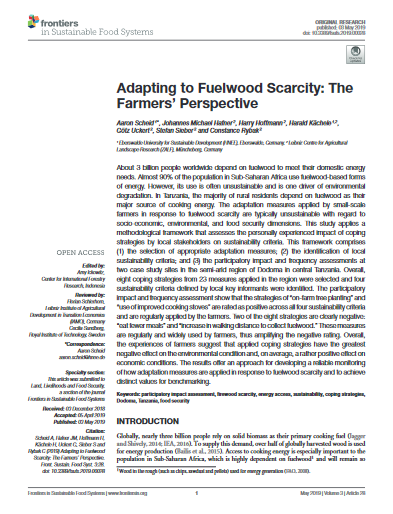
 
screenshot first page

© 2019 Scheid, Hafner, Hoffmann, Kächele, Uckert, Sieber and Rybak.

About 3 billion people worldwide depend on fuelwood to meet their domestic energy needs. Almost 90% of the population in Sub-Saharan Africa use fuelwood-based forms of energy. However, its use is often unsustainable and is one driver of environmental degradation. In... Read more

Scheid A, Hafner JM, Hoffmann H, Kächele H, Uckert G, Sieber S and Rybak C (2019) Adapting to Fuelwood Scarcity: The Farmers' Perspective. Front. Sustain. Food Syst. 3:28. doi: 10.3389/fsufs.2019.00028

Selected events by Aaron Scheid
 

The picture shows the MoorNet roll-up banner and the foyer with participants.

|

©Christian Schneider / Ecologic Institute

Peatlands were unique ecosystems that not only provided habitat for a wide range of specialized plant and animal species, but also served as significant natural carbon stores and climate regulators. In light of the extensive drainage and use of peatland areas in Germany... Read more

Conference:MoorNet Final Conference 2025

Date
-
Location
Berlin, Germany
 

Photo by Jewgenia Stasiok | pixelio.de

Insect mortality, loss of biodiversity in the agricultural landscape, but also pesticide residues in food? Surely no one wants that. As well as pesticides or their degradation products in the soil, water and air. Nevertheless, around 30,000 metric tons of pesticides are... Read more

Digital Event:Alternatives to Synthetic Chemical Pesticides in Agriculture

Date
Location
online
Selected presentations by Aaron Scheid
 

©MartinaChmielewski|Fotolia.com

On 21 March 2023, Aaron Scheid presented Ecologic Institute's analysis of the German CAP Strategic Plan at the NABUtalk on the next CAP reform. He joined State Secretary Silvia Bender and CAP experts Dr. Sebastian Lakner, Sönke Beckmann, and Dr. Norbert Röder to discuss... Read more

Panel discussion:What's in for Climate and Environment?

Date
Location
Berlin, Germany
 

Photo by Jewgenia Stasiok | pixelio.de

Food is supposed to be healthy and grown sustainably. But in reality, more and more pesticides end up on the fields and thus in our food. Mass pesticide use has devastating effects on health and the environment. Is this really necessary? What are the concrete effects of... Read more

Panel discussion:Stocktaking and Alternatives to Pesticides in Agriculture

Date
Location
online
 

-

Diverse crop rotation, mechanical weed control, beneficial insects to protect crops: According to a study commissioned by BUND, standard practice in organic farming could also be used more often by conventional farmers. Aaron Scheid from the Ecologic Institute and... Read more

Interview:Alternatives to Pesticides also Exist for Conventional Agriculture

Date
Location
Deutschlandfunk, Germany