Photo: Mehr Demokratie, CC BY-SA 2.0, via Wikimedia Commons, Cover: Ecologic Institute, 2025
Smarter, Simpler, More Effective: Options to Improve EU Clean Transition Policy
Enhancing climate policy management through simplification
- Publication
- Citation
Evans, Nick and Matthias Duwe (2025): Smarter, simpler, more effective: Options to improve EU transition policy. Ecologic Institute, Berlin.
Existing frameworks for a competitive, clean, and fair EU economy are comprehensive but complex, risking slower delivery, stalled investments, and policy fatigue. As shown by the latest report by the European Climate Neutrality Observatory (ECNO), these have been slow to deliver the necessary and wide-reaching structural changes in the EU economy and society in many areas.
As expressed by the Draghi Report and picked up in the European Commission's Simplification and Implementation Agenda, more streamlined management of the EU's climate neutrality transition could facilitate better implementation, save costs by freeing up admin capacity, and lead to more transparent and reliable policy-making. This would not only help ensure the delivery of EU objectives but also foster certainty for investors, companies, and citizens alike. In short: simpler, more predictable policymaking leads to greater trust, which in turn leads to greater investment and buy-in to a clean economic future.
This policy paper outlines the main arguments for smarter EU governance of the clean transition and explores what this could look like in practice. In the context of the ongoing revision to the Governance Regulation and general development of a post-2030 EU climate policy architecture, the brief offers eight concrete options for more effective, performance-oriented policy-making that have the potential to reduce administrative burden and regulatory complexity.
The eights options explored in the paper take several forms, including integration through the exploitation of synergies between processes and policy areas, leaner planning and reporting obligations for Member States, and enhanced data infrastructure and accessibility of information.
Eight priority actions for simpler, leaner, and more performance-oriented management of the clean transition:
- Integrate planning and reporting – link national energy and climate plans (NECP) and their reports (NECPR) in an iterative process to cut duplication
- Merge long- and short-term planning – combine long-term strategies and NECPs, and align with other sectoral plans for consistent planning over sectors and time horizons
- Integrated monitoring of related objectives – draw on synergies between systems to track progress on decarbonization, competitiveness, and just transition aims
- Adopt common indicators – introduction of a 'common core' set of data points to inform policy planning and reporting
- Streamline reporting requirements – remove low-value obligations and ensure all data serve a clear purpose
- Digitalize reporting systems – advance the EU's 'once-only' and 'digital by default' principles and explore AI-assisted tools
- Merge platforms – unify Reportnet 3 and ReportENER into a single submission interface
- Create a single transition dashboard – visualize progress across Member States and policy domains.
This research received support from the European Climate Foundation. The final paper was developed under the Kopernikus project ARIADNE, which is funded by the German Federal Ministry of Research, Technology, and Space.


Contact

- Language
-
English
- Authorship
- Funding
-
European Climate Foundation (ECF), International Federal Ministry of Education and Research (BMBF), Germany - Published by
-
Ecologic Institute, Germany - Year
- Dimension
- 24 pp
- Project
- Project ID
- Keywords
-
simplification, Governance Regulation, EUEurope
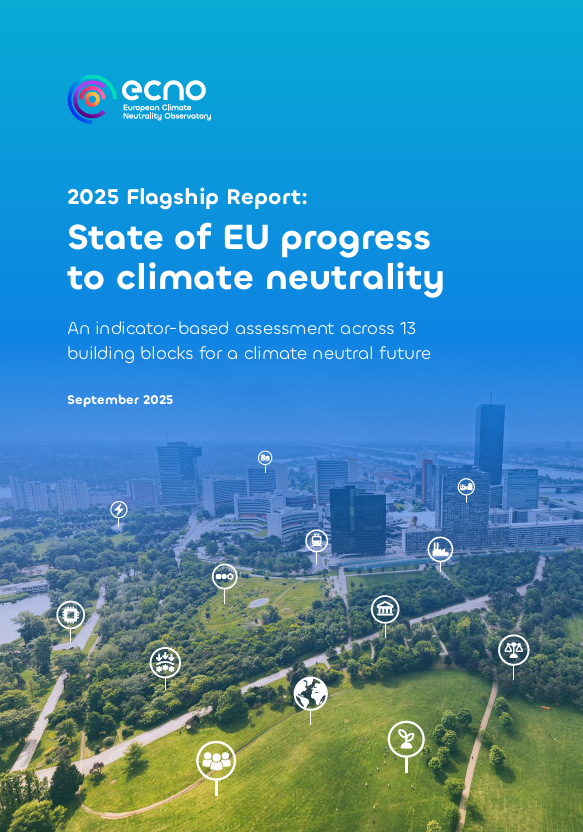

Velten, Eike Karola et al. 2025: 2025 Flagship Report: State of EU progress to climate neutrality. An indicator-based assessment across 13 building blocks for a climate neutral future. European Climate Neutrality Observatory (ECNO).