
© European Scientific Advisory Board on Climate Change, 2026; Photo by Glenn Carstens-Peters via Unsplash
Climate Change Mitigation and Adaptation in the Agri-food Sector
Recommendations for coherent EU policies
- Publication
- Citation
European Scientific Advisory Board on Climate Change (2026) Climate adaptation and mitigation in the agri-food system: Recommendations for coherent EU policies. Luxembourg: Publications Office of the European Union. https://doi.org/10.2800/3706315
The European Scientific Advisory Board on Climate Change (ESABCC) has published the report “Climate Change Mitigation and Adaptation in the Agri-food Sector – Recommendations for a Coherent EU Policy”. The report calls on the EU to better integrate climate mitigation and adaptation across the entire value chain. Its aim is to safeguard food security, strengthen farmers’ livelihoods and align the agri-food system with the EU’s climate goals.
Rising climate risks for the agri-food system
The EU agri-food system, spanning the value chain from fertiliser production to food consumption, plays a central role in food security and rural livelihoods, while accounting for roughly one-third of the EU’s net greenhouse gas emissions. At the same time, it is increasingly exposed to climate-related risks such as droughts, floods and heatwaves, with agricultural losses already reaching tens of billions of euros annually. According to the report, current policies are not sufficient to deliver the emission reductions and resilience needed to meet EU climate targets.
A systemic transition across the food system
The Advisory Board concludes that incremental improvements in technologies and farming practices will not be enough. Instead, a systemic transition across the entire agri-food system is required, including changes in production systems, land use and consumption patterns. Upcoming revisions of the EU budget, the Common Agricultural Policy (CAP) and the EU’s climate framework offer an important opportunity to better align agricultural policy with climate objectives.
The report outlines several policy recommendations, including:
- Phasing out CAP payments that incentivise the most greenhouse gas-intensive practices
- Introducing a greenhouse gas pricing mechanism for the agri-food system
- Providing targeted transition support for farmers
- Promoting healthy, climate-friendly diets and reducing food waste
- Ensuring sufficient public funding for the transition
The report emphasises that the transition must be gradual and fair, with targeted support for farmers and regions facing the greatest challenges.
Contact

- Language
-
English
- Credits
The Advisory Board would like to acknowledge the assistance received from Ramboll (Karin Attström, May Hobeika, Pavlos Kailos, Amy Donnelly, Iulia Vizman), Ecologic Institute (Aaron Scheid, Hugh McDonald, Jonathan Gardiner, Benjamin Görlach, Julia Jägle and Johanna Meier) and the Öko-Institut (Margarethe Scheffler, Anne Siemons, Cristina Urrutia, Kristen Wiegmann) in supporting data collection on potential mitigation and adaptation options and scenarios for the EU agri-food system, the assessment of relevant current EU policies and identification of future policy options for pricing agricultural greenhouse gas emissions, reforming the common agricultural policy and managing potential spill-over effects. The Advisory Board would also like to acknowledge the assistance received from Maria Vincenza Chiriacò in supporting the mapping of potential synergies and tradeoffs between climate mitigation, adaptation and other environmental and socio-economic dimensions in the EU agri-food system.
- Funding
-
European Environment Agency (EEA), International - Published by
-
Publications Office of the European Union (Publications Office), International - Year
- Dimension
- 313 pp.
- ISBN
-
978-92-9480-742-7 (print)978-92-9480-741-0 (pdf)
- DOI
-
10.2800/5509580 (print)10.2800/3706315 (pdf)
- Project
- Project ID
- Table of contents
-
Click to show full table of contents
- Keywords
-
EU agricultural and food system, climate adaptation in agriculture, reduction of agricultural emissions, EU climate policy in the agricultural sector, sustainable food systems in the EU, reform of the Common Agricultural Policy, climate-resilient agriculture, greenhouse gas pricing in agriculture, transformation of the food system in the EU, policy for sustainable agricultureEuropePolicy analysis, climate risk assessment, analysis of emissions trends, analysis of the value chain in the agri-food sector, scenario-based policy evaluation
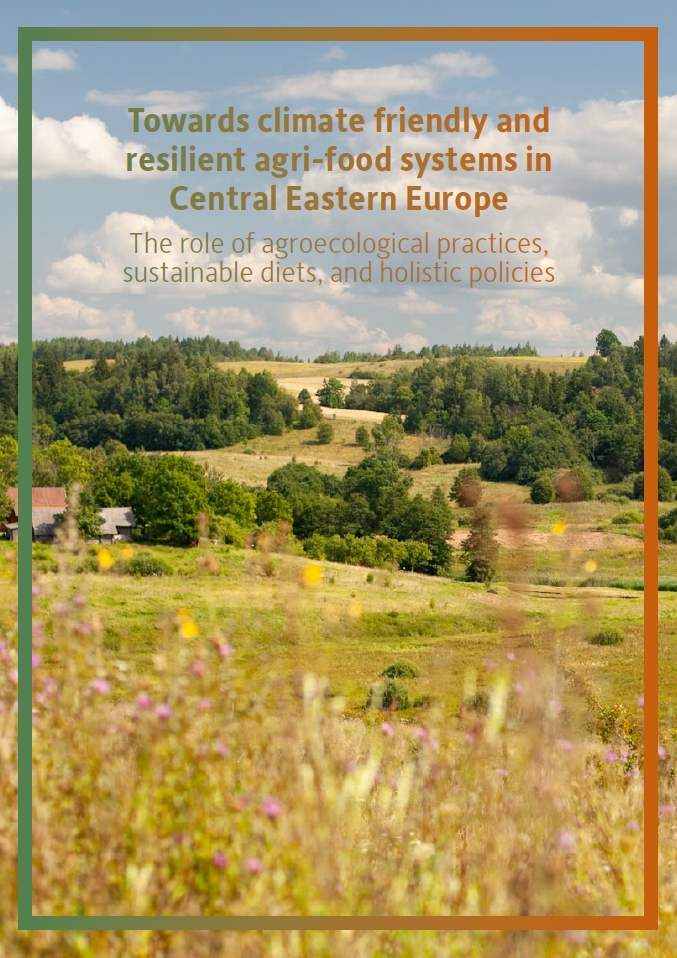
Frelih Larsen, A. et al. (2024). Towards climate friendly and resilient agri-food systems in Central Eastern Europe: the role of agroecological practices, sustainable diets, and holistic policies. Ecologic Institute, Berlin. ISBN 978-3-937085-37-1
Sebastian Rogga, Stephanie Wunder, Bernd Pölling, Andreas Obersteg, Annette Piorr (2024). KOPOS- Sustainability and transformation criteria set for sustainability initiatives in the agri-food sector, Dataset, BonaRes Repository. https://doi.org/10.4228/zalf-c6vf-py89