© Ecologic Institute, 2026
Which Policy Instruments Help Cities Implement Nature-based Solutions?
Insights from the Urban Governance Atlas
- Presentation
- Date
-
- Location
- Berlin, Germany
- Speech
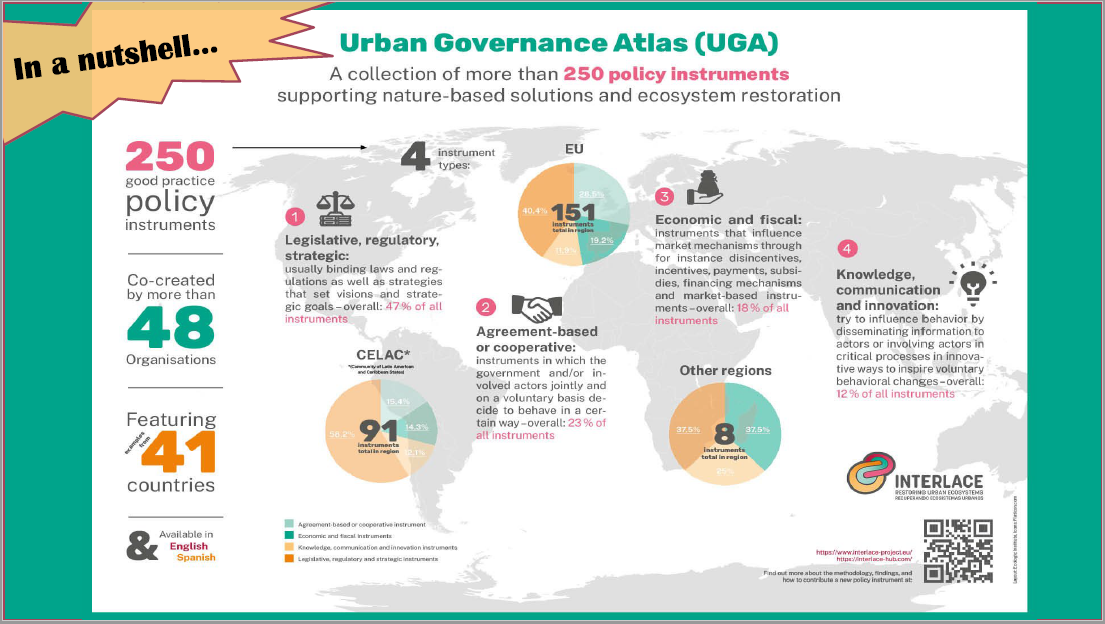
At the German Nature Conservation Day (Deutscher Naturschutztag, DNT), Doris Knoblauch from Ecologic Institute presented the Urban Governance Atlas, developed as part of the EU-funded INTERLACE project. The collection highlights governance and policy instruments that can support cities in successfully implementing nature-based solutions.
Nature-based solutions (NbS) are increasingly recognised as important approaches to making cities more climate-resilient while strengthening biodiversity. Many successful examples – such as green infrastructure, river restoration, or sustainable stormwater management – have already been documented in the Urban Nature Atlas. But which policy and governance instruments help municipalities to actually implement these solutions?
This question was at the centre of a presentation by Doris Knoblauch (Ecologic Institute) at the German Nature Conservation Day (DNT). She introduced the Urban Governance Atlas, which was developed within the INTERLACE project. The collection provides an overview of governance and policy instruments that can support the implementation of nature-based solutions in cities. In her presentation, Doris Knoblauch highlighted selected examples from the atlas and discussed how these instruments can help embed nature-based solutions in local policy and planning processes.
The session “Nature-based solutions for biodiversity and climate adaptation”, moderated by Sandra Naumann (Berlin Senate Department for Urban Mobility, Transport, Climate Action and the Environment) and Svane Bender (Environmental Action Germany, DUH), was fully booked with more than 70 participants. Work on the Urban Governance Atlas at Ecologic Institute was coordinated by McKenna Davis and Natalia Burgos Cuevas.
The German Nature Conservation Day, which attracted around 1,600 participants – the largest in its history – offered further insights from research and practice within this session. A keynote by Prof. Dr Nadja Kabisch (Leibniz University Hannover) addressed the application, potential and limits of nature-based solutions. Additional presentations were given by Dr Ulrich Heink (Environmental and Nature Conservation Office Charlottenburg-Wilmersdorf, Berlin), Ferdinand Schmeller (City of Vienna), Yvonne Richter (City of Kronberg), Grit Rudas (Berlin Rainwater Agency), and the City of Łódź, sharing insights on innovative financing instruments for urban nature.
Contact

- Event
- Organizer
-
Bundesverband Beruflicher Naturschutz (BBN), Germany - Speech
- Team
-
Natalia Burgos Cuevas
- Date
-
- Location
- Berlin, Germany
- Language
-
German
- Project
- Project ID
- Keywords
-
urban climate resilience, urban biodiversity governance, municipal climate adaptation strategies, urban ecosystem restoration, green urban planning, sustainable urban development, urban environmental governance, nature-based urban adaptation, climate-resilient cities, ecosystem-based urban planning, urban sustainability policy, biodiversity-friendly urban designLatin America, Europe, Granollers, Spain, Envigado, Colombia, Portoviejo, Ecuador, Chemnitz, Germany, Metropolia Krakowska, Poland, Corredor Biológico Interurbano Río María Aguilar-San José, Costa Ricacase study analysis, knowledge platform development, policy instrument mapping, governance analysis, stakeholder dialogue, knowledge exchange, expert presentations, policy dissemination, conference session discussion
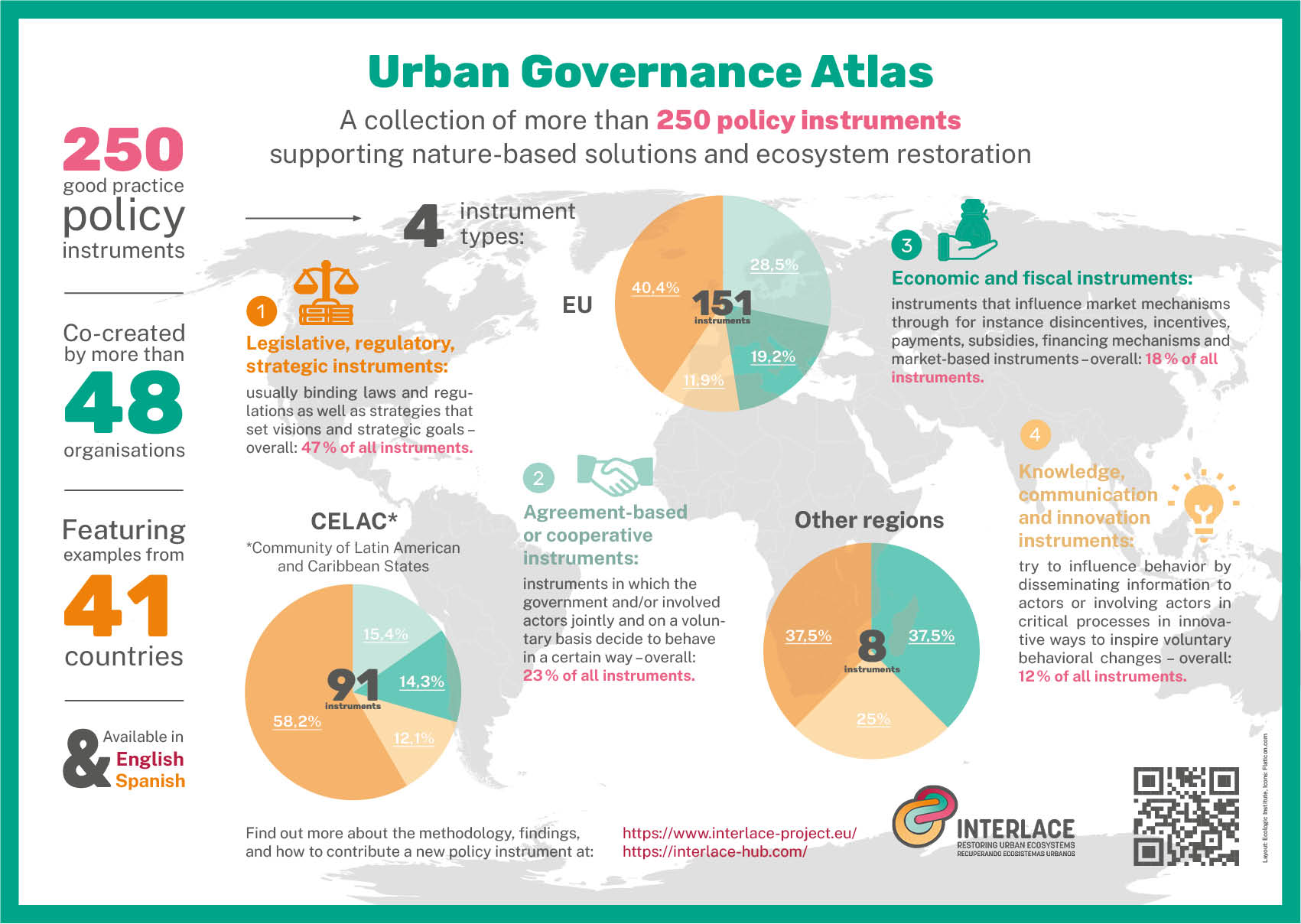
Ecologic Institute 2023: Urban Governance Atlas. Infographic. English, German and Spanish.
Speech:Digital Tools for Urban Climate Adaptation
- Date
-
- Location
- online
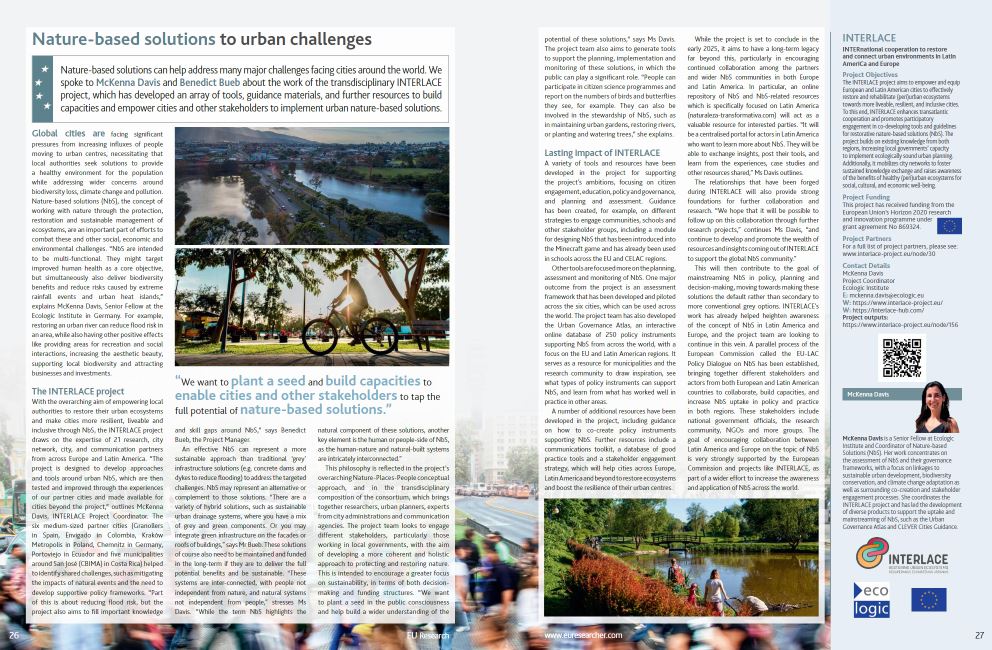
Davis, M., Bueb, B. (2024) 'Nature-based solutions to urban challenges', EU Research, Autumn 2024 vol. (39), pp. 26 -27.

INTERLACE 2024: Nature-based Solutions: How to regenerate nature to make neighborhoods more livable, biodiverse, and resilient to climate change. Massive Open Online Course. Online: https://learningwith.uclg.org/p/restoring-urban-ecosystems.
INTERLACE project consortium 2023: Urban Governance Atlas. Interactive database. Published on 11 May 2023. Online: https://interlace-hub.com/urban-governance-atlas.