
© brgfx via Magnific, 2026
Resource Efficiency and Natural Resources in an International Context III
Strengthening the science-policy interface for sustainable resource management
- Project
- Duration
-
-
Global material consumption continues to rise, putting increasing pressure on the environment and contributing to climate change, biodiversity loss and pollution. At the same time, securing reliable access to raw materials has become a growing political and economic priority. The energy transition, digitalisation and industrial transformation are driving demand for critical and strategic raw materials, while geopolitical tensions and disruptions to global supply chains are exposing the vulnerabilities of existing supply structures.
These developments highlight the need for a resource policy that combines environmental sustainability with economic resilience. Reducing primary raw material consumption, improving resource efficiency and strengthening the circular economy can help mitigate environmental impacts while also reducing import dependencies and contributing to a more secure raw material supply. Achieving these objectives requires integrated policy approaches that take account of planetary boundaries as well as economic and geopolitical challenges.
Against this background, the project supports the German Federal Ministry for the Environment, Climate Action, Nature Conservation and Nuclear Safety (BMUKN) and the German Environment Agency (UBA) through scientific analysis, policy assessment and evidence-based recommendations. Building on the previous projects "Resource Efficiency and Natural Resources in the International Context I and II", it examines current developments in international, European and national resource policy and translates scientific findings into practical insights for policy-making.
The project aims to strengthen the scientific foundations for an integrated resource policy that advances resource conservation, the circular economy and sustainable raw material supply. Its work focuses on three areas:
- International resource policy and scientific assessments: Analysing key studies, research findings and policy developments, particularly those of the UNEP International Resource Panel (IRP), the OECD, the G7 Alliance for Resource Efficiency (G7-ARE), the G20 and the UN Climate Change Conferences (COPs). This includes technical support for the preparation and follow-up of IRP Steering Committee meetings.
- Critical and strategic raw materials: Assessing raw material value chains with a particular focus on circularity, resource conservation and the environmental impacts of extraction and processing.
- Implementation of Germany's National Circular Economy Strategy (NKWS): Providing scientific support for selected implementation measures, particularly in the areas of international cooperation and stakeholder dialogue.
Ecologic Institute leads and coordinates the project in collaboration with the Institute of Economic Structures Research (GWS). Its work focuses in particular on analysing and assessing scientific studies and policy developments to support evidence-based resource policy.
Contact

- Funding
-
German Environment Agency (UBA), Germany - Partner
-
Ecologic Institute, Germany Gesellschaft für Wirtschaftliche Strukturforschung (GWS), Germany - Team
- Duration
-
-
- Project ID
- Keywords
-
International Resource Policy, Resource Efficiency, Circular Economy, Critical Raw Materials, Sustainable Raw Material Supply, Resource Conservation, Germany's National Circular Economy Strategy, Raw Material Supply Chains, Environmental Impacts of Raw Material Extraction, Sustainable Resource ManagementGermany, Europe, WorldScientific Literature Review, Policy Analysis and Assessment, Raw Material Value Chain Analysis, Environmental Impact Assessment, Stakeholder Dialogue and Consultation
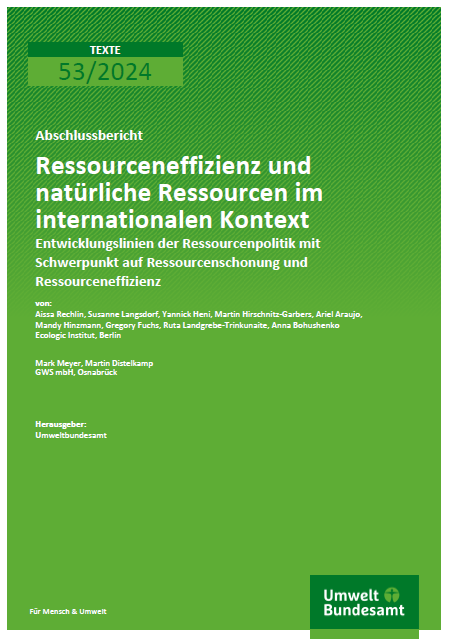
Rechlin, Aissa et al. 2024: Ressourceneffizienz und natürliche Ressourcen im internationalen Kontext. Entwicklungslinien der Ressourcenpolitik mit Schwerpunkt auf Ressourcenschonung und Ressourceneffizienz. Abschlussbericht. Umweltbundesamt: Dessau-Roßlau.

Resource Efficiency and Natural Resources in an International Context
- Duration
-
-
- Funding
-
German Environment Agency (UBA), Germany
Resource Efficiency and Natural Resources in an International Context
- Duration
-
-
- Funding
-
German Environment Agency (UBA), Germany