This briefing by Michael Jakob and colleagues' reviews some of the major developments in global climate politics in the past year and looks ahead to 2023.
There is a clear need for sustainable resource use to confront the multiple environmental crises while allowing societies to thrive. Governments around the world seek to establish systematic policies towards the implementation of sustainable resource use and a circular economy. In the session "Sustainable Resource Use and Circular Economy – the Social Dimension" we take a closer look at how these developments affect the social aspects of sustainability. What implications can changing resource use patterns in Europe have for well-being, development, prosperity and health, especially in the global South? How can an inter- and intragenerational just resource use be achieved and what are the stumbling blocks?
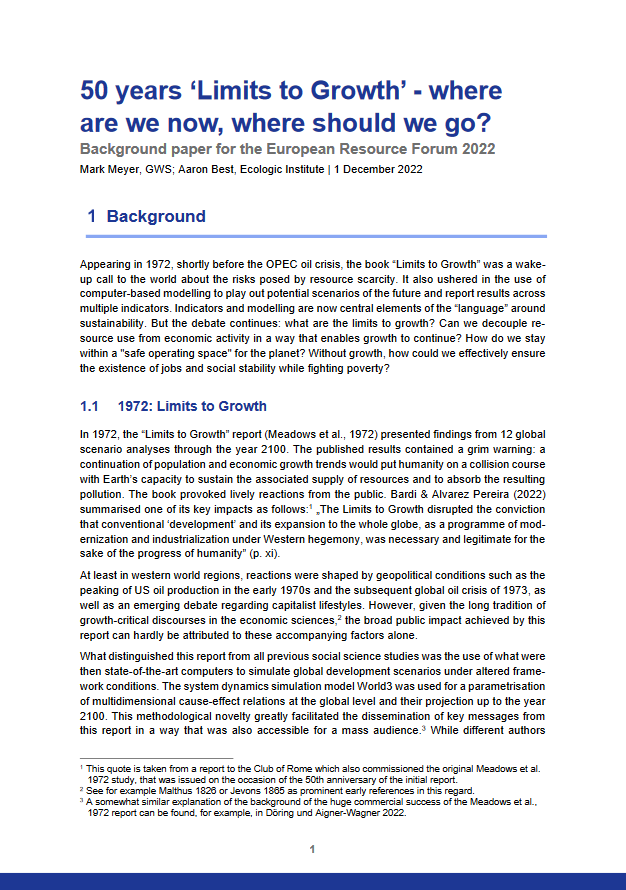
In December 2022, the 6th European Resources Forum – "Transformative approaches for sustainable resource use and a circular economy" took place. Dr. Aissa Rechlin of Ecologic Institute supported the German Environment Agency in content-related issues surrounding the Forum, including the preparation of this background paper.
The transition to sustainable resource use and a circular economy is broadly recognised as an important lever in dealing with the various current crises. Debates in various international organisations suggest that such a transition will require profound systemic changes and the increased integration of previously separated policy fields in order to deliver the expected benefits. Moreover, current efforts are largely focused on entire product value chains.
In December 2022, the 6th European Resources Forum – "Transformative approaches for sustainable resource use and a circular economy" took place. Aaron Best of Ecologic Institute supported the German Environment Agency in content-related issues surrounding the Forum, including the preparation of this background paper.
Carbon pricing is gaining traction around the world, as more and more jurisdictions implement emissions trading systems or tax carbon emissions to achieve their climate objectives. The annual "State and Trends of Carbon Pricing" is the flagship report of the World Bank to provide a concise, up-to-date overview of what is happening in this field. With over 70,000 annual downloads, it is one of the most prominent publications on this matter. 2023 marks the 10th edition of the State and Trends report. A consortium of adelphi and Ecologic Institute supported the World Bank in developing the 2023 edition of the report.
In collaboration with the International PtX Hub, we analyzed the emerging EU and international regimes and develop recommendations on GHG accounting and PtX sustainability. In a series of bilateral online workshops, we provided guidance to policy makers and other stakeholders from Algeria, Chile, Colombia, India, Kenya, Jordan, Namibia, South Africa, Uruguay and Vietnam.
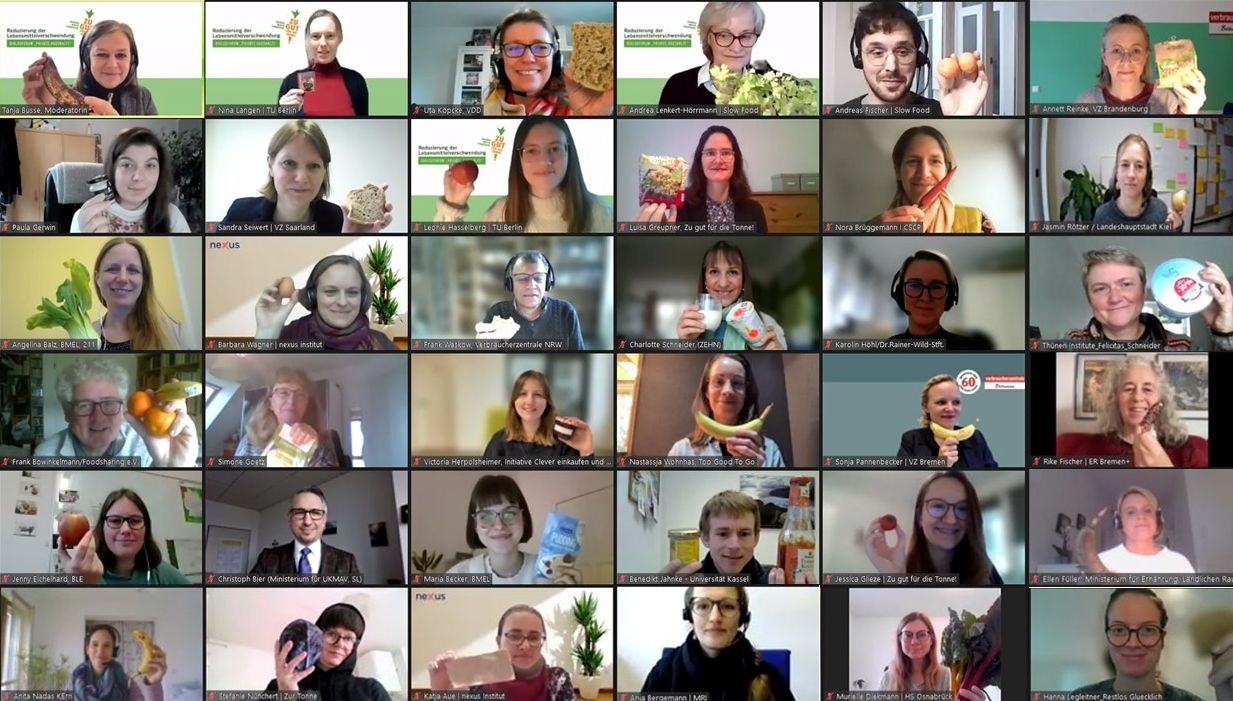
The fourth online dialogue forum "Private Households" took place on 01 December 2022. The event focused on the Citizen Science project "Deutschland rettet Lebensmittel!". More than 70 participants from civil society, science, administration, and associations exchanged views with the Dialogue Forum team and three speakers from the field on actions carried out during the action week, (survey-)tools and initial findings from the Citizen Science project during the three-and-a-half-hour event.
This analysis shows that there is considerable potential in Germany to facilitate, stimulate, and ultimately increase the use of recycled materials through political regulation and incentivization. It provides recommendations for a successful policy mix to increase the use of recyclates.
Climate adaptation and climate protection are among the most important challenges of our time and have therefore become a major policy responsibility. The same applies to protecting biodiversity and ensuring the availability of water. Nature-based solutions (NBS) can play an essential role in addressing these challenges, as they are multifunctional and can generate high synergy effects. But what exactly are NBS, what do they have to do with climate adaptation, and can they be implemented? Sandra Naumann, Senior Fellow at Ecologic Institute, answered these questions in an interview with adelphi. The interview was published in the fifth issue of the Center for Climate Adaptation's Newsletter.
In light of current experiences in energy markets, Western democracies, and the EU in particular, are exploring new supply chains and strategies to reduce their raw material dependence on China. The findings presented here by the authors of this study provide an overview of the main options that the EU can currently use to counter the pressures of growing dependencies. This study discusses some positive examples of feasible circular approaches that aim to achieve savings in the use of rare earths.
This document presents main takeaways and insights from a workshop organised by the Ariadne Project in Brussels on 30 November 2022. The workshop convened experts from seven organisations that operate carbon market models – academic institutions as well as carbon market analysts.
The report maps out four policy avenues for how the EU could attain climate neutrality. The policy avenues consist of a mix of policy instruments sequenced over time, and the institutional arrangements to deliver them. Each policy avenue embodies a different paradigm, i.e., a different approach to (climate) policymaking. They thus sketch different paths that the EU could follow to align its climate policy with the goal of climate neutrality by 2050.
With the Fit-for-55 package about to be put into law, and the RePowerEU plan adopted in response to the energy crisis, EU climate and energy is undergoing the most profound change in years, getting the EU on track to a post-fossil energy system. In a three-day series of events, partners from the Ariadne research project presented key insights from their work that is relevant for the further development of EU climate and energy policy, and discussed these with representatives from political institutions, academia, civil society and business. The events served to share research insights, to discuss and validate findings and their relevance for EU policy process, and to gather inputs for further research.
This event discussed how stable long-term policy direction can be maintained despite uncertainties, and in this context will zoom into the role of long-term strategies and scientific climate advisory councils. To exchange views on these tools with each other and the audience, Climate Recon 2050 and ARIADNE have brought together several experienced practitioners.