This paper reviews a secretive Joint Statement (JS) on Gas Supply Security to Central and Eastern Europe that was signed in Washington, D.C., on 24 February 2026 on the sidelines of meetings organised by the White House, its ‘National Energy Dominance Council’, and the ‘Donald J. Trump Institute of Peace’. Signatories comprise the US, eight EU Member States and four candidate countries.
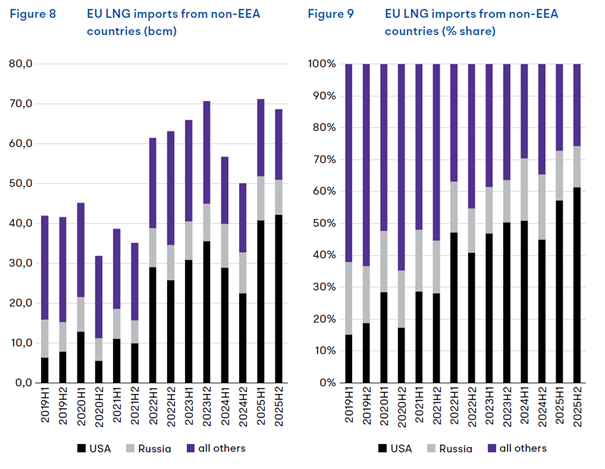
Based on a novel analysis covering the entire European Economic Area (EEA, notably including Norway), this policy brief shows that US gas imports into the EEA sharply surged in 2025. They now account for almost 40% of total EEA gas imports and nearly 60% of LNG imports. This trend exposes Europe to heightened geopolitical pressure, price volatility and the risk of stranded assets.
This report contributes to a better understanding of the economic implications of climate change adaptation across the European Union. Its central objective is to analyse three key dimensions: the costs of adapting to climate change, the costs of inaction, and current levels of adaptation funding. The analysis focuses on three climate-sensitive sectors of strategic importance for the EU economy and society: transport, energy, and agriculture.
This paper examines the penalty provisions in the draft Czech implementing law submitted on 11 November 2025 by the Minister for the Environment to the Prime Minister. It briefly considers the draft's legislative status in light of the political situation following the 3–4 October general election, assesses its compliance with the EU-MER, and compares it with good practice in Denmark and with Italy's draft law.
This paper examines the penalty provisions in the draft Romanian implementing law proposed by the Romanian government on 22 July 2025. It briefly considers the draft's legislative status, assesses its compliance with EU-MER, and compares it with good practice in Denmark and with Italy's draft law.
After giving a concise overview of the penalty provisions in the EU Methane Regulation (EU-MER), this paper counters the scaremongering narrative promoted by fossil energy groups that the EU-MER creates "unmanageable liability" for EU fossil-fuel importers through fines of up to 20% of annual turnover.
The triple planetary crisis is a systemic challenge, not three separate issues: climate change, biodiversity loss, and pollution reinforce one another through shared drivers and feedback, threatening planetary and human well-being. It is driven by fossil fuel dependence, unsustainable production and consumption, overexploitation of land and resources, and structural inequalities. The analysis concludes that the triple crisis can only be effectively addressed through systemic, cross-sectoral, and justice-oriented approaches. By linking resource governance, NbS, and transformative change, this report highlights how today’s triple crisis can be turned into an opportunity to regenerate ecosystems, reduce inequalities, and build resilient societies within planetary boundaries.
This fact sheet summarizes the information contained in the publication Burgos Cuevas et al. (2025): Moving from interconnected crises to systemic solutions. Resource efficiency, nature-based solutions, and systemic transformation as responses to the complexity of the triple planetary crisis. Interim report, Climate Change 83/2025. German Environment Agency: Dessau-Roßlau. https://doi.org/10.60810/openumwelt-8108.
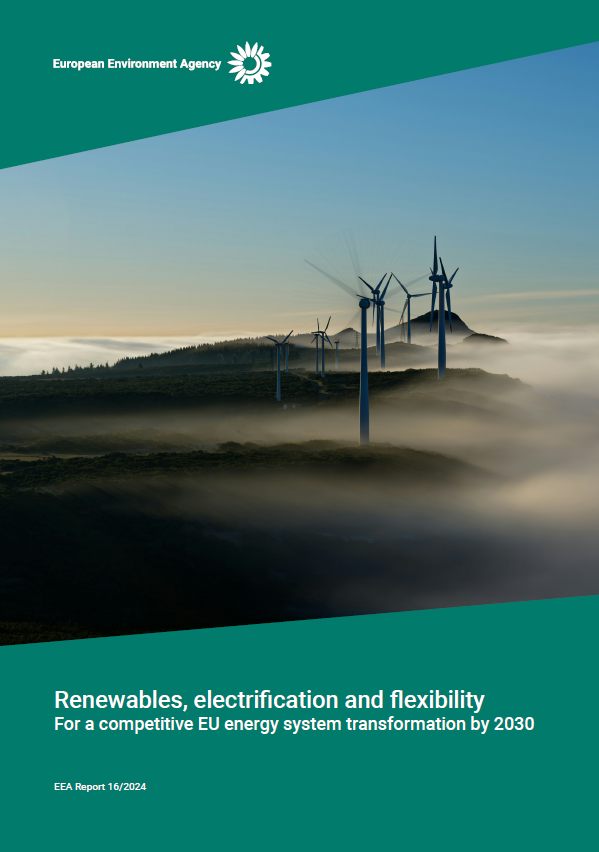
The EU must rethink its energy security in light of increasingly renewable, decentralized, and electrified energy systems. Energy security already benefiting from the early start of the energy transition. In the transition phase now beginning, a forward-looking and adaptable approach is needed to maximize synergies and manage potential conflicts between decarbonization and energy security.
How can the EU stay on track to climate neutrality – despite tightening budgets and rising geopolitical pressure? A new Ariadne background paper reviews the Fit for 55 package, discusses open questions for the post-2030 period, and outlines options for a more coherent EU policy architecture.
This report explores the design and implications of an international oil extraction levy as a mechanism to mobilize new sources of climate finance. The assessed levy places a price on the embedded CO₂ in extracted crude oil, increasing production costs and likely raising oil prices for final consumers. By internalising part of the climate costs of fossil fuels, the mechanism aligns with the polluter pays principle.
Under the EU’s Governance Regulation, Member States are legally required to hold multilevel climate and energy dialogues (MLCEDs), structured spaces for deliberation between governments, civil society, and other stakeholders. In the Review of European, Comparative & International Environmental Law (RECIEL), Ricarda Faber (Deutsche Gesellschaft für Internationale Zusammenarbeit (GIZ) GmbH), Deyana Kocher, and Matthias Duwe (Ecologic Institute) offer an assessment of how Member States are implementing these dialogues under Article 11.
This report systematically analyses and assesses progress towards the 2030 climate target by comparing the historical evolution of a wide range of indicators in each subsystem with the modelled benchmarks from the Impact Assessment accompanying the EU's 2040 Climate Target Plan.
Eurostat's "Sustainable Development in the European Union: Monitoring Report on Progress towards the SDGs in an EU Context" (2025 edition) offers the ninth comprehensive assessment of the EU's journey toward the 17 Sustainable Development Goals. Researchers from Ecologic Institute authored the chapters on Zero Hunger (SDG 2), Clean Water and Sanitation (SDG 6), Affordable and Clean Energy (SDG 7), Climate Action (SDG 13), Life Below Water (SDG 14), Life on Land (SDG 15) and Partnerships for the Goals (SDG 17), providing rigorous, policy-relevant evidence.
The 2025 overview brochure accompanies Eurostat's ninth regular report monitoring progress towards the SDGs in an EU context. Ecologic Institute's authors covered the chapters on SDG 2 (Zero Hunger), SDG 6 (Clean Water and Sanitation), SDG 7 (Affordable and Clean Energy), SDG 13 (Climate Action), SDG 14 (Life Below Water), SDG 15 (Life on Land) and SDG 17 (Partnerships for the Goals). The brochure is available for download.
This report, funded by the European Climate Foundation (ECF), examines the assumptions for industrial carbon removals in the European Commission's 2040 Climate Target Impact Assessment. It focuses on the deployment of industrial carbon removal technologies and their resource demands.
While hydrogen (H2) emissions make up a negligible fraction of today's GHG emissions, they are set to become more significant in the 2030s and, should the EU and the global community progress towards climate neutrality, will likely be substantial in the 2040s, as achieving climate neutrality requires the expansion of hydrogen use alongside the rapid reduction of other GHGs. As decisions made today will shape hydrogen value chains for decades, this paper develops a series of policy proposals to implement a four-pronged strategy.
This interactive infographic shows what the future could look like in 20 to 30 years - in two scenarios: one with resolute climate protection and another scenario that leaves everything as it is. The intention is to make the consequences of climate change more tangible and to illustrate the urgency of climate protection measures.