
Photo by Chirag Saini on Unsplash, Cover © German Environment Agency, 2025
Moving from Interconnected Crises to Systemic Solutions
Resource efficiency, nature-based solutions, and systemic transformation as responses to the complexity of the triple planetary crisis
- Publication
- Citation
Burgos Cuevas, Natalia et al. (2025): Moving from interconnected crises to systemic solutions. Resource efficiency, nature-based solutions, and systemic transformation as responses to the complexity of the triple planetary crisis. German Environment Agency: Dessau-Roßlau. https://doi.org/10.60810/openumwelt-8108.
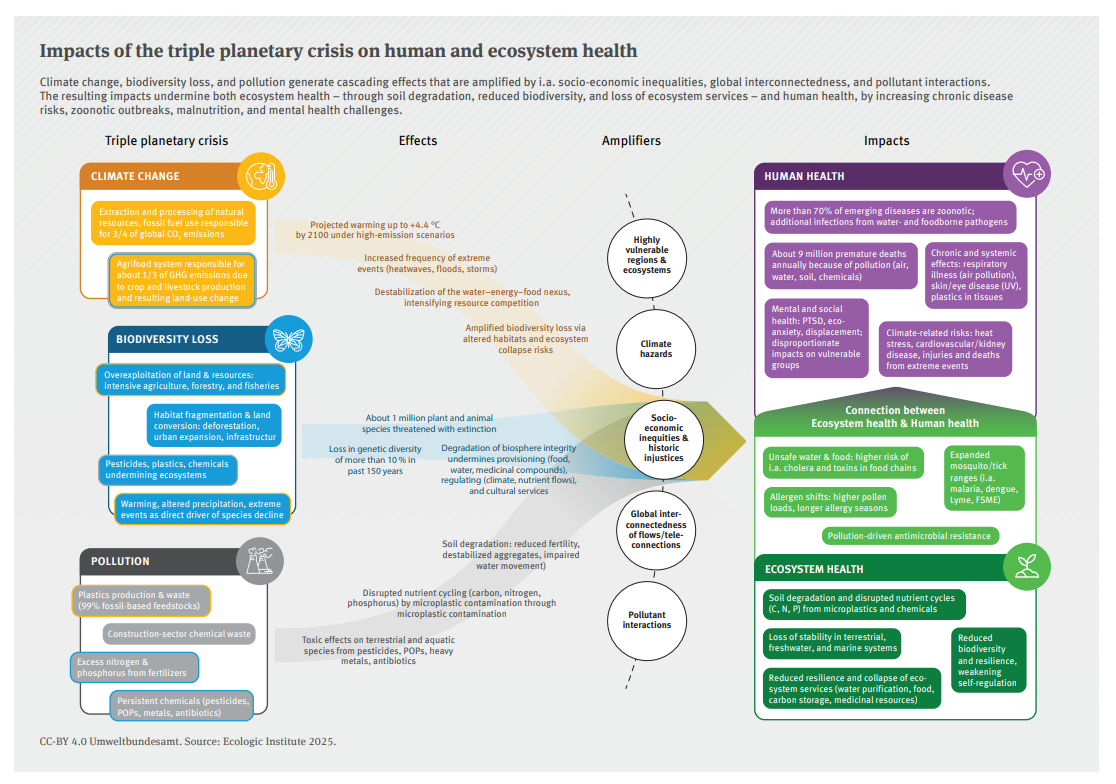
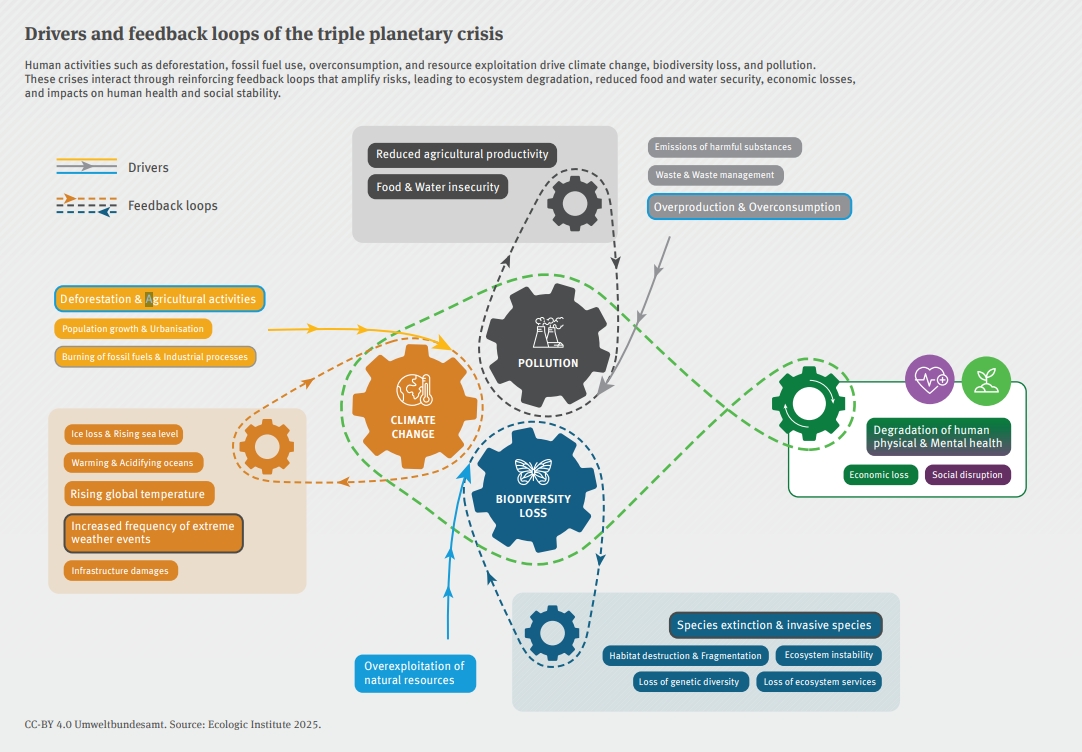
The triple planetary crisis is a systemic challenge, not three separate issues: climate change, biodiversity loss, and pollution reinforce one another through shared drivers and feedback, threatening planetary and human well-being. It is driven by fossil fuel dependence, unsustainable production and consumption, overexploitation of land and resources, and structural inequalities. Seven of nine planetary boundaries have already been crossed, pushing ecosystems toward tipping points, while sectoral amplifiers – energy with its major GHG emissions, land degradation and pollution; agriculture with plastic and nutrient pollution, biodiversity loss and climate links; and construction with high land, material, and energy demand causing emissions and habitat loss – intensify pressures. The impacts are distributed unequally, with Indigenous Peoples, low-income groups and countries, women and youth facing the greatest burdens while holding the least decision-making power and resources to adapt.
The need for integrated action
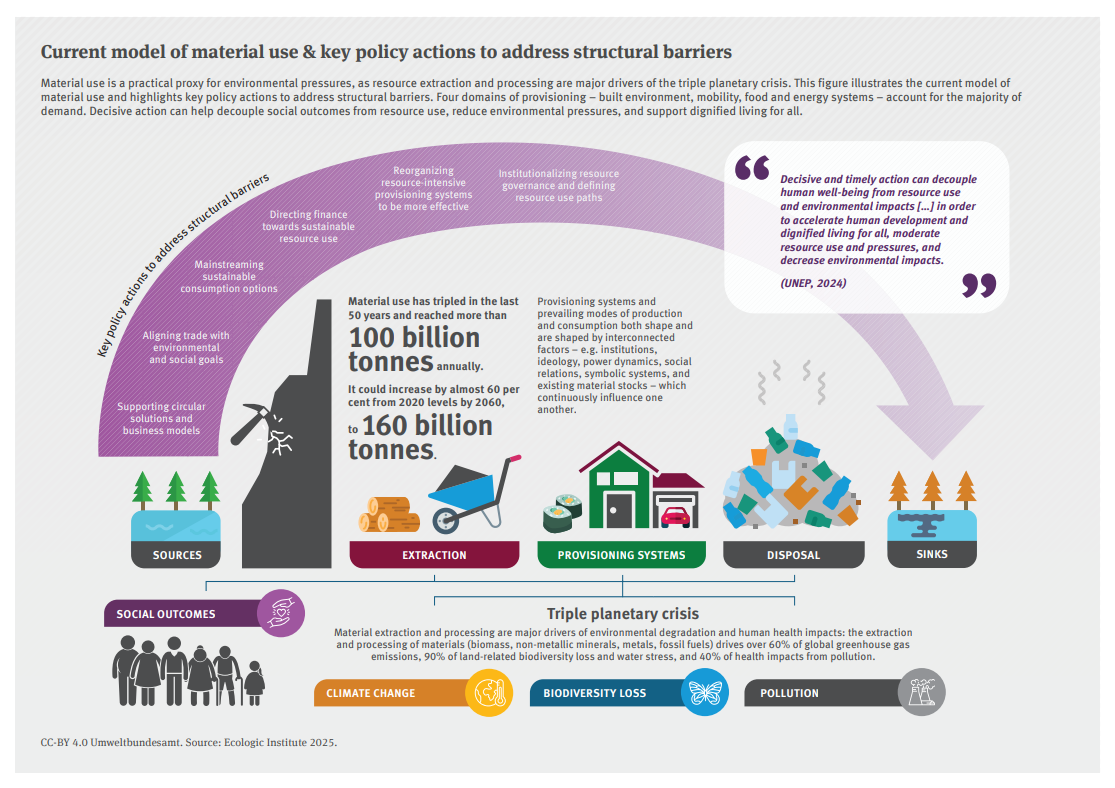
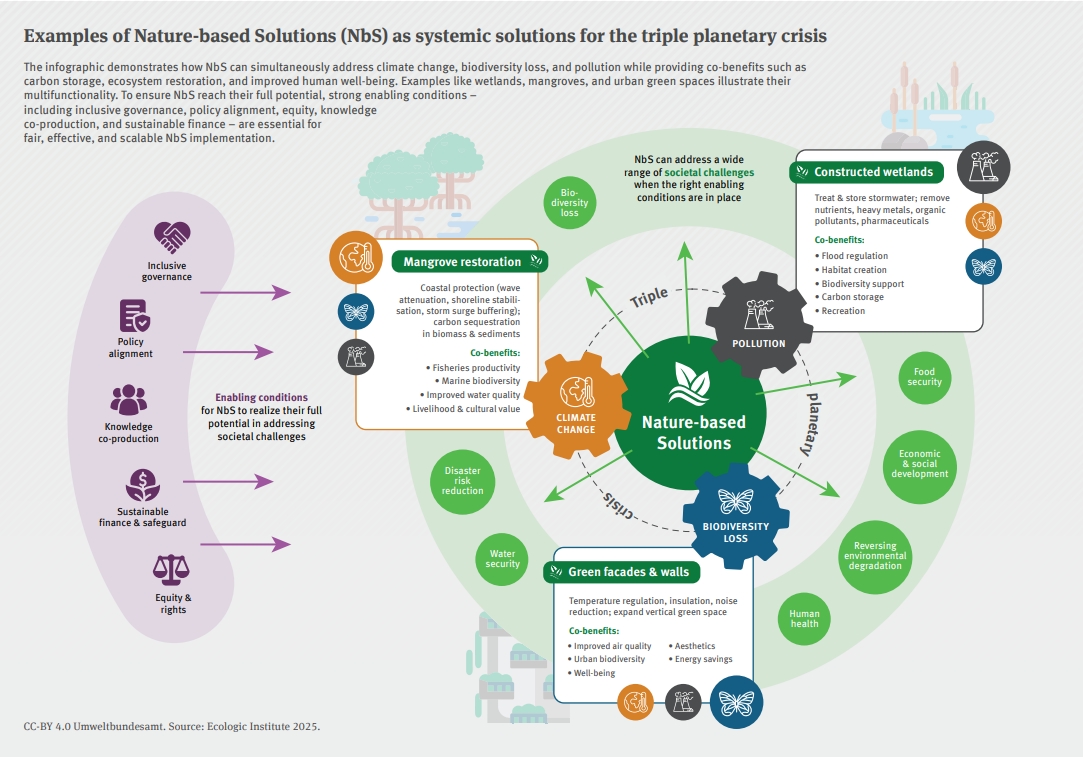
Current policy responses remain fragmented, focusing on single issues rather than addressing systemic and underlying drivers. This report provides an integrated perspective by examining three mutually reinforcing pathways: governing societal metabolism and resource use through efficiency, sufficiency, and equity; scaling up nature-based solutions (NbS) to restore ecosystems, reduce emissions, and curb pollution while enhancing well-being; and advancing systemic transformation that reorganizes governance, markets, and societal values to embed justice and resilience at their core. The analysis concludes that the triple crisis can only be effectively addressed through systemic, cross-sectoral, and justice-oriented approaches. By linking resource governance, NbS, and transformative change, this report highlights how today’s triple crisis can be turned into an opportunity to regenerate ecosystems, reduce inequalities, and build resilient societies within planetary boundaries.
Contact

- Language
-
English
- Authorship
- Funding
-
German Environment Agency (UBA), Germany - Published by
-
German Environment Agency (UBA), Germany - Year
- Dimension
- 28 pp.
- ISSN
-
1862-4359
- DOI
- Project
- Project ID
- Table of contents
-
Click to show full table of contents
- Keywords
-
triple planetary crisis, climate change biodiversity pollution, systemic solutions for sustainability, resource efficiency policy, nature-based solutions, planetary boundaries governance, sustainable resource use, circular economy strategies, environmental policy integration, systemic transformation climate, biodiversity loss solutions, pollution prevention policy, sustainable development pathways, environmental justice and equity, EU climate and sustainability policyEurope, European Union, EU Member States, Brussels, Global South, Latin America, Africa, Asia-Pacific, urban regions, rural landscapespolicy analysis, comparative case studies, systems thinking approach, stakeholder consultation, qualitative literature review
Iwaszuk, E.; Spantzel, T.; Kroos, F.; Knoblauch, D. (2025): Integrated Approaches to Addressing the Triple Planetary Crisis: Country Best Practices. Lessons learned from Brazil, Colombia, Japan, New Zealand, Panama, Rwanda and Sweden. Policy paper. Climate Change 81/2025, German Environment Agency: Dessau-Roßlau. https://doi.org/10.60810/openumwelt-8106
Burgos Cuevas, Natalia et al. (2025): Moving from interconnected crises to systemic solutions. Resource efficiency, nature-based solutions, and systemic transformation as responses to the complexity of the triple planetary crisis. Fact sheet. German Environment Agency: Dessau-Roßlau. https://doi.org/10.60810/openumwelt-8102.
Knoblauch, D., Felthöfer, C., Heni, Y., Burgos Cuevas, N., & Best, A. (2025). The Interconnected Challenges of Climate Change, Biodiversity Loss and Environmental Pollution: Drivers, Interdependencies and Impacts of the Triple Planetary Crisis. Interim report, Climate Change 82/2025. German Federal Agency. https://doi.org/10.60810/openumwelt-8107.
Felthöfer, C., Knoblauch, D., & Best, A. (2025). The interconnected challenges of climate change, biodiversity loss and environmental pollution: Drivers, interdependencies and impacts of the triple planetary crisis (Fact sheet). German Federal Agency. https://doi.org/10.60810/openumwelt-8070
Umweltbundesamt 2025: Drivers and feedback loops of the triple planetary crisis. Infographic.