This report examines the penalty provisions contained in the revised Draft Emergency Ordinance (DEO) proposed by the Romanian government in April 2026 to implement the EU Methane Emissions Regulation (EUMR).
Researchers at Ecologic Institute have developed a new tool to help governments to produce socially just climate adaptation strategies. The Just2Adapt tool allows the user to analyse the justice dimensions of Heat Action Plans at the strategic level as well as at the level of individual measures. It is important that heat adaptation strategies integrate social justice considerations because of the unequal way in which the heat-health effects of climate change are distributed across the population.
In light of the agreed expansion of European emissions trading (inter alia the gradual inclusion of maritime transport and the introduction of the EU ETS 2), the study contains an analysis of the current sanctions regime in emissions trading. The fundamental amendment to the TEHG brought about by the TEHG EU Alignment Act 2024 has already been taken into account. Proposals for a more effective sanctions regime are put forward, relating both the enforcement of existing regulations and reforms of these regulations. The study focuses on administrative offence law.
ECNO’s 2026 update provides the first comprehensive assessment of all 27 final National Energy and Climate Plans (NECPs). It evaluates whether Member States’ contributions and policy frameworks are sufficient to meet the EU’s 2030 climate and energy targets. The results show a clearer and more complete picture than previous assessments. However, the overall conclusion remains unchanged: despite some progress, the EU is still not fully on track to meet its 2030 targets.
Nature-based solutions (NbS) at the landscape scale are increasingly recognised for their role in supporting biodiversity, enhancing ecological connectivity and contributing to climate change adaptation. However, their assessment and implementation remain complex. This article examines these challenges using the concept of pondscapes – networks of ponds and their surrounding terrestrial habitats – as a case for landscape-scale NbS.
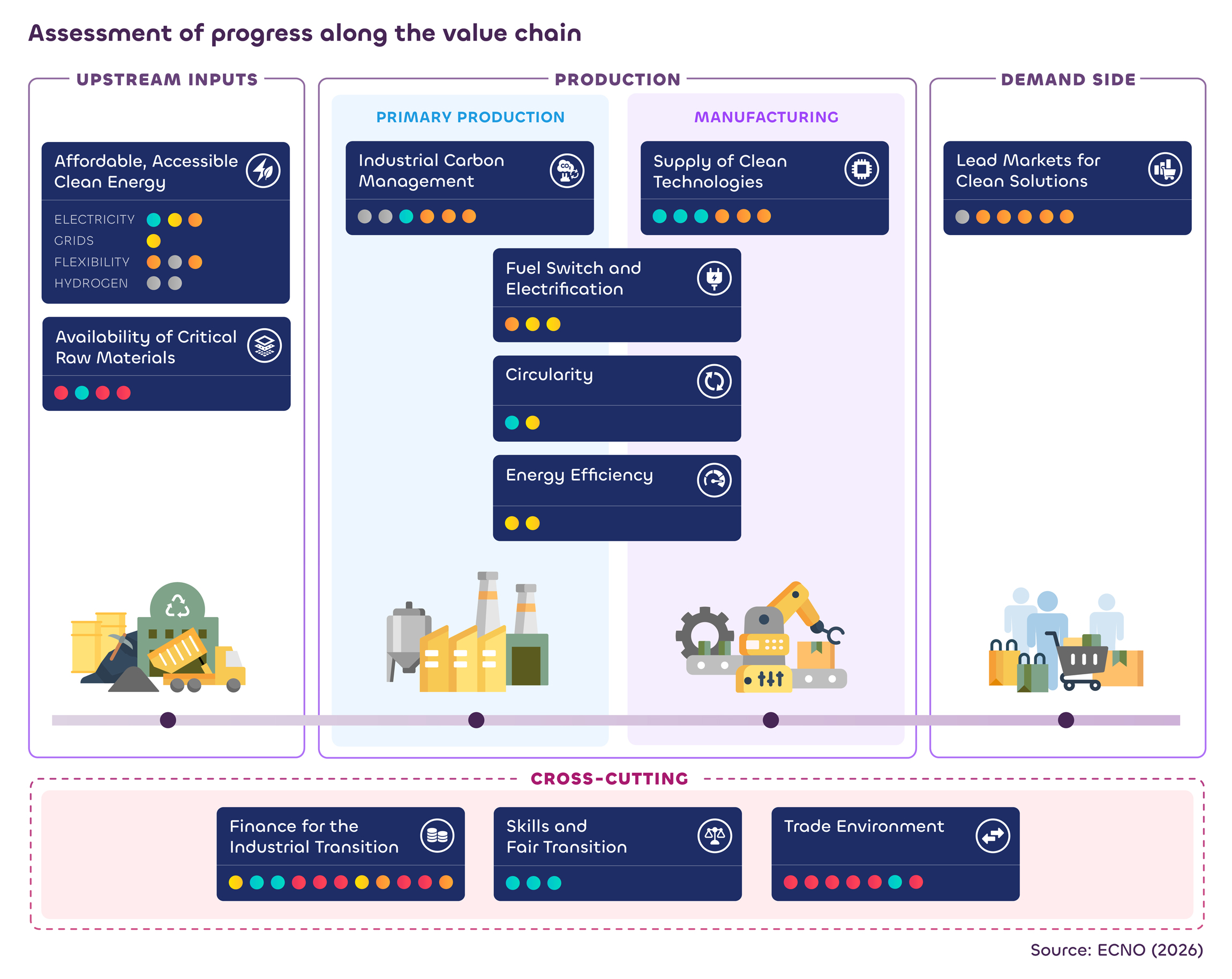
The infographic underscores a central insight of the Clean Industrial Transition Monitor: Europe has put in place many of the necessary building blocks for a clean industrial transition. However, achieving scale will depend on addressing remaining bottlenecks and ensuring coherent implementation across all parts of the value chain.
The transition to a clean and competitive industrial base is crucial to strengthening Europe’s resilience and strategic economic independence. The Clean Industrial Transition Monitor by ECNO assesses real-world progress using more than 50 indicators and provides a comprehensive and nuanced picture of both progress and remaining gaps.
Presented at the European Carbon Farming Summit 2026, this poster highlights key findings on the risks, opportunities and policy implications of integrating temporary carbon units from carbon farming into EU agri-food climate policy.
This policy brief examines how current climate-action rewarding mechanisms address – or fail to address – organic farming as a systemic and climate-resilient approach. It analyses existing monetary, regulatory and supportive instruments at EU level, with a particular focus on the Common Agricultural Policy (CAP) and the Carbon Removal and Carbon Farming (CRCF) Regulation.
The chapter “International climate finance: institutions in the climate regime” by Dr. Ralph Bodle appears in the Research Handbook on Climate Finance and Investment Law. The volume is part of the Research Handbooks in Climate Law series and was published by Edward Elgar Publishing in 2025.
This pilot roadmap is designed to support national authorities and stakeholders in Romania in develo ping a strategic framework for planning coastal wetland restoration, for example in the context of National Restora tion Plans. It draws on the latest scientific data, tools and methods developed by the EU-funded project RESTORE4Cs.
This pilot roadmap is designed to support national authorities and stakeholders in Portugal in developing a strategic framework for planning coastal wetland restoration, for example in the context of National Restoration Plans.
"RESTORE4Cs Restoring Coastal Wetlands in Europe – Implementation Roadmap to Guide National Action" is a practical guidance document, designed to support national authorities and stakeholders in developing or strengthening strategies for coastal wetland restoration, helping countries meet these and other related obligations. The Implementation Roadmap builds on the latest scientific knowledge and integrates key RESTORE4Cs findings, tools and methodologies into a coherent decision-support framework.
This paper examines the penalty provisions in the draft Czech implementing law submitted on 11 November 2025 by the Minister for the Environment to the Prime Minister. It briefly considers the draft's legislative status in light of the political situation following the 3–4 October general election, assesses its compliance with the EU-MER, and compares it with good practice in Denmark and with Italy's draft law.
This paper examines the penalty provisions in the draft Romanian implementing law proposed by the Romanian government on 22 July 2025. It briefly considers the draft's legislative status, assesses its compliance with EU-MER, and compares it with good practice in Denmark and with Italy's draft law.
After giving a concise overview of the penalty provisions in the EU Methane Regulation (EU-MER), this paper counters the scaremongering narrative promoted by fossil energy groups that the EU-MER creates "unmanageable liability" for EU fossil-fuel importers through fines of up to 20% of annual turnover.
A competitive, clean, and fair EU economy depends on smarter governance practices. This paper proposes eight priority actions for simpler, leaner, and more performance-oriented transition governance in the EU.
Humanity has already exceeded six of the nine planetary boundaries, with climate change, biodiversity loss, and pollution pushing the Earth system beyond its safe operating space. Because these boundaries interact through complex feedback loops, surpassing one accelerates pressures on the others, creating cascading effects that amplify environmental degradation. This interconnected dynamic is driving a systemic triple planetary crisis, or polycrisis, that undermines ecological resilience and threatens long-term human well-being. Addressing it requires integrated, cross-sectoral approaches that tackle shared drivers and deliver co-benefits across environmental and socio-economic domains.