Dicklyon, CC BY-SA 4.0, via Wikimedia Commons, Cover: Ecologic Institute, 2025
Technologische Möglichkeiten zur Reduktion von Kunststoffabfällen in den Meeren
Gutachten
- Publication
- Citation
Hinzmann, Mandy; Knoblauch, Doris; Schritt, Hannes; Kraemer, R. Andreas (2025): Technologische Möglichkeiten zur Reduktion von Kunststoffabfällen in den Meeren. Gutachten. Ecologic Institute, Berlin.
Can plastic waste efficiently be removed from waterways before it reaches the ocean, or even if it has already entered the ocean? Which technologies are suitable and where are they most effective? This report examines different approaches to removing plastic waste from wastewater, rivers, harbours, coastal areas and the open sea. It draws on scientific studies, recent reports, information provided by technology developers, and expert interviews.
A large share of plastic waste in the environment enters the seas and oceans via rivers, making them a central sink for inland waste. At the same time, part of this plastic is washed back onto coastlines and beaches. In the environment – particularly in sensitive aquatic ecosystems – plastic waste causes harm to flora, fauna and ecosystem functioning. Various companies, associations and organisations are working to remove waste from seas and oceans or to intercept it in wastewater and rivers before it reaches the marine environment. To this end, a range of technologies has been developed.
The analysis shows that many of these technologies are already in use. The report assesses their efficiency, ecological risks, suitable conditions for deployment, and the handling of recovered waste. Based on this, it outlines possible application scenarios and relates their effectiveness to waste prevention strategies.
Key findings of the report include:
- A combination of preventive measures and the targeted application of plastic removal technologies offers the greatest potential to sustainably reduce pollution in aquatic environments.
- Efforts should focus in particular on wastewater, rivers, estuaries and harbours, where plastic can be collected more efficiently and greater ecological damage can be avoided.
- Due to limited efficiency and potential environmental impacts, the removal of plastic waste from the open ocean should be restricted to exceptional cases, such as the recovery of ghost nets or responses to maritime accidents.
- To date, there has been a significant lack of scientifically sound information on the effectiveness of these technologies. There is a need for harmonised monitoring standards to assess unintended environmental impacts, efficiency, and appropriate areas of application.
At the same time, it is important to note that while technological solutions can remove existing waste, they do not address the root causes of marine pollution. Without systemic change, plastic will continue to enter the oceans—and volumes are likely to increase.
The report was commissioned by the Office of Technology Assessment at the German Bundestag (TAB). It has been incorporated into the TA-Kompaktstudie Nr. 5 (doi:10.5445/IR/1000191167).
Contact

- Language
-
German
- Authorship
- Funding
-
Office of Technology Assessment at the German Bundestag (TAB), Germany - Published by
-
Ecologic Institute, Germany Alfred Wegener Institute (AWI), Germany - Year
- Dimension
- 66 pp.
- Project
- Project ID
- Table of contents
-
Click to show full table of contents
- Keywords
-
plastic pollution, plastic waste, marine pollution, ocean plastic waste, aquatic ecosystems, microplastics, macroplastics, plastic removal technologies, plastic waste removal, wastewater treatment, water pollution control, plastic collection in water, circular economy plastics, plastic recycling, environmental water pollution, marine biodiversity loss, impacts of plastic on marine ecosystems, ghost nets, fishing for litter, plastic in rivers, plastic in oceans, waste prevention strategiesglobal oceans, world oceans, coastal regions, European rivers, river mouths, European ports, North Sea, Baltic Sea, global waters, urban wastewater systems, coastal cities, inland waters, international waters, European waters, German rivers, maritime regions, coastal ecosystems, marine regions worldwidetechnology assessment, technology typology, qualitative interviews, expert interviews environment, literature review, scientific analysis, grey literature analysis, environmental impact assessment, efficiency analysis, cost-benefit analysis, technology comparison, scenario analysis, environmental technology assessment methods, technology readiness level TRL, ecological risk assessment, systematic analysis, empirical environmental research, methodological framework, environmental data analysis
Burgos Cuevas, Natalia et al. (2025): Moving from interconnected crises to systemic solutions. Resource efficiency, nature-based solutions, and systemic transformation as responses to the complexity of the triple planetary crisis. Fact sheet. German Environment Agency: Dessau-Roßlau. https://doi.org/10.60810/openumwelt-8102.
Syberg K, Gündoğdu S, Olsen T, et al. A circular plastic economy should account for all societal costs. Cambridge Prisms: Plastics. Published online 2025:1-10. doi:10.1017/plc.2025.10019
Infographic: Morales-Caselles, Carmen; Knoblauch, Doris; Aliani, Stefano (2025): An effective plastics treaty for marine life, Science of The Total Environment, Volume 970, 2025, 178941, ISSN 0048-9697, https://doi.org/10.1016/j.scitotenv.2025.178941.
Morales-Caselles, Carmen; Knoblauch, Doris; Aliani, Stefano (2025): An effective plastics treaty for marine life, Science of The Total Environment, Volume 970, 2025, 178941, ISSN 0048-9697, https://doi.org/10.1016/j.scitotenv.2025.178941.
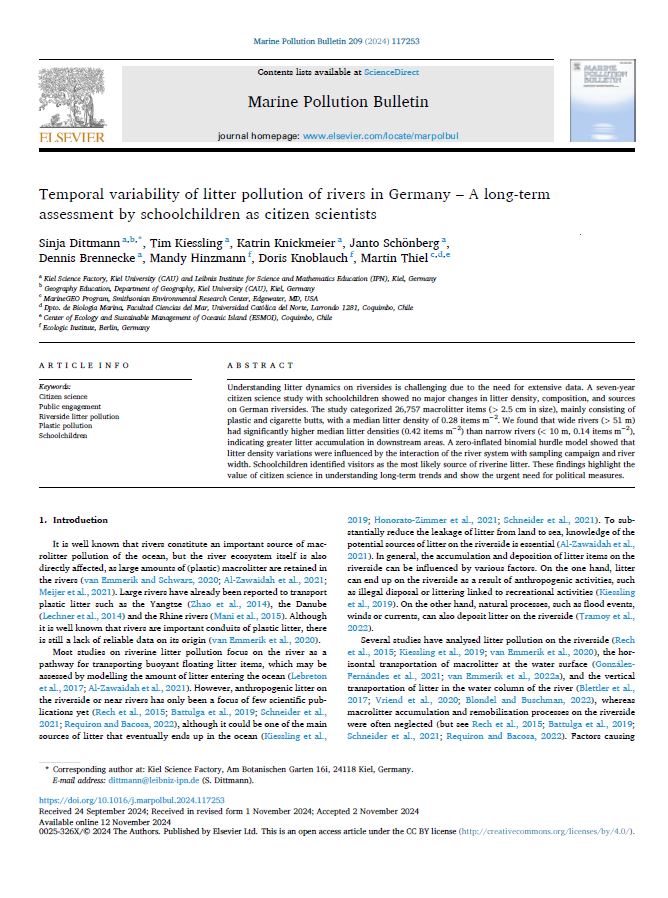

Dittmann, Sinja et al. (2024). Temporal variability of litter pollution of rivers in Germany – A long-term assessment by schoolchildren as citizen scientists, Marine Pollution Bulletin, Volume 209, Part B, December 2024, 117253. https://doi.org/10.1016/j.marpolbul.2024.117253
Tessnow-von Wysocki, Ina; Wang, Mengjiao; Morales-Caselles, Carmen; Woodall, Lucy C.; Syberg, Kristian; Carney Almroth, Bethanie; Fernandez, Marina; Monclús, Laura; P. Wilson, Scott; Warren, Matt; Knoblauch, Doris; Helm, Rebecca R. (2023): Plastics treaty text must center ecosystems, Science, 2 Nov 2023, Vol 382, Issue 6670, pp. 525-526.