Connecting the Dots on EU Transition Governance
Towards more integrated climate, economic, and social policy for the clean transition
- Publication
- Citation
Evans, Nick; Kocher, Deyana; Wendt, Fabian; Fürst, Corinna; Duwe, Matthias (2026): Connecting the dots on EU transition governance: Integrating policy planning, monitoring, and feedback for a clean, competitive, and fair European economy. Ecologic Institute, Berlin.
A new policy paper by Ecologic Institute examines how the EU can better integrate climate, economic, and social governance frameworks for the clean transition. It finds that important links already exist, but differences in timing, reporting, and political priorities often prevent them from working effectively.
The paper analyses key instruments, including National Energy and Climate Plans, the European Semester, Social Climate Plans and other EU investment plans, as well as progress monitoring tools like the European Pillar of Social Rights Scoreboard and the Annual Single Market and Competitiveness Report and Scoreboard. It finds that these instruments are formally linked, but coordination often breaks down in practice. Planning and funding cycles do not line up, reporting systems remain fragmented, and decisions may rely on an outdated or inconsistent information base.
The social dimension is particularly weak. Climate and economic monitoring increasingly share indicators, while relevant aspects like employment effects, skills, energy and transport poverty, and the distribution of costs and benefits are less consistently integrated into climate policy formulation. At the same time, climate and social priorities have also gained ground in the European Semester as indicated by the growing scope of country-specific recommendations.
The paper recommends four steps to enhance integration across climate, economic, and social governance in the EU:
- Better align planning and funding cycles: Future EU investment plans should build directly on national climate and energy pathways rather than developing alongside them.
- Strengthen integrated monitoring: Existing indicators on emissions, investment, employment, skills, poverty and distributional impacts should be used more consistently across policy areas.
- Use integration to confront trade-offs: Better coordination should make visible who benefits, who bears the costs, and where policy objectives may conflict.
- Improve the European Semester as a vehicle for a fair transition: Stronger links to climate and social planning, and sufficient space for long-term transition investment, could make the European Semester a more effective coordination framework for clean transition governance.
The EU does not necessarily need new governance structures. It needs to connect existing processes more effectively through better coordination and improve the use of shared evidence to ensure that the co-benefits and trade-offs between decarbonisation, competitiveness, and fairness aims are considered together.


Contact

- Language
-
English
- Authorship
- Funding
-
Federal Ministry of Research, Technology and Space (BMFTR), Germany - Published by
-
Ecologic Institute, Germany - Year
- Dimension
- 32 pp.
- Project
- Project ID
- Table of contents
-
Click to show full table of contents
- Keywords
-
EU climate policy, climate neutrality, clean transition, transition policy, competitiveness, social fairness, European Semester, climate and energy policy, transition finance, policy governance, European Union, EU, EU Member StatesEuropepolicy analysis, governance analysis, comparative policy analysis, policy instrument analysis, indicator analysis, monitoring, policy integration, policy coherence
Evans, Nick and Matthias Duwe (2025): Smarter, simpler, more effective: Options to improve EU transition policy. Ecologic Institute, Berlin.
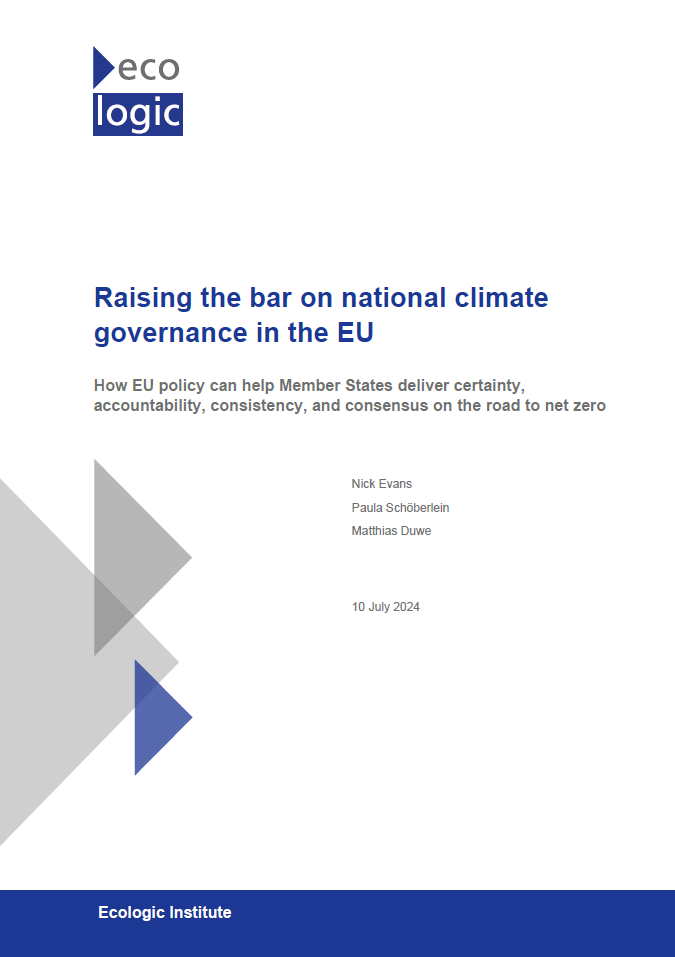

Evans, Nick, Paula Schöberlein, Matthias Duwe (2024). Raising the bar on national climate governance in the EU: How EU policy can help Member States deliver certainty, accountability, consensus, and consistency on the road to net zero. Ecologic Institute: Berlin.