
From marine research to the kitchen: participants prepare dishes using edible invasive species at the SEA4FUTURE cookery workshop in Heraklion.
|© Ecologic Institute, 2026
The Best Way to Beat Them? Eat Them!
In Crete, marine research, fishing communities and culinary trainees are putting invasive species on the menu.
- Event
- Date
-
- Location
- Heraklion, Crete, Greece
How do you fillet a lionfish? What can you make with a blue swimming crab? And why should aspiring chefs be learning about marine species that are becoming an increasing problem in the waters around Crete?
These were some of the questions explored in Heraklion on 12 November 2026, when marine researchers, fishers, sustainable seafood experts and the next generation of Crete's hospitality industry came together for an event on 'Gastronomy and Marine Resource Conservation'. Their shared aim was to explore how edible invasive alien species might be put to good use – and whether doing so could also help protect marine ecosystems.
The day culminated in an unusual cookery workshop prepared by teachers and trainees from Crete's Experimental School of Higher Vocational Training in Tourism. The focus was on marine species rarely encountered in traditional Cretan cooking, including lionfish (Pterois miles) and blue swimming crabs (Portunus segnis).
From Research Subject to Culinary Ingredient
Bringing these unfamiliar ingredients into the kitchen was itself a collaborative effort. Researchers from the Hellenic Centre for Marine Research (HCMR) worked with local fishers to source the species for the workshop. They also contributed their expertise on the spread of invasive alien species, their ecological impacts and the potential benefits of targeted removal.
Dr Giorgos Chrisidis of HCMR explained the science behind biological invasions in the Mediterranean. Professional fisher Manolis Tsapakis, from Lentas, described how the arrival of new species is affecting everyday fishing operations. Dr Nota Peristeraki, also of HCMR, explored how the targeted removal of edible invasive species could, under the right conditions, help reduce pressure on native marine life.
The researchers were therefore far more than guests at the table. They provided the scientific context, worked alongside fishers and helped lay the groundwork for the workshop. The trainees brought an equally important perspective: what could actually be done with these unfamiliar ingredients in a professional kitchen?
Can a Good Recipe Help Protect the Sea?
The idea behind the event was as simple as it was intriguing. If restaurants develop an appetite for edible invasive species, fishers may have a stronger economic incentive to remove them from local waters. That could create new market opportunities for small-scale fisheries while potentially helping to control invasive populations. But turning an ecologically troublesome species into a successful restaurant dish is not straightforward. How can an unfamiliar fish be prepared safely? How do you persuade diners to try it? And how can a promising initiative avoid creating a new market with unintended environmental consequences?
These questions brought together marine conservation, local livelihoods and food culture throughout the event. Elisabeth Vallet, Director of Ethic Ocean, discussed sustainable seafood and the responsibility of the hospitality sector in choosing its ingredients. Tourism school teachers Marina Papazoglou and Maria Xenaki addressed sustainable food practices, while Giorgos Apladas of the Hellenic Mediterranean University examined the steps involved in bringing lionfish from the fishing boat to the market.
There are, however, important limits. Not every invasive species is safe to eat. The silver-cheeked toadfish (Lagocephalus sceleratus), which has spread into the Mediterranean, contains the highly potent toxin tetrodotoxin and must never be consumed.
When Knowledge Becomes a Dish
At the end of the day, the kitchen took centre stage. The practical workshop was led by Stelios Miliarakis, Executive Chef at the five-star Elounda Mare hotel in Crete. Working alongside teachers and culinary trainees from Crete's Experimental School of Higher Vocational Training in Tourism, he showed how selected edible invasive species could be transformed into appealing dishes. Drawing on his experience in professional gastronomy, Miliarakis also demonstrated that lionfish is more than an experimental ingredient: it is already being prepared and served, with an encouraging response from diners.
That was what made the event particularly compelling. Scientists could explain why certain species are spreading and what their arrival means for Mediterranean ecosystems. Fishers knew where and how they could be caught. And the hospitality sector could show how these unfamiliar catches might become dishes that restaurants and their customers would genuinely want to try.
The event was organised by the Region of Crete and the Experimental School of Higher Vocational Training in Tourism of Crete as part of the EU-funded SEA4FUTURE project. Contributors included HCMR, Ethic Ocean and Ecologic Institute. Hosted at the Hellenic Mediterranean University, it also formed part of the activities associated with Crete's designation as European Region of Gastronomy 2026. For SEA4FUTURE, this kind of collaboration offers an important starting point. Efforts to manage invasive alien species can only succeed in the long term if they are grounded in sound science, make economic sense and work for the people expected to put them into practice.
Whether creating demand for edible invasive species can become an effective marine conservation measure remains to be seen. But the workshop in Heraklion demonstrated the possibilities that emerge when marine science reaches beyond the laboratory – and joins forces with fishing communities and the next generation of culinary professionals.


Contact

- Funding
-
European Commission, Directorate-General Research & Innovation (DG Research & Innovation), International - Organizer
-
Region of Crete, Greece Experimental School of Higher Vocational Training in Tourism of Crete (SAEK Tourism of Crete), Greece - Partner
- Team
- Date
-
- Location
- Heraklion, Crete, Greece
- Language
-
Greek
- Project
- Project ID
- Keywords
-
culinary innovation, sustainable fish consumption, responsible seafood cuisine, alternative fishery products, regional value creation, food competence, sustainable coastal tourism, promotion of culinary talent, biological invasion, marine neobiota, biodiversity protection, Blue Food, sustainable menu designGreece, southeastern Mediterranean, eastern Mediterranean basin, Greek islands, European Mediterranean region, Mediterranean coast, CretePractical workshop, cooking demonstration, professional environmental education, practice-oriented knowledge transfer, interdisciplinary professional exchange, cross-sector collaboration, experiential learning, skill development, awareness raising, expert lectures, dialogue event, demonstration of sustainable food processing
Discussion:Science Sips on Marine Biodiviersity in the Science Year 2016*17 – Seas and Oceans
- Date
-
- Location
- Berlin, Germany
A Taste of the Future of the Seas
- Duration
-
-
- Funding
-
Federal Ministry of Education and Research (BMBF), Germany
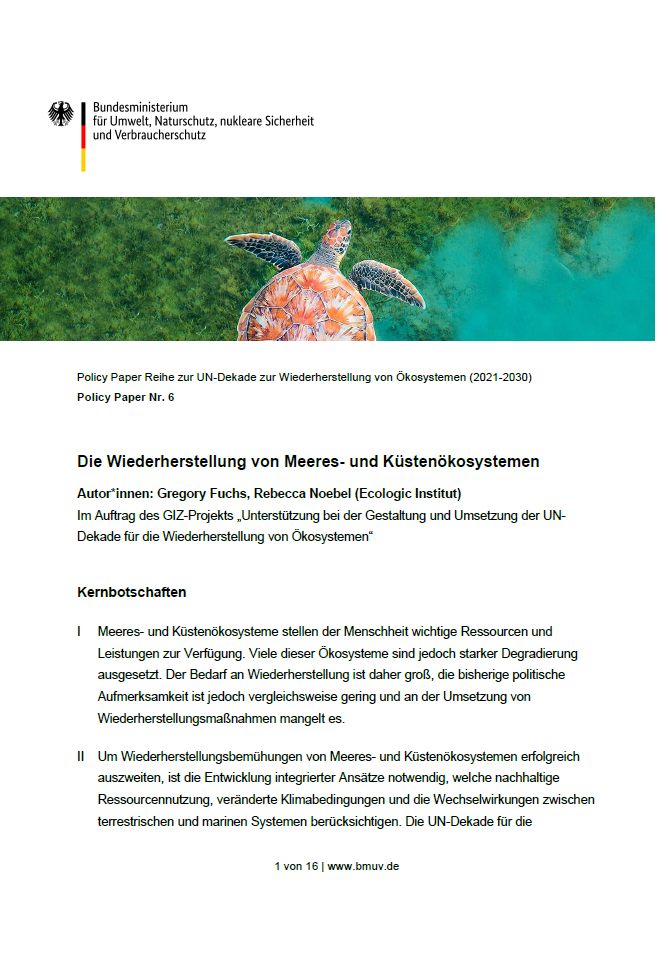
Fuchs, Gregory and Rebecca Noebel 2023: Die Wiederherstellung von Meeres- und Küstenökosystemen. Papier Nr. 6 der Policy Paper Reihe zur UN-Dekade für die Wiederherstellung von Ökosystemen (2021-2030). Federal Ministry for the Environment, Nature Conservation, Nuclear Safety and Consumer Protection, Berlin.
Stelljes, N., Fuchs, G., Kroos, F., Haase, F., Martinez, G., & Maguire, C. (2026). MEER:STARK – Meeresentlastung und Resilienzstärkung: Sektorübergreifende Transformation, Anpassung, Revitalisierung und Klimaschutz für Nord- und Ostsee. Umweltbundesamt. https://doi.org/10.60810/openumwelt-8297
Ellermann, A., G.Özerol, J. V.-d.Kruijf, et al. 2026. “Innovations for Stakeholder Engagement in Water Governance: A Systematic Literature Review From a Sustainability Transition Perspective.” Environmental Policy and Governance1–20. https://doi.org/10.1002/eet.70066.
Fuchs, G., Stelljes, N., Kroos, F. et al. Towards climate-ready marine protected areas: challenges and strategic pathways. npj Ocean Sustain 5, 15 (2026). https://doi.org/10.1038/s44183-026-00184-3