In Berlin, a variety of initiatives show how the economy can be different: with more solidarity, more democracy, more ecological and better for all. We discuss why this is not easy, but can be promising. In the sixth edition of Wandelwecker, our morning impulse for a social and ecological metropolis, we discussed these questions with two experts.
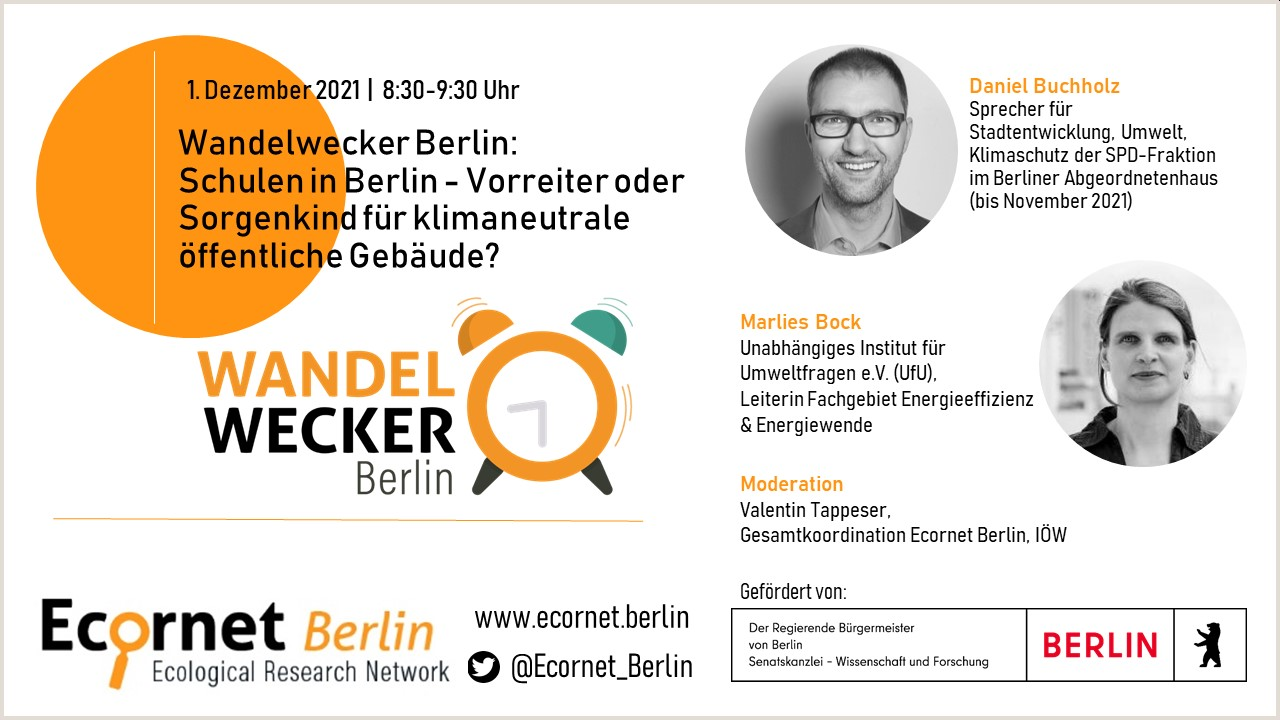
The more stringent climate targets of the state of Berlin require that both the heat supply be converted to renewable energies in the next few years and that the building envelopes be ambitiously renovated to make them more energy efficient. This poses great challenges for the state and districts as well as the real estate industry. At the same time, due to the tense situation on the Berlin housing market, there is a need for regulations to protect tenants, which is why the number of milieu protection areas in Berlin's districts has risen sharply. In these areas, which already contain a relevant proportion of old buildings which are in need of refurbishment, there are additional obstacles to climate protection measures that are in line with the objectives.
Berlin has set ambitious standards for the prevention of CO2 emissions, with significantly stricter targets in the new Climate Protection Act (EWG Bln). What are the targets and opportunities, and what are still the major challenges and barriers? In order to become climate-neutral, it is imperative that the building sector be given greater consideration. The Climate Protection Act and the Berlin Energy and Climate Protection Program (BEK) 2030 emphasize the exemplary role of the public sector in this area. This means that public buildings such as school buildings are a key factor. In the districts' renovation roadmaps, schools sometimes account for more than 80 percent of the buildings that need to be renovated for energy efficiency in the next few years.
The digital, or perhaps in this case "intelligent" technologies that are to shape all areas of society in the future, especially our cities, need regulation. After all, these kinds of technologies inform, decide and control — but in whose interest and with which objectives in mind? Recently, there has been increasing thought and debate about the possibilities of democratic data governance "from below". Citizens should (also) be able to decide what intelligent, data-driven machines are used for by consciously sharing their data. Can such approaches be a model for the sustainable digitalization of cities and municipalities and provide a counterweight to the data monopolies of large corporations? What could democratic data governance in Berlin look like?
In this presentation, Ecologic Institute's International Climate Protection Fellow Mario Alejandro Delgado Galarraga reviews whether the evolution of Rights of Nature in America has influenced International Environmental Law, especially at a Regional level. It appraise and contrast national legal conducts with the Inter-American Court of Human Rights' Advisory Opinion "OC-23/17" (Environment and Human Rights). Thus, it centre on Comparative Law and International Environmental Law. The presentation was held during the IUCN World Conservation Congress 2021.
Natural resource extraction and processing accounted for 23 % of global greenhouse gas emissions in 2015. Therefore, reducing resource use through resource efficiency promises significant contributions to climate protection. This "climate-resource-nexus" has mostly been explored from a scientific, Global North-oriented perspective. In this article, researchers from the Ecologic Institute analyze the potential interactions between climate and resource policy in different world regions. They did not find a generic climate-resource-nexus policy. The article is available online.
Stephan Sina 2022: Stellungnahme zum Antrag der Fraktion BÜNDNIS 90/DIE GRÜNEN "Bekämpfung von Umweltkriminalität in NRW endlich stärken – Schwerpunktstaatsanwaltschaft und Koordinierungsstelle für NRW einrichten", Drucks. 17/14258. Berlin: Ecologic Institute.
Stephan Sina 2021: Stellungnahme zum Entwurf der SPD für ein Gesetz zum Schutz von Menschen und Natur vor dem Klimawandel und seinen Folgen – Drucks. 20/5899 –1. Berlin: Ecologic Institute.
On 1 September 2021, Dr. Stephan Sina, Senior Fellow at Ecologic Institute, participated as an expert in a hearing of the Hessian State Parliament's Committee for Environment, Climate Protection, Agriculture and Consumer Protection on the draft of the SPD parliamentary group for a law to protect people and nature from climate change and its consequences. Together with twelve associations and experts, he commented on the draft law and answered questions from members of parliament. The written statement of Stephan Sina is published on the website of the Hessian State Parliament (Part 1, page 39 ff.) and is available here separately as a download.
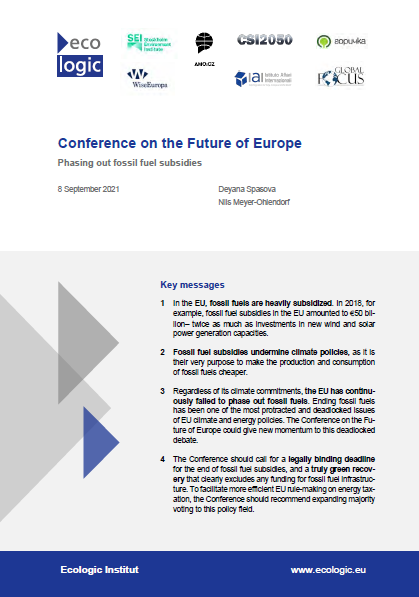
Regardless of its climate commitments, the EU has continuously failed to phase out fossil fuels. Ending fossil fuels has been one of the most protracted and deadlocked issues of EU climate and energy policies. The Conference on the Future of Europe could give new momentum to this deadlocked debate.
This article gives an example of how to use Segrass in a sustainable way. "Using Seagrass as Insulation Material" by Nico Stelljes is published in the "Baltic Stories Magazine" that is devoted to promoting cooperation around the Baltic Sea, joint initiatives and projects of the European Union Strategy for the Baltic Sea Region (EUSBSR). The article is available online.
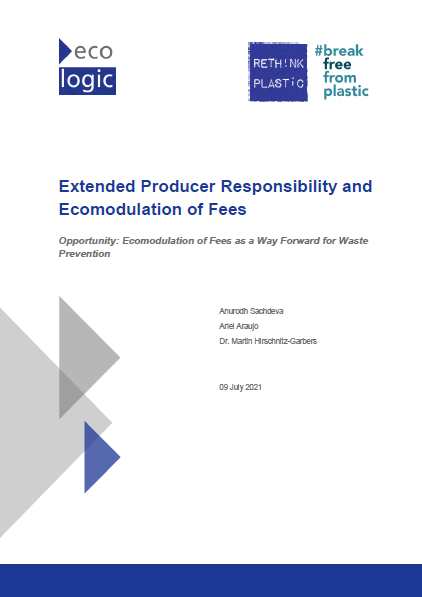
In this analysis, Ecologic Institute focused on four product streams: plastic/packaging, waste electric and electronic equipment (WEEE), batteries and textiles to investigate the four cross-sectional aspects: modulation criteria, size of the fees, cost coverage and revenue use. The analysis suggests a systemic change in EPR and ecomodulation of fees is required which is more focused on waste prevention measures.
The Berlin Energy and Climate Protection Program 2030 gives solar energy a central role, as it is the most important renewable energy source that can be developed locally. The state government wants to cover 25 percent of Berlin's electricity supply from solar energy as quickly as possible. In the densely populated city, this also requires the roofs of apartment buildings to be used. In the discussion format Wandelwecker on 8 September 2021, Fabian Zuber from the Reiner Lemoine Foundation and Ecologic Institute's Katharina Umpfenbach discussed options transforming the regulation of tenant electricity and local solar power supply. The event was moderated by Valentin Tappeser from IÖW. It became clear that solar expansion can only be achieved at the required speed with a fundamentally new regulatory approach centered around joint self-supply that intelligently links on-site power generation via solar systems with charging of electric vehicles and heat generation.
The formulation and implementation of climate adaptation plans in cities worldwide needs to speed up rapidly to keep in pace with projections of climate risks. The research project: "Resilience in Europe through Activating City Hubs reaching Out to Users with Triple-A climate adaptation Tools" (REACHOUT) aims to support the implementation of the European Green Deal by developing user-oriented climate services. It is funded through the European Commission's Horizon 2020 programme. Research partners, climate service providers and city stakeholders are co-developing a coherent set of tools and services for seven City Hubs (Cork, Ireland; Athens, Greece; Lillestrøm, Norway; Milan, Italy; Logroño, Spain; Gdynia, Poland; and Amsterdam/APG, the Netherlands).
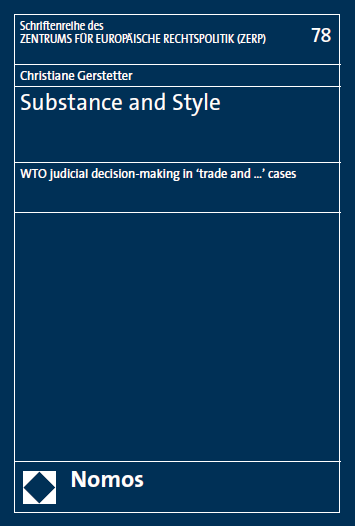
Christiane Gerstetter, Senior Fellow in Ecologic Institute's Legal Team, examines in this book how the dispute settlement bodies of the World Trade Organization (WTO) have decided non-trade cases. These are cases in which national measures that serve non-trade objectives such as environmental and health protection are under judicial scrutiny.