
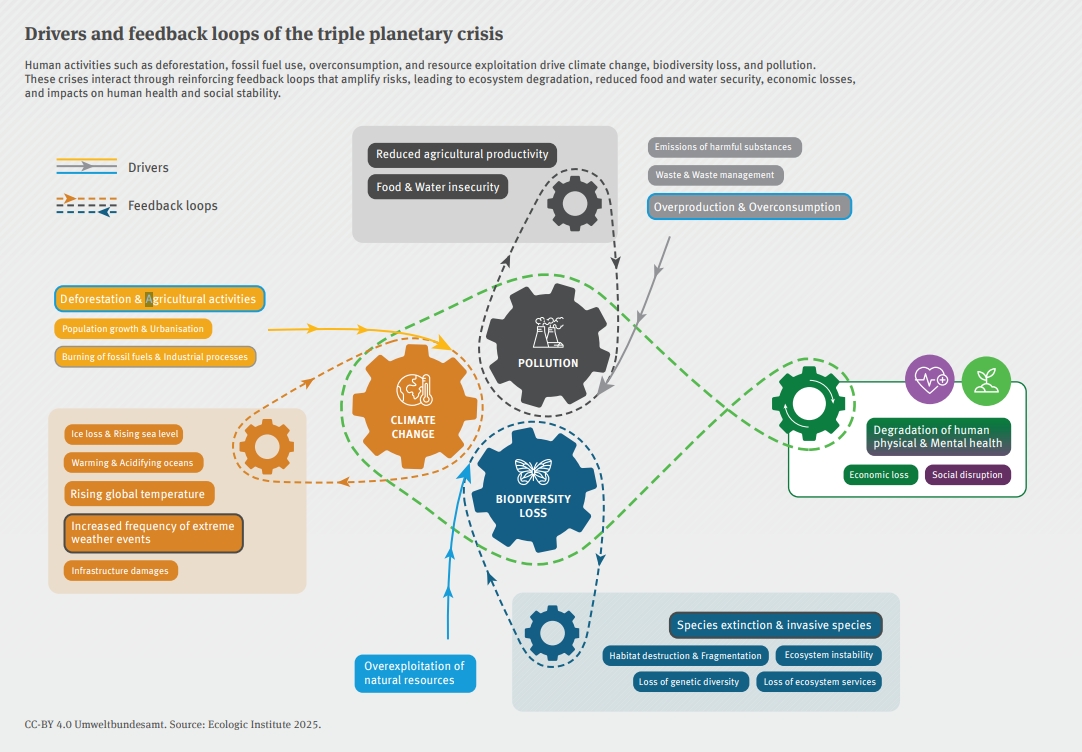
Drivers and Feedback Loops of the Triple Planetary Crisis
Infographic Series
- Publication
- Citation
Umweltbundesamt 2025: Drivers and feedback loops of the triple planetary crisis. Infographic.
Climate change, biodiversity loss and environmental pollution are deeply interconnected and reinforce one another. This infographic, based on the report "The Interconnected Challenges of Climate Change, Biodiversity Loss and Environmental Pollution: Drivers, Interdependencies and Impacts of the Triple Planetary Crisis", illustrates the main human-driven causes of the triple planetary crisis and the feedback loops that intensify its impacts.
Download the infographic series on the triple planetary crisis:
- Drivers and feedback loops of the triple planetary crisis
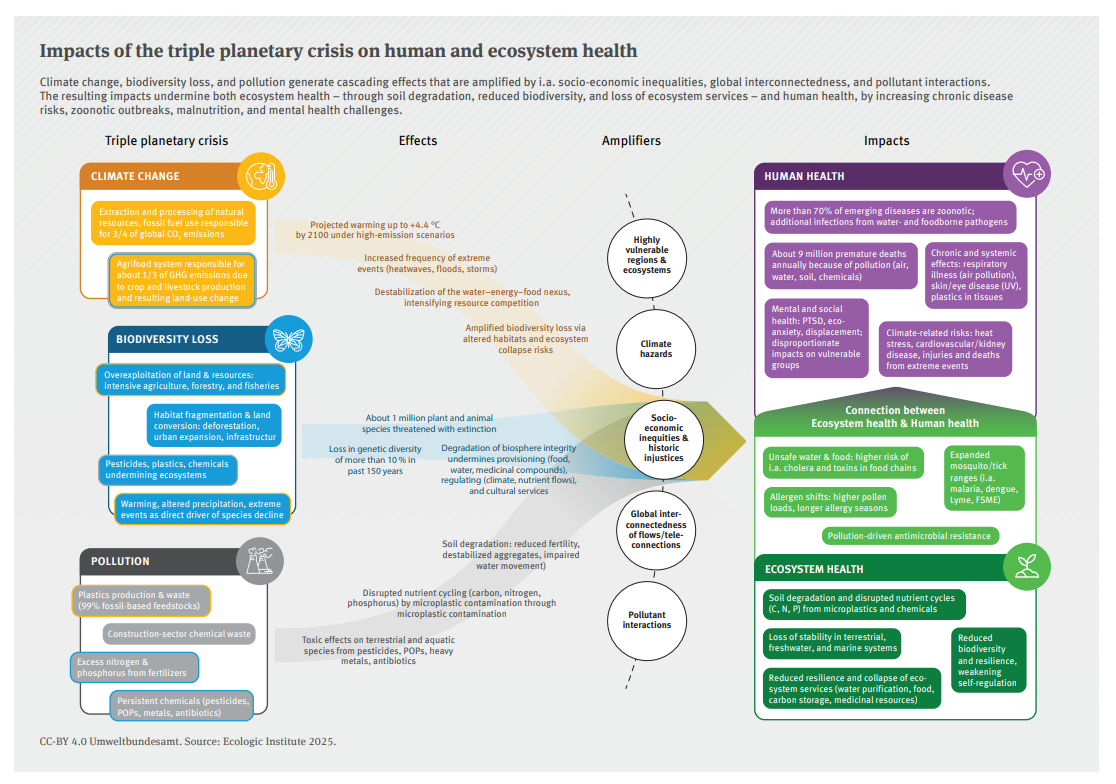
- Impacts of the triple planetary crisis on human and ecosystem health
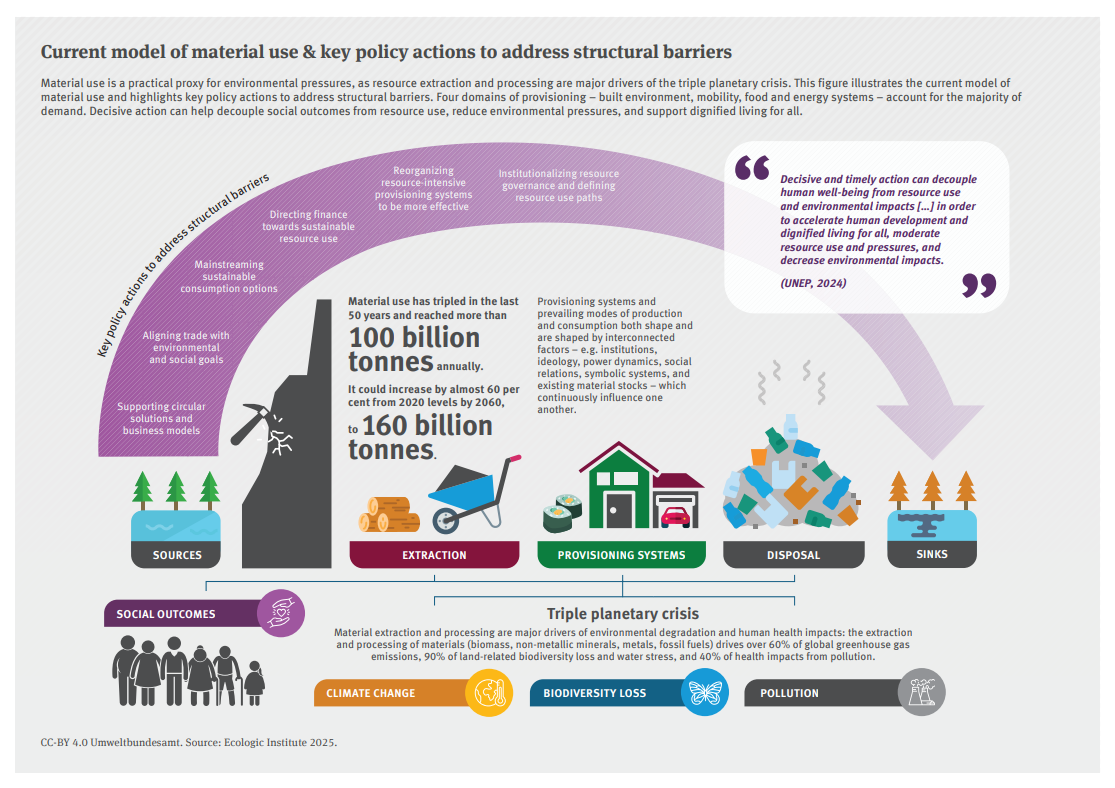
- Current model of material use & key policy actions to address structural barriers
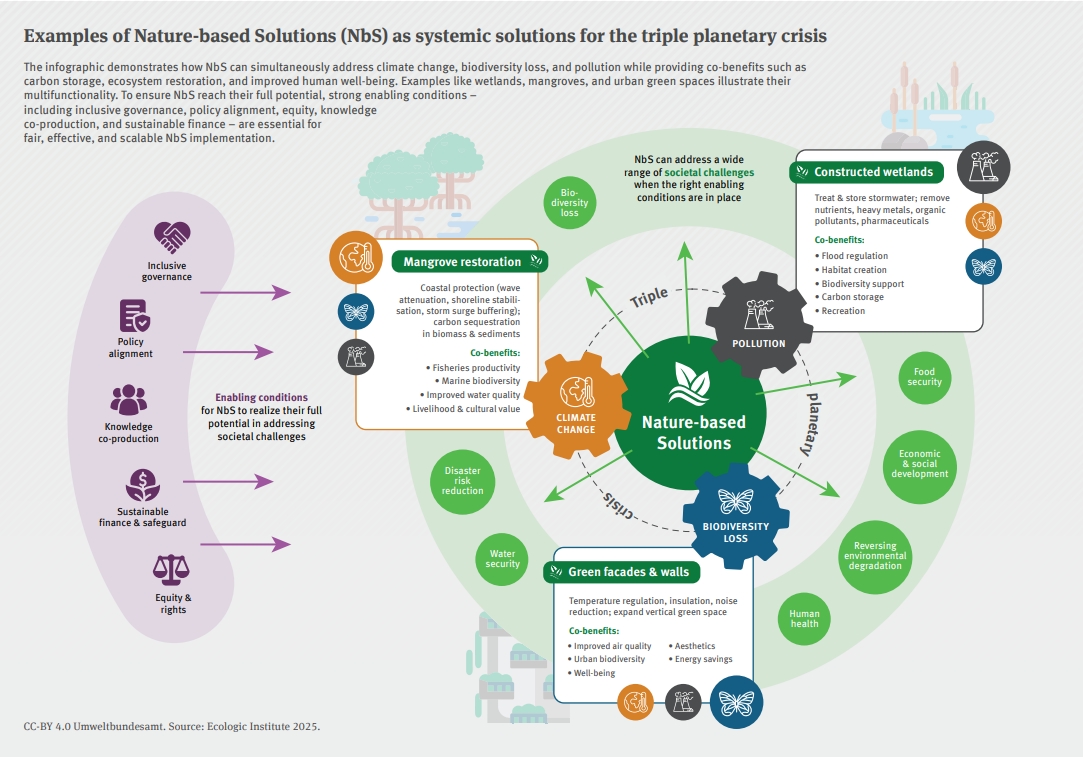
- Examples of nature-based solutions as systemic solutions for the triple planetary crisis
The infographics are part of the UBA publications on the triple planetary crisis. Published under a CC BY 4.0 license, they may be shared and adapted provided that the source is credited. We encourage their use and dissemination to support a better understanding of the systemic drivers, impacts and solution pathways of the triple planetary crisis in policy, research and practice.
Contact

- Language
-
English
- Credits
Media format: coloured infographic for a report and fact sheet
Copyright: CC BY 4.0
Content: Aaron Best, Charlotte Felthöfer, Doris Knoblauch, Natalia Burgos Cuevas, Teresa Spantzel, Yannick Heni
Graphic design: Jennifer Rahn, Lena Aebli
- Funding
-
German Environment Agency (UBA), Germany - Published in
- The Interconnected Challenges of Climate Change, Biodiversity Loss and Environmental Pollution
- Published by
-
German Environment Agency (UBA), Germany - Year
- Project
- Project ID
- Keywords
-
triple planetary crisis, systemic environmental solutions, climate change and biodiversity loss, resource efficiency, nature-based solutions, planetary boundaries, environmental justice, cross-sectoral transformation, sustainable resource use, integrated environmental policyGlobal, Germany, Europe, Global Southsystematic literature review, systems analysis of societal metabolism, cross-sectoral policy analysis, nature-based solutions assessment, justice- and MAPA-focused governance analysis
Umweltbundesamt 2025: Examples of nature-based solutions as systemic solutions for the triple planetary crisis. Infographic.
Photo: Belgian Presidency of the Council of the EU 2024 from Belgium, CC BY 2.0, via Wikimedia Commons, Page: John Wiley & Sons, 2025
.jpg)
Faber R, Kocher D, Duwe M. Meaningful participatory climate governance: Lessons from EU multilevel climate and energy dialogues. RECIEL. 2025;34(2):394-408. doi:10.1111/reel.12618
Blicharska, M., Lago, M., McDonald, H. et al. Challenges for assessing and implementing nature-based solutions at landscape-scale – insights from project on ponds and pondscapes. Hydrobiologia (2026). https://doi.org/10.1007/s10750-026-06212-0
Iwaszuk, E.; Spantzel, T.; Kroos, F.; Knoblauch, D. (2025): Integrated Approaches to Addressing the Triple Planetary Crisis: Country Best Practices. Lessons learned from Brazil, Colombia, Japan, New Zealand, Panama, Rwanda and Sweden. Policy paper. Climate Change 81/2025, German Environment Agency: Dessau-Roßlau. https://doi.org/10.60810/openumwelt-8106
Burgos Cuevas, Natalia et al. (2025): Moving from interconnected crises to systemic solutions. Resource efficiency, nature-based solutions, and systemic transformation as responses to the complexity of the triple planetary crisis. German Environment Agency: Dessau-Roßlau. https://doi.org/10.60810/openumwelt-8108.
Burgos Cuevas, Natalia et al. (2025): Moving from interconnected crises to systemic solutions. Resource efficiency, nature-based solutions, and systemic transformation as responses to the complexity of the triple planetary crisis. Fact sheet. German Environment Agency: Dessau-Roßlau. https://doi.org/10.60810/openumwelt-8102.
Knoblauch, D., Felthöfer, C., Heni, Y., Burgos Cuevas, N., & Best, A. (2025). The Interconnected Challenges of Climate Change, Biodiversity Loss and Environmental Pollution: Drivers, Interdependencies and Impacts of the Triple Planetary Crisis. Interim report, Climate Change 82/2025. German Federal Agency. https://doi.org/10.60810/openumwelt-8107.
Felthöfer, C., Knoblauch, D., & Best, A. (2025). The interconnected challenges of climate change, biodiversity loss and environmental pollution: Drivers, interdependencies and impacts of the triple planetary crisis (Fact sheet). German Federal Agency. https://doi.org/10.60810/openumwelt-8070