
Photo by Chirag Saini on Unsplash, Cover © German Environment Agency, 2025
The Interconnected Challenges of Climate Change, Biodiversity Loss and Environmental Pollution
Drivers, Interdependencies and Impacts of the Triple Planetary Crisis
- Publication
- Citation
Knoblauch, D., Felthöfer, C., Heni, Y., Burgos Cuevas, N., & Best, A. (2025). The Interconnected Challenges of Climate Change, Biodiversity Loss and Environmental Pollution: Drivers, Interdependencies and Impacts of the Triple Planetary Crisis. Interim report, Climate Change 82/2025. German Federal Agency. https://doi.org/10.60810/openumwelt-8107.
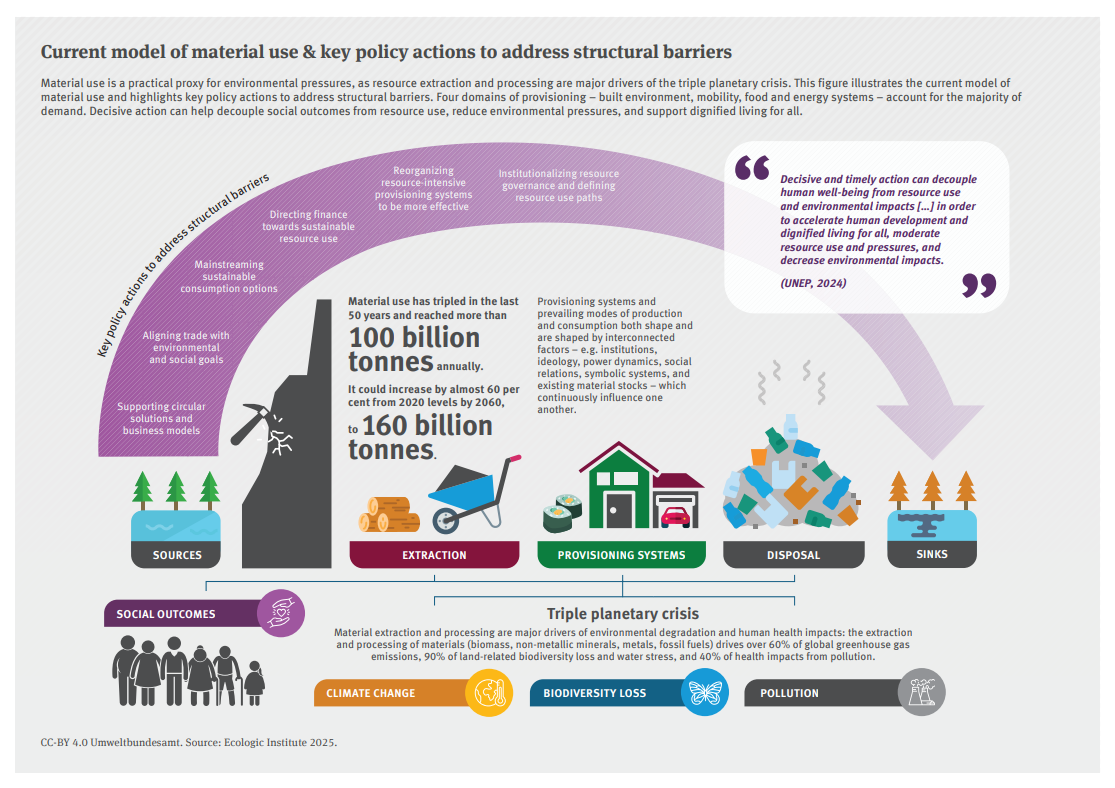
For a long time, the multiple environmental crises, also called the triple planetary crisis of climate change, biodiversity loss, and environmental pollution were viewed separately. However, research and policy increasingly recognize that they are deeply interconnected with mutually reinforcing impacts. The report "The Interconnected Challenges of Climate Change, Biodiversity Loss and Environmental Pollution", commissioned by the German Federal Agency (UBA), provides a systematic analysis of this triple planetary crisis. It demonstrates why climate change, biodiversity loss, and environmental pollution cannot be understood and tackled in siloes, but instead share common drivers, feedback mechanisms, and cascading effects. The aim of the report is to close knowledge gaps and provide political and scientific actors with an integrated, holistic understanding.
Understanding the Risks and Pathways of the Triple Planetary Crisis
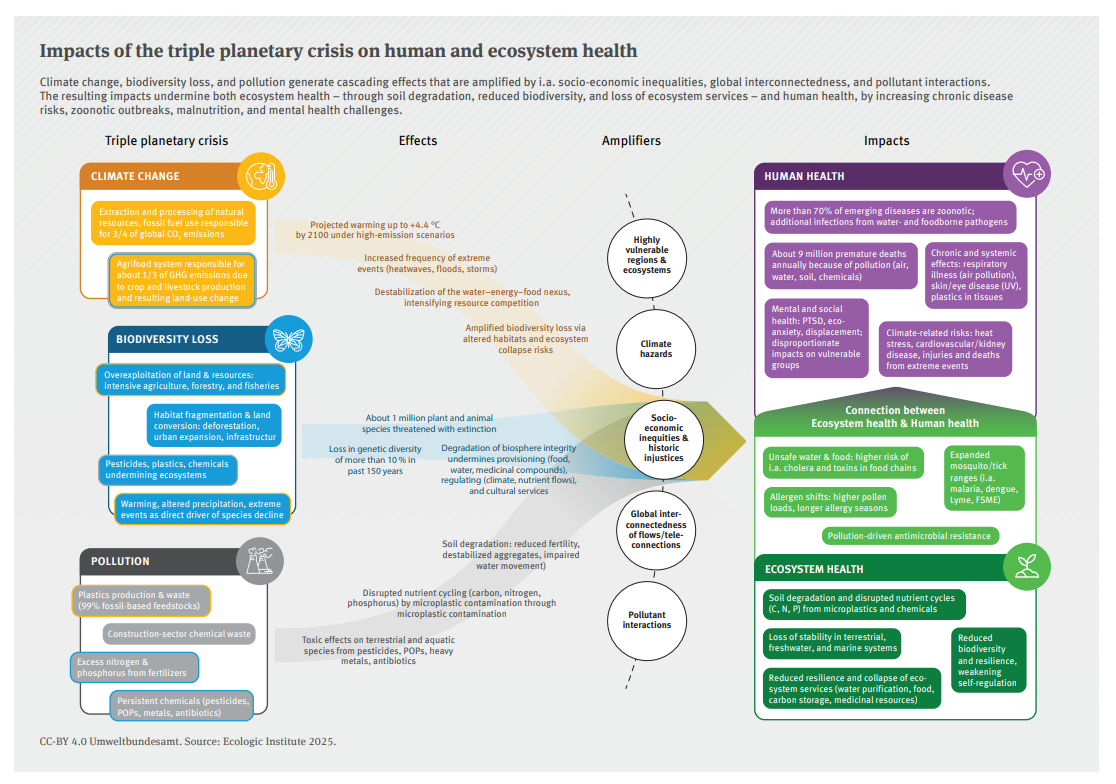
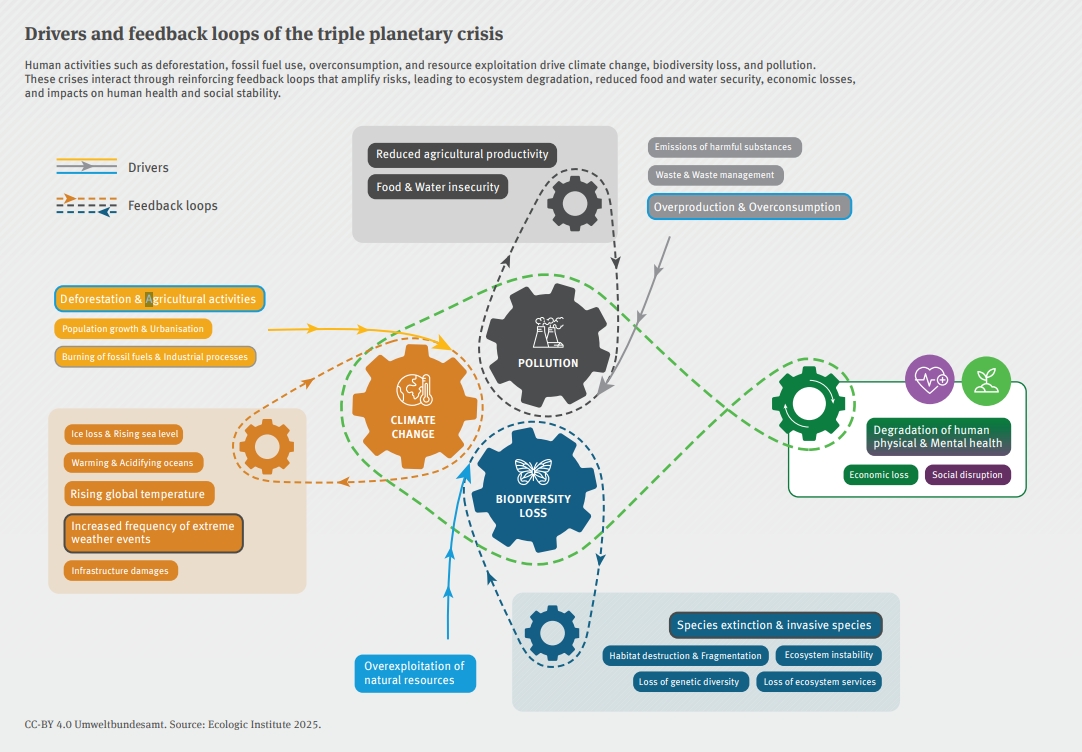
Starting by examining the shared drivers and feedback loops connecting the three crises, the report then describes their impacts on ecosystem health and human health. A dedicated section focuses on the socioeconomic impacts, highlighting which groups are particularly affected. The report concludes with a synthesis that brings together the key risks and identifies entry points for integrated and just solution pathways. The findings show that the triple planetary crisis is largely driven by resource use, land-use change, and social inequalities. Its effects amplify one another, for instance, when biodiversity loss reduces the adaptive capacity of ecosystems to climate change, or when pollution increases health risks. At the same time, the analysis shows that impacts are unequally distributed, with vulnerable groups worldwide such as women, indigenous people and migrants being disproportionately affected. The report makes clear that isolated measures are insufficient. What is needed are cross-sectoral strategies that respect ecological limits, incorporate social justice, and remain politically feasible.
Contact

- Language
-
English
- Authorship
- Funding
-
German Environment Agency (UBA), Germany - Published by
-
German Environment Agency (UBA), Germany - Year
- Dimension
- 21 pp.
- ISSN
-
1862-4359
- DOI
- Project
- Project ID
- Table of contents
-
Click to show full table of contents
- Keywords
-
climate crisis, biodiversity loss, planetary boundaries, pollution impacts, environmental resilience, integrated policy solutions, nature-based solutions, circular economy, sustainable transformation, ecological governanceGlobalSystematic literature review, keyword-based database search (Web of Science & Google Scholar), SVTEEG analytical framework, MAPA (Most Affected People and Areas) perspective analysis, AI-assisted literature screening with expert validation
Iwaszuk, E.; Spantzel, T.; Kroos, F.; Knoblauch, D. (2025): Integrated Approaches to Addressing the Triple Planetary Crisis: Country Best Practices. Lessons learned from Brazil, Colombia, Japan, New Zealand, Panama, Rwanda and Sweden. Policy paper. Climate Change 81/2025, German Environment Agency: Dessau-Roßlau. https://doi.org/10.60810/openumwelt-8106
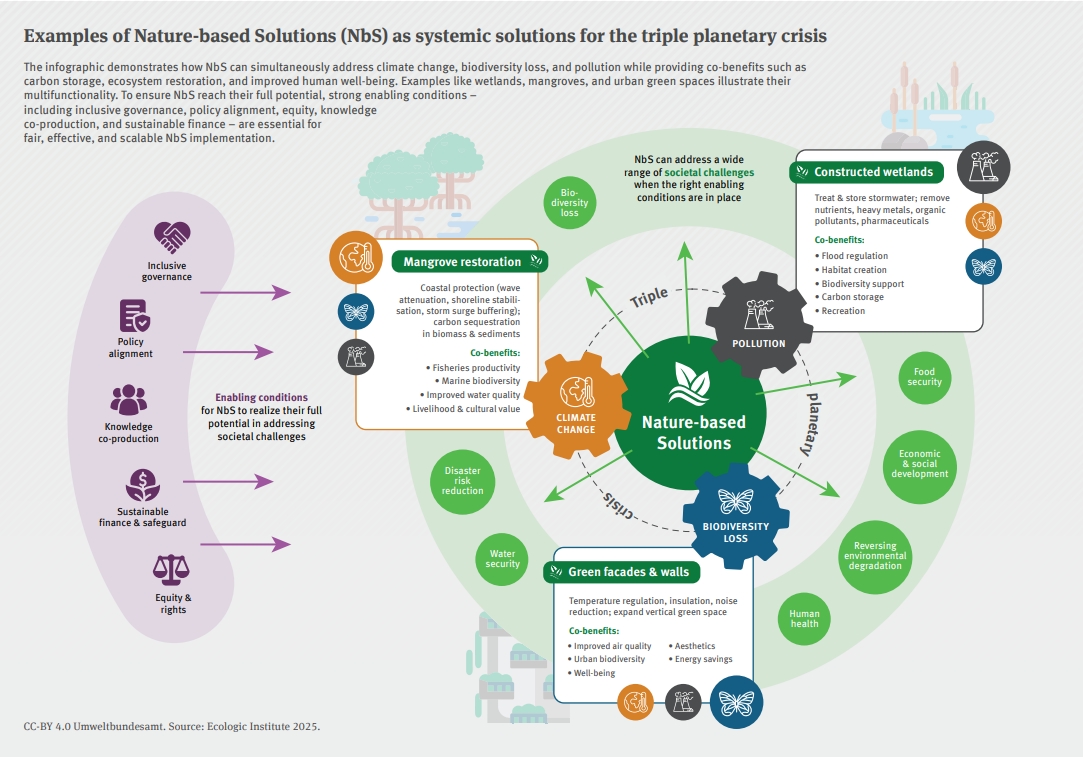
Burgos Cuevas, Natalia et al. (2025): Moving from interconnected crises to systemic solutions. Resource efficiency, nature-based solutions, and systemic transformation as responses to the complexity of the triple planetary crisis. German Environment Agency: Dessau-Roßlau. https://doi.org/10.60810/openumwelt-8108.
Burgos Cuevas, Natalia et al. (2025): Moving from interconnected crises to systemic solutions. Resource efficiency, nature-based solutions, and systemic transformation as responses to the complexity of the triple planetary crisis. Fact sheet. German Environment Agency: Dessau-Roßlau. https://doi.org/10.60810/openumwelt-8102.
Umweltbundesamt 2025: Drivers and feedback loops of the triple planetary crisis. Infographic.
Felthöfer, C., Knoblauch, D., & Best, A. (2025). The interconnected challenges of climate change, biodiversity loss and environmental pollution: Drivers, interdependencies and impacts of the triple planetary crisis (Fact sheet). German Federal Agency. https://doi.org/10.60810/openumwelt-8070