Foto von Craftsman Concrete Floors auf Unsplash
Clean Industrial Transition Monitor
Quaterly Bulletin 02/2026
- Publication
- Citation
Stefanczyk, Aneta et al. 2026: Clean Industrial Transition Monitor. Quarterly Bulletin 02/2026. European Climate Neutrality Observatory (ECNO).
The second 2026 edition of the European Climate Neutrality Observatory's (ECNO) Clean Industrial Transition Monitor Quarterly Bulletin finds that, despite high fossil fuel costs, supply uncertainty and climate shocks, EU industry remains resilient, with manufacturing output increasing moderately in Q2 2026 by 0.7% compared to Q2 2025. At the same time, industrial employment declined again in Q2 2026, and both the EU ETS Review and Electrification Action Plan could provide new financial instruments in support of industrial decarbonisation, but risk weakening the carbon-price signal.
The Quarterly Bulletin complements ECNO's Clean Industrial Transition Monitor. It combines tracking of key Clean Industrial Deal files with 18 economic and energy indicators, providing a regular update on how Europe's clean industrial transition is progressing.
High energy costs and climate shocks test EU industrial resilience
Renewed escalation in the US–Iran conflict is driving up fossil fuel prices and prolonging supply uncertainty. In September, Brent crude prices again surpassed USD 100/bbl, following a brief decline in June. This summer's extreme weather events have impacted industry through elevated input costs, supply disruptions and reduced operational capacity. The full economic impact of extreme heat and wildfires in 2026 is estimated to amount to EUR 180 billion, equivalent to 1% of the EU's GDP – almost as much as the European Commission's 1.1% 2026 GDP growth forecast.
Despite difficult conditions, Eurozone manufacturing output improved in July and August, with new orders strengthening in August as demand for AI-related technology goods and defence equipment supported manufacturers. Survey data suggests that manufacturing employment in the Eurozone likely edged up in August.
Industrial employment declines remain limited, but regional gaps widen
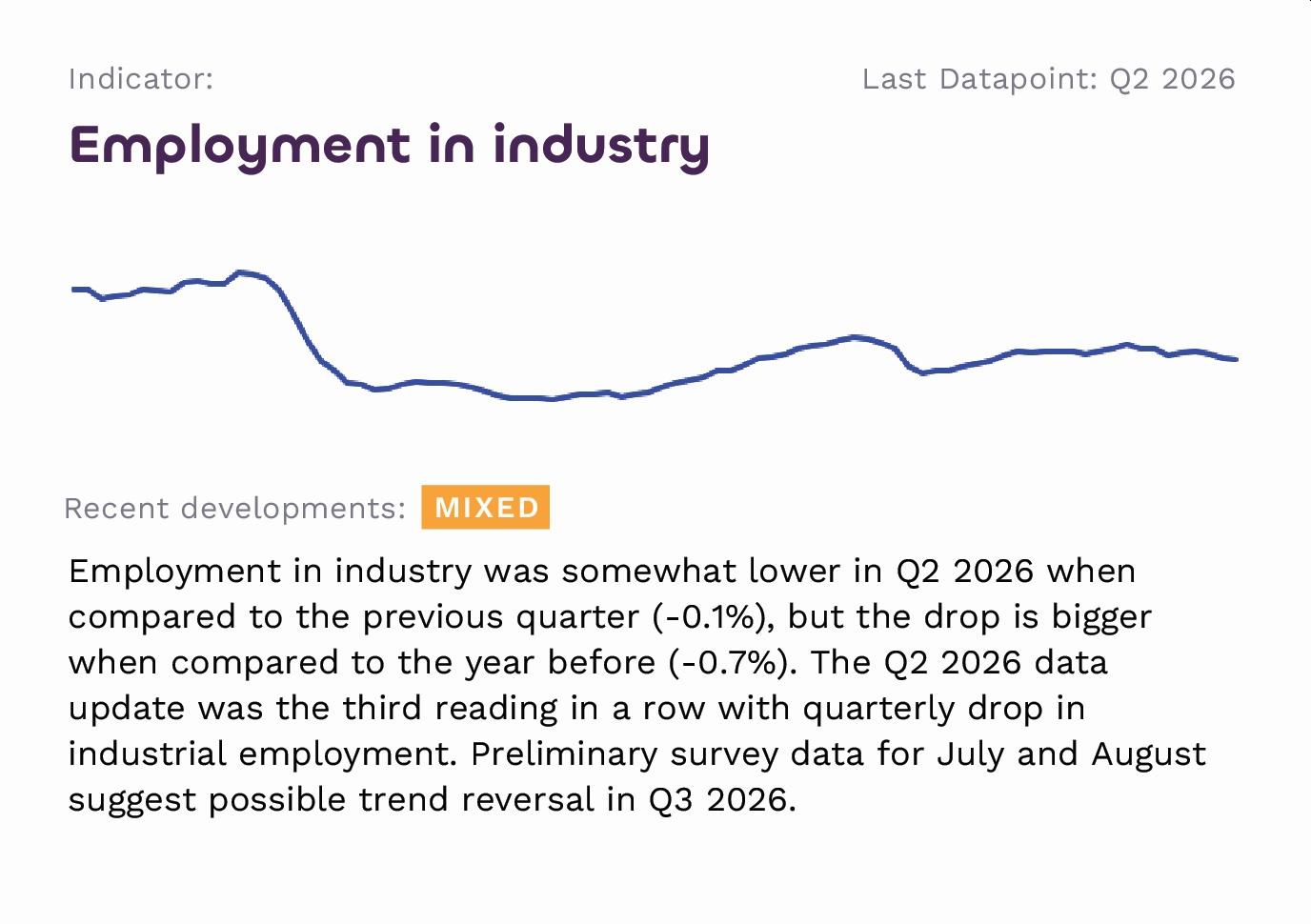
In the three most recent quarters, industrial employment fell by 0.2% in Q4 2025, 0.4% in Q1 2026 and 0.2% in Q2 2026 compared with the previous quarter. Together, this corresponds to around 261,000 fewer industrial jobs. In relative terms, the decline remains limited in scale: the 261,000 fewer jobs amount to around 0.8% of the EU's more than 33 million industrial jobs. However, the recent three consecutive quarterly declines are a cause for concern going forward, as they may indicate the emergence of a more persistent negative trend.
Over the last two years, employment in the industrial sector for the whole EU decreased by 1.4%, but contributions to this change were heavily concentrated in a few Member States. Largest losses were observed in Germany (-295,000 workers), Romania (-144,000 workers) and Poland (-70,000 workers). Over the same timeframe, Spain added the most industrial workplaces in the whole EU (+153,000 workers). Job losses in German industry were largely driven by the automotive sector, which accounted for 30% of all industrial jobs lost between June 2024 and June 2026. Energy-intensive industries in Germany, including manufacturing of paper, chemicals, non-metallic mineral products, basic metals, and rubber and plastic products, together lost 66,500 industrial jobs.
EU risks weakening carbon price signal as climate pressures rise
Published together on 17 July, the review of the EU Emissions Trading System (ETS) and the Electrification Action Plan (EAP) frame the political rentrée around a common objective: reducing fossil-fuel dependence while strengthening Europe's industrial competitiveness. Yet they rely on different, and not entirely aligned, logics. The Electrification Action Plan seeks to accelerate demand for clean electricity, while the ETS review would provide greater short-term flexibility to industry at the cost of a slower emissions-reduction trajectory and a potentially weaker incentive to invest.
The ETS proposal nevertheless strengthens the public-finance instruments for industrial decarbonisation. The main new EU-level instrument is the Industrial Decarbonisation Bank, which could mobilise up to EUR 100 billion. The EAP establishes an indicative objective of raising electricity's share in final energy consumption from 23% to 46% by 2040, effectively doubling the target. This stands against ECNO data showing that electrification has been essentially flat for the past decade, with no structural trend yet pointing in that direction.
The central question for the next phase is whether additional public support for industrial decarbonisation can compensate for a weaker carbon-price signal. The Plan and the ETS review will ultimately be judged by whether they work together to make clean electricity both investable and affordable.
Read more in the full Bulletin.
Further details on the methodology used in the policy and data analysis are available at the ECNO project website.


Contact